L'Etivaz
On 24 September 1999 L'Etivaz alpine cheese became the first designation of origin entered in the federal register.
Entry based on 9 sources · Our method · Reusable text (CC BY-SA)
Origin of the name L'Etivaz
The name appears in the forms « Leytiva » in 1460 and « Leytivaz » in 1514. It is said to derive from the patois « Léthuà », meaning « border », perhaps the border with the Ormonts. The former German name of the place is « Lessi ».[1][2]
Founding of L'Etivaz
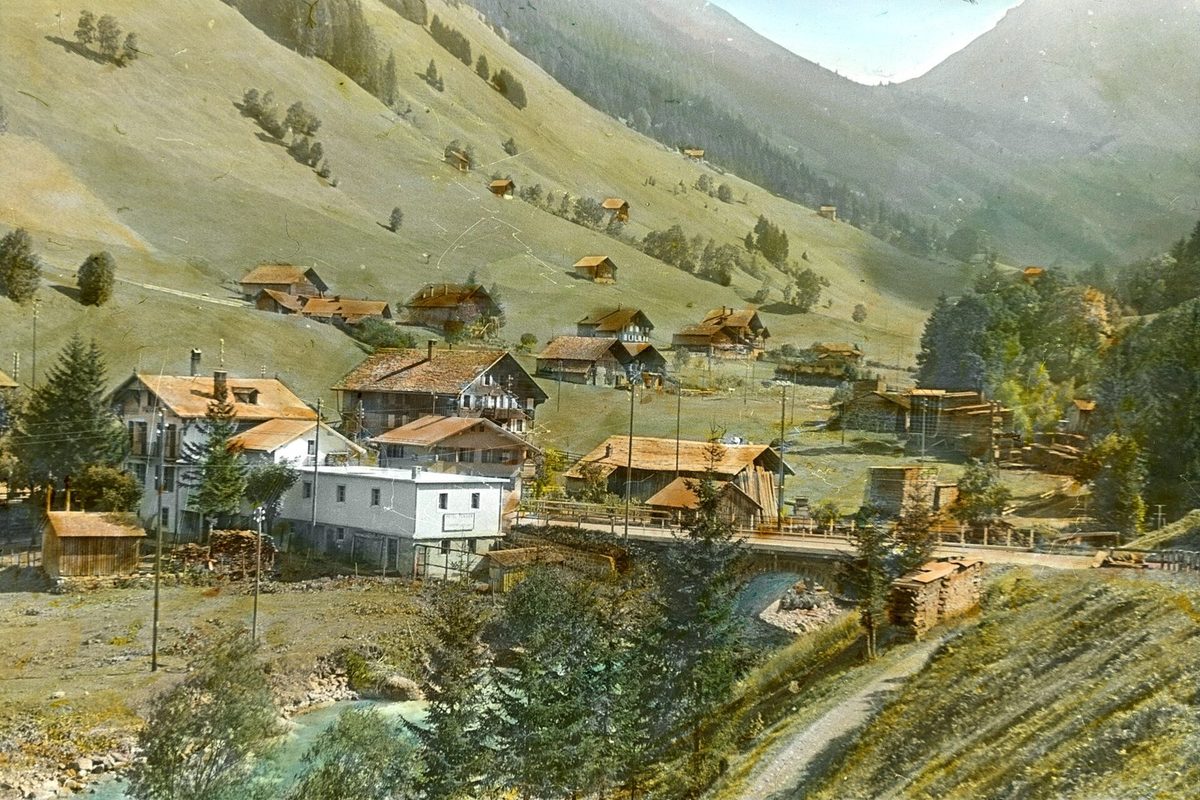
In the Middle Ages the valley belonged to the counts of Gruyère, like the rest of the Pays-d'Enhaut, and formed one of the seven « établées » of the municipality of Château-d'Œx. As early as 1276 a deed mentions the Thoumaley and Saziémaz alpine pastures here: it was first of all pasture land. In the 13th century its inhabitants were German-speaking, and settlement seems to have continued with farms worked all year round. After the Reformation, French-speaking families from the Pays-d'Enhaut took over the pastures. They produced butter and exploited the forests. The village lies in the south of the municipality of Château-d'Œx, on the Col des Mosses road. Who founded L'Etivaz remains unknown.[1][2]
History of L'Etivaz
1276. A deed mentions the Thoumaley and Saziémaz alpine pastures, at the edge of the valley, at about 1'800 metres.[2]
13th century. The inhabitants of the valley are German-speaking.[1]
15th century. A chapel exists at L'Etivaz.[1]
1460. Mentioned in the form « Leytiva ».[2]
1497. Under an agreement of 2 July, the priest of Château-d'Œx undertakes, for an annual payment of five pounds, to come and celebrate Mass every Thursday in the chapel.[2]
1514. Mentioned in the form « Leytivaz ».[2]
1555. The Reformation is imposed; French-speaking families from the Pays-d'Enhaut then gain the upper hand over the pastures.[1]
1584-1590. The present church is built on an earlier chapel. Dates vary: 1584 (or 1589-1590, with a doorway dated 1589).[1][2]
1707. Construction of a house next to the church, later acquired to lodge the pastor and adapted in 1747.[2]
1713. L'Etivaz, until then part of the parish of Château-d'Œx, becomes an independent parish.[1][2]
1714. A thermal bath attracts visitors from 1714 (or 1719). The spring is used until the early 20th century.[1]
1867. A carriage road is built through the Pissot gorge, from Les Moulins.[1][2]
1880-1881. Construction of the school.[2]
1887. Opening of the hôtel des Bains.[1]
around 1900. Construction of the Hôtel du Chamois.[2]
1934. Construction of a cooperative cellar, regularly enlarged, for ripening the alpine cheese.[1][3]
1999. On 24 September L'Etivaz cheese is registered as a controlled designation of origin (AOC). It is the first designation of origin entered in the federal register.[3]
2013. The protected designation of origin (AOP) reportedly replaces the AOC designation at this point; date uncertain.
Population of L'Etivaz
Sources and references: [1]
| 1764 | 180 |
Economy of L'Etivaz, past and present
Cattle, cheese and timber. L'Etivaz's economy rests almost entirely on cattle rearing and cheesemaking, and also on forestry. In 2013 these activities still dominate. Introduced towards the end of the 16th century, the Gruyère recipe opened export markets and brought substantial income. A large sawmill by the river is the only real industry in the village and in the whole valley.[2]
L'Etivaz cheese. It is made in alpine chalets between 1'000 and 2'000 metres, from 10 May to 10 October, in copper vats heated only by wood fire. After seven days at most, the wheels go down to the ripening cellars of the Pays-d'Enhaut. They mature there for at least 135 days, and 30 months for L'Etivaz à rebibes. In 1999, the application for the designation of origin was filed on behalf of the 80 producers of L'Etivaz.[4]
The cooperative and its cellars. In 1932, the tenants of the alpine pastures decided to join forces, as the cheese was losing quality in the chalet cellars. The first cellars, in 1934, took in the 2'700 wheels of the 30 members. In 1945, the cooperative was freed from the obligation to deliver to the Swiss Cheese Union in Bern. From 1946 it extended to all the Vaud Alps. Several extensions raised capacity to 14'000 wheels in 1986. In 2012, new cellars for 7'000 wheels replaced those of 1934.[3][4]
The baths. Two Minod brothers opened a bathhouse in 1719. It declined in the early 19th century, after the spring's flow dropped. A new bathhouse was built in 1887. Operations ended in 1949 and the property was sold to the town of Montreux.[2]
Historic sites in L'Etivaz
L'Etivaz church. Place of worship built in the late 16th century on an earlier chapel, its doorway bearing the date 1589. It is roofed with wooden shingles (tavillons).[1][2]
Parsonage. House built in 1707, acquired to lodge the pastor after the parish was created in 1713 and adapted in 1747.[2]
School. Building of 1880-1881 with two timber storeys above a ground floor.[2]
Hôtel du Chamois. Hotel built around 1900: a central log building flanked by two masonry cross wings.[2]
Maison de L'Etivaz. The cooperative of L'Etivaz alpine cheese producers, which ripens the alpine cheeses, is housed in a building built in 1990. The Maison de L'Etivaz, a socio-economic centre and shop, dates from 1994. The first cooperative cellars date back to 1934.[1][2][3]
L'Etivaz baths. Thermal spring visited from 1714 (or 1719) and used until the early 20th century. The hôtel des Bains dates from 1887.[1]
Protected heritage in L'Etivaz
Cultural property of regional significance (B objects)[8]
- L'Etivaz, cure
- L'Etivaz, temple
Legends of L'Etivaz
The fox sprite of Les Martines. A mocking sprite haunted the house of Les Martines. A man from Château-d'Œx passing by at night saw through the window a fox calmly spinning at a distaff by lamplight. A hunter who took aim at it saw it grow until it was bigger than a horse. The shot went off and the vision vanished.[7]
Traditions and festivals in L'Etivaz
The désalpe. In September, L'Etivaz celebrates the return of the herds after the summer on the mountain pastures. The cows parade through the village, and the day brings together a craft market, a cheese competition and a tasting of the first L'Etivaz AOP wheels of the summer. The L'Etivaz désalpe is linked to the one in Gstaad by a tradition shared across the language border.[9]
Sources
- Dictionnaire historique de la Suisse, David Birmingham, « L'Etivaz », version du 21.03.2006
- Inventaire fédéral des sites construits d'importance nationale (ISOS), « L'Etivaz », 2013
- Coopérative des producteurs de fromages d'alpage L'Etivaz, « Story » (ancien site etivaz-aop.ch)
- Office fédéral de l'agriculture, « L'Etivaz : résumé de la demande d'enregistrement » (AOC), 24.09.1999
- Statistique Vaud, « Population résidante permanente au 31 décembre 2025 »
- geo.admin.ch, Recherche de lieux (swisstopo)
- Alfred Cérésole, Légendes des Alpes vaudoises, ill. Eugène Burnand, Lausanne, 1885, p. 47-48
- Federal Office for Civil Protection (FOCP), Swiss Inventory of Cultural Property (PCP), list for the canton of Vaud (as of 1.1.2026)
- L'Etivaz alpine cheese producers' cooperative, "Désalpe de L'Etivaz"
Published by Sébastien Jörg ·
Other villages near L'Etivaz
Missing information, or do you have a source? Suggest a correction or addition. Every submission is checked before it's published.
Suggest a change