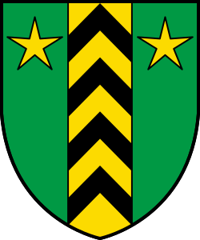
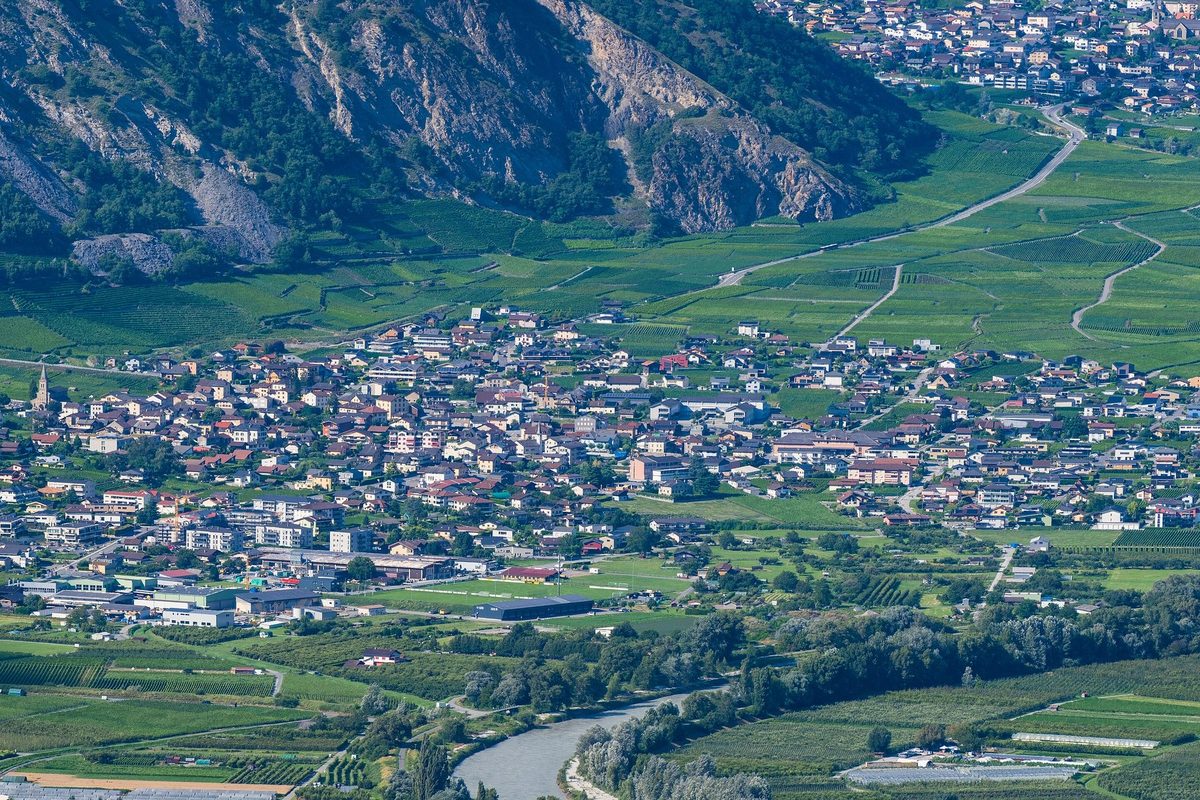
Leytron
Origin of the name Leytron
The name appears in 1219 as « Leitrun ». It may come from the Latin lactarius (milkman, cream seller) and designate the estate of a man so called, but this is not certain. In the local patois the village is reportedly called Laïtron.[1]
Founding of Leytron
A La Tène grave shows that the territory was occupied long before the first written records. In 1033 Leytron was an allodial estate of Count Ulrich I of Lenzburg. He ceded it to his nephew Aymon of Savoy, bishop of Sion, and the place became an episcopal lordship. Under Savoy and then under the Upper Valais, Leytron belonged to the castellany and banner of Saillon: the castellan and the mayor of Saillon administered it, together with local officers. The community had thus long existed when the municipality officially separated from Saillon. The date is uncertain (1819 or 1820).[1][2]
History of Leytron
La Tène. A La Tène grave is discovered on the territory.[1]
1033. Leytron is an allodial estate of Count Ulrich I of Lenzburg, then an episcopal lordship after its cession to his nephew Aymon of Savoy, bishop of Sion.[1]
11th century. Leytron depends spiritually on Saillon.[1]
1130-1475. Savoyard possession, attached to the castellany and banner of Saillon.[1]
1219. Mentioned as « Leitrun ». The vidomnat belongs to the de La Tour family.[1]
Around 1264. Leytron forms a separate parish.[1]
1292. The vidomnat passes to the de Mar family.[1]
1315. First attestation of the municipality.[1]
1327. The vidomnat belongs to the de Châtillon d'Aoste family.[1]
1356-1786. The vidomnat is held by the de Montheolo family, until it is bought back by the State in 1786.[1]
1413. Mention of the old church of Saint-Martin.[1]
1475-1798. Possession of the Upper Valais.[1]
1550. Fire.[1]
1570. Rockfalls from the Ardève.[1]
1820. Official constitution of the municipality, separated from Saillon.[1]
1883-1884. Construction of the bridge over the Rhône, rebuilt in 1991-1992.[1]
1900. Construction of a new church.[1]
1907. Catchment of the waters of the Salentse.[1]
1921. Electric pumping; irrigation follows in 1956 and drains a formerly marshy plain.[1]
Population of Leytron
Sources and references: [1][3]
| 1798 | 421 |
| 1850 | 615 |
| 1900 | 1'073 |
| 1950 | 1'697 |
| 2000 | 2'128 |
| 2025 | 3'593 |
Historic sites in Leytron
Ovronnaz. Locality of the municipality at 1'350 m above sea level, which has become a summer and winter resort.[1]
Hamlets of the municipality. Leytron-Plan, Produit, Montagnon, Les Places, Dugny and Le Four lie between 497 and 1'041 m above sea level. Produit and Montagnon are threatened by one of the largest landslides in the Valais.[1]
Church. New church built in 1900, succeeding the old church of Saint-Martin mentioned in 1413.[1]
Vineyard. At the beginning of the 21st century the municipality lives mainly from its vineyard, which accounts for one seventh of that of the Valais.[1]
Remains in Leytron
La Tène grave. Iron Age burial discovered on the municipal territory.[1]
Sources
- Dictionnaire historique de la Suisse, « Leytron » (Patrick Maye), version du 24.01.2008
- Dictionnaire historique de la Suisse, « Saillon (commune) » (Benjamin Roduit), version du 29.05.2012
- Office fédéral de la statistique (OFS), STATPOP, chiffres provisoires au 31.12.2025, via citypopulation.de
- geo.admin.ch, service de recherche de swisstopo (Leytron)
Localities of the municipality with a page
Other villages near Leytron
Missing information, or do you have a source? Suggest a correction or addition. Every submission is checked before it's published.
Suggest a change