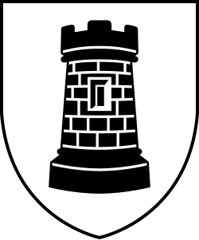
Saillon
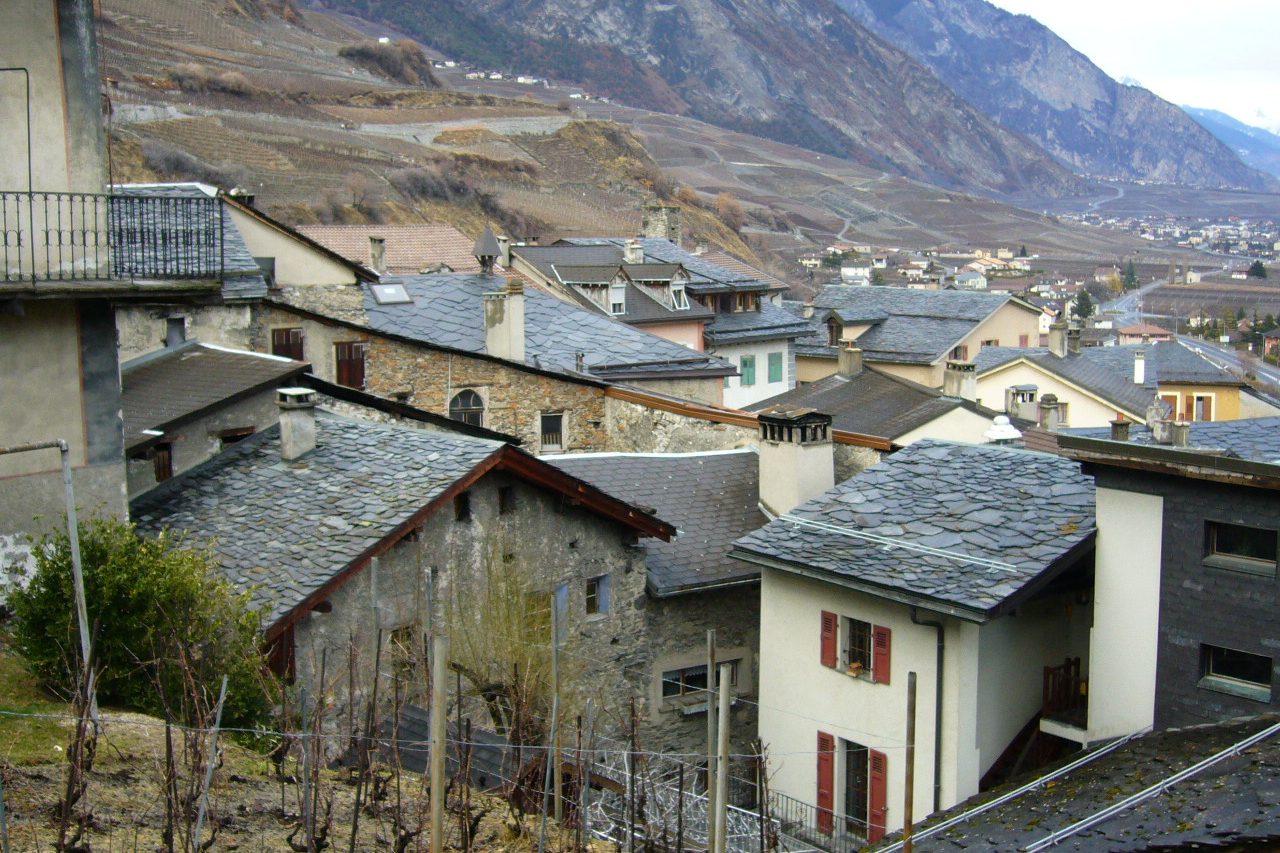
Origin of the name Saillon
The place is mentioned in 1052 as « castellum Psallionis » (or « castrum Psallionis »), then as Sallon and Sallun in the 12th century. The name may share its origin with Latin salire, alluding to the rocky spur on which the town stands. It has also been linked to the Latin personal name Salius or Sallius. Neither explanation is established. The former German name is Schellon.[1][4]
Founding of Saillon
The site has been frequented since prehistory, as stone tools from the Poteux cave show, and Roman buildings, including a villa, have been identified there. In the mid-11th century the place belonged to the cathedral chapter of Sion, later to the lords of Saillon. The Savoys then took over the castle, strengthened it and made Saillon the seat of a castellany. Next to it they founded a new fortified borough, with franchises, fairs and markets. The old village, whose location remains uncertain, disappeared as early as the 14th century.[1]
History of Saillon
Prehistory. Stone tools in the Poteux cave.[1]
Roman period. Roman buildings, including a villa.[1]
5th-6th century. A funerary oratory is built in the Roman villa in the late 5th or early 6th century. It is followed by a new building in the late 8th or 9th century.[1]
1052. Mentioned as « castellum Psallionis » (or « castrum Psallionis »). The estate belongs to the cathedral chapter, then to the lords of Saillon. Vineyards are attested from this date.[1][4]
12th century. At the end of the century the building becomes a parish church dedicated to Saint-Laurent.[1]
1257. The castle, now held by the Savoys, is strengthened. Saillon becomes the seat of a castellany.[1]
1261-1262. Construction of the tower of the town wall known as the Bayart tower.[1]
1271. The new fortified borough receives franchises, with fairs and markets.[1][4]
1356. Saillon has 43 hearths.[1]
14th century. Foundation of the Saint-Jacques hospice, which operated until the mid-19th century. Disappearance of the old village.[1]
1475. Destruction of the castle.[1][4]
1740. Construction of the present Baroque church.[1][4]
1798. Creation of the modern municipality, which then includes Leytron.[1]
1819. Leytron separates from Saillon.[1]
1847. Aqueduct in the Salentze gorge.[1]
1864-1879. Embankment of the Rhône.[1]
1876-1926. Operation of a marble quarry.[1]
1917-1927. Canals built and marshes drained from 1917, then land consolidation (1922-1927), making it possible to grow strawberries, asparagus, apple and pear trees.[1]
1975. Promotion of the medieval site with the Écu d'or. Spa activity develops from 1976.[1]
2000. Opening of the Counterfeit Money Museum (date uncertain: 2000 or 1976); new flooding by the Rhône.[1]
Population of Saillon
Sources and references: [1][2]
| 1356 | 43 hearths (households) |
| 1792 | 136 |
| 1850 | 208 |
| 1900 | 422 |
| 1950 | 788 |
| 2000 | 1'519 |
| 2025 | 3'225 |
Historic sites in Saillon
Fortified borough. New fortified borough granted franchises in 1271, with fairs and markets, and seat of the Savoyard castellany. Its wall reportedly dates from the 13th century.[1][4]
Church of Saint-Laurent. The present Baroque church dates from 1740. It succeeds the building that became a parish church dedicated to Saint-Laurent at the end of the 12th century.[1][4]
Salentze gorge. Gorge crossed by the aqueduct of 1847. The Salentze caused a flood in 1958. A 92 m long footbridge spans it 136 m above the bottom.[1][5]
Counterfeit Money Museum. Opened in 2000 (or 1976) as part of the cultural offer linked to the medieval site, in a 17th-century village house. Farinet is one of its three themes, alongside genuine and counterfeit money.[1][6]
Pont-du-Traux. Area of clustered housing linked to the strong population growth since 1980, together with the A9 motorway.[1]
Remains in Saillon
Bayart tower. Tower of the town wall built in 1261-1262 under the Savoys. It reportedly takes its name from Dame Bayart, owner of the land.[1]
Castle. Castle of the lords of Saillon and then of the Savoys, strengthened from 1257 and destroyed in 1475. Only remains of the keep and of three towers survive.[1]
Roman villa and oratory. Roman villa in which a funerary oratory was built in the late 5th or early 6th century, the origin of the church of Saint-Laurent.[1]
Marble quarry. Quarry worked from 1876 to 1926. Its marble was used to decorate Charles Garnier's Paris Opera.[1][4]
Legends of Saillon
Farinet, the counterfeiter. Joseph-Samuel Farinet, a counterfeiter born in 1845 in the Aosta Valley, is said to have handed out his fake coins to the population and to have died in 1880 in the Salentze gorge, pursued by the police. Popular tradition turned him into a legendary figure.
Sources
- Dictionnaire historique de la Suisse, « Saillon (commune) » (Benjamin Roduit), version du 29.05.2012
- Office fédéral de la statistique (OFS), STATPOP, chiffres provisoires au 31.12.2025, via citypopulation.de
- geo.admin.ch, service de recherche de swisstopo (Saillon)
- Inventaire fédéral des sites construits à protéger en Suisse (ISOS), « Saillon », 2e version, février 1996
- CFF, idées d'excursions : « Passerelle à Farinet »
- museums.ch, « Musée de la fausse monnaie » (Saillon)
Localities of the municipality with a page
Other villages near Saillon
Missing information, or do you have a source? Suggest a correction or addition. Every submission is checked before it's published.
Suggest a change