Mont-sur-Rolle
The village was called Mont-le-Grand until the 20th century: the Council of State imposed «Mont-sur-Rolle» for postal reasons, despite the inhabitants' opposition.
Entry based on 10 sources · Our method · Reusable text (CC BY-SA)
Origin of the name Mont-sur-Rolle
The name «Mont-sur-Rolle» has not yet been explained. The place appears between 994 and 1031 in the form «Monte». The forms «Montibus» and «Mont loz Grant» are also attributed to it for 1403, but this is not certain. In the 20th century the Council of State replaced the old name «Mont-le-Grand» with «Mont-sur-Rolle», reportedly for postal reasons. The inhabitants opposed the change.[1][3][4]
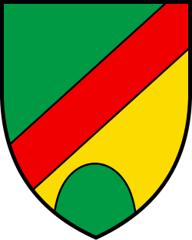
Coat of arms of Mont-sur-Rolle
Per bend sinister vert and Or, a bend sinister gules overall, in base a mount of the first. A diagonal rising from left to right divides the shield, green at the top and yellow at the bottom. A red band follows this diagonal, and a green mount rises in the yellow part. The green stands for the forests, the yellow for the vineyards and the red for the roof tiles.[8][4]
Founding of Mont-sur-Rolle
No founding act is known for Mont-sur-Rolle. In the Middle Ages Mont was the centre of the lordship of Mont-le-Grand, seat of the lords of Mont, whose first castle stood on the Molard. The monasteries of Romainmôtier and Bonmont owned land here. In the early 15th century Mont, Germagny and Haute-Cour probably formed three territorial units, which began in the 16th century to organise themselves as a municipality, with a cemetery, a town house and a chapel.[1]
History of Mont-sur-Rolle
966 (or 996). A small town called Sainte-Marie, with a parish church, is recorded. The castle of the lords of Mont stood on the Molard.[3]
994-1031. First mention of the place, in the form «Monte».[1]
Middle Ages. Mont is the centre of the lordship of Mont-le-Grand, seat of the lords of Mont. The monasteries of Romainmôtier and Bonmont hold land there.[1]
1403. The forms «Montibus» and «Mont loz Grant» reportedly appear at this date.[3]
1405. Mont, Germagny and Haute-Cour probably form three distinct territorial entities.[1]
1475. During the Burgundian Wars, the castle on the Molard and the small town are destroyed.[3]
late 15th century. Probable construction of the fortified house known as the «Château», recorded in 1517.[3]
1539-1798. Mont is incorporated into the bailiwick of Morges. It is governed by a council of nine members.[1]
1553-1558. Hans Steiger, treasurer of the Pays de Vaud, buys the lordship. His family reportedly kept it until 1798, though this is not established.[3][5]
16th century. The three entities begin to organise themselves as a commune (cemetery, town hall, chapel).[1]
1621. Forming a parish with Perroy, Mont is a dependency of Gimel from the Reformation until 1621, then of Rolle.[1][3]
1627. The fortified house, now the Steigers' château, is rebuilt.[3]
1677. The Steigers have a large wine-grower's house built below the château, called the Grosse Maison from the late 18th century.[3]
1798-2006. Mont-sur-Rolle belongs to the district of Rolle.[1][3]
1841. Construction of the neoclassical temple, replacing the dilapidated old church. It is reportedly the work of the architect Henri Perregaux.[3]
1941. Founding of a wine-growers' cooperative cellar.[1]
1980s. Beginning of strong residential development.[1][4]
2000. The municipality has 32 wine-growing holdings covering 270 hectares.[1]
2008. Mont-sur-Rolle moves to the new district of Nyon, effective 1 January 2008.
Population of Mont-sur-Rolle
Sources and references: [1][2][3]
| 1764 | 414 |
| 1850 | 673 |
| 1900 | 683 |
| 1950 | 684 |
| 1980 | 1'035 |
| 2000 | 1'796 |
| 2025 | 2'759 |
Families of Mont-sur-Rolle
Citizen families before 1800. Benoit, Blondel, Chanson, de la Harpe, de Mestral, Déléchat, Désoches, Gros, Monnard, Renaud and Renevier, as well as the de Weiss family of Bern, with no precise date. The Richard family was registered in 1594, the Ansermet and the Gallay, the latter from Essertines-sur-Rolle, in 1716.[9]
In the 19th century. Baud and Chardon, with no precise date. The Juillerat-Chasseur family of Nyon was admitted in 1835.[9]
From 1901 to 1962. Twelve entries. France gave the Jégu (1926), the Hutin (1932) and the Clavel (1947), Italy the Florian (1935) and the Molteni (1959), the last family registered, and Austria the Mennel (1953). The Gander family of Versoix GE was admitted in 1956. The year 1957 brought five families: the Christen of Affoltern im Emmental BE, the Gfeller of Bern, the Gilgen of Wahlern BE, the Haldi of Saanen BE and the Maurer of Kappel am Albis ZH.[9]
Notable people of Mont-sur-Rolle
Louis Rilliet-de Constant (1794-1856). Born in Mont-sur-Rolle, this grandson of Louis Necker served in the French imperial army. As a federal colonel, he commanded the 1st Division against the Sonderbund troops and received the surrender of Valais. A Radical deputy, he was a Geneva State Councillor from 1847 to 1848.[10]
Economy of Mont-sur-Rolle, past and present
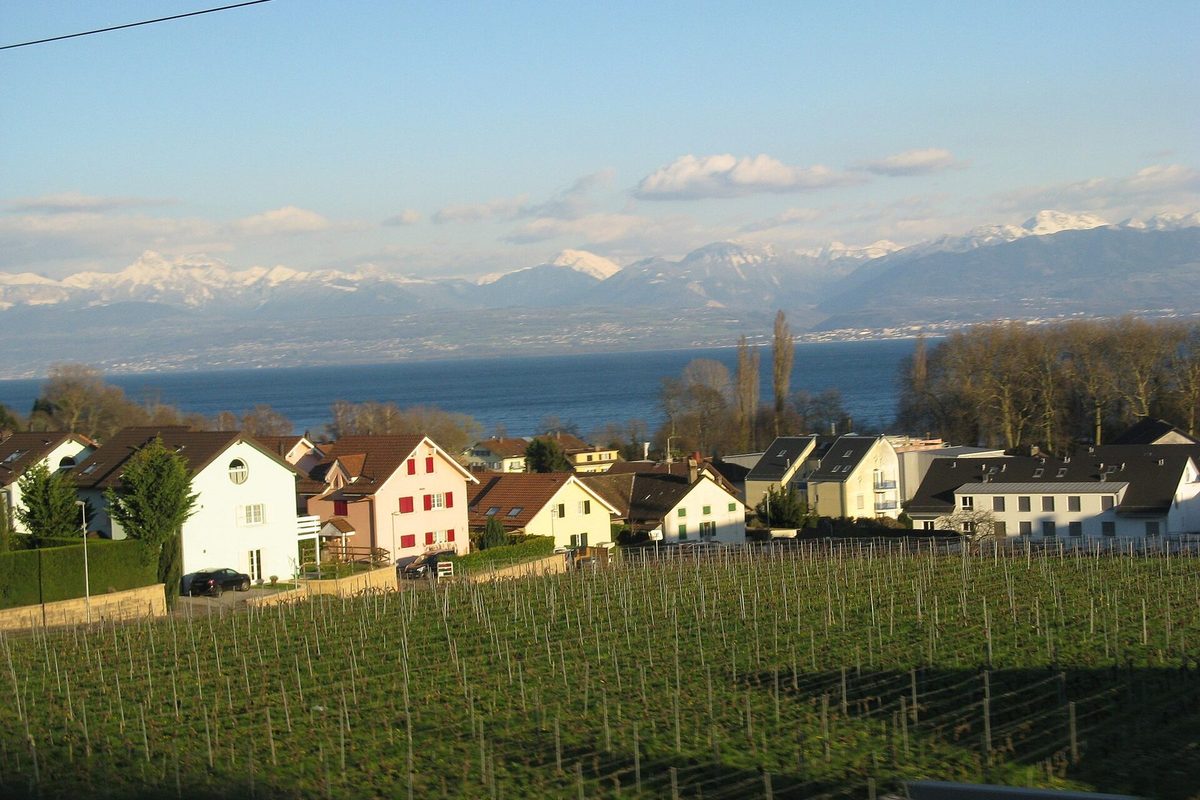
Vineyards. Wine growing remains the main activity. More than 40% of the 386 hectares of the territory are planted with vines, and nearly thirty winegrowers who make their own wine cultivate as many grape varieties. On the Siegfried map of 1895, the vineyard already covers the same area.[3][4]
Winegrowers' houses. The winegrowers' houses in the La Noyère core date from the 17th and 18th centuries. The Abbaye house dates from the late 16th century, the Maison Blanche from the early 18th. In the 17th century Montbeney is recorded as a house with a wine press. An industrial wine cellar was built on the slope in the first half of the 20th century.[3]
Forests, fields and small firms. In the 19th century the municipality also drew income from its forests and farmland. The lower plateau, once farmland, has been taken over by residential districts. A few small, mostly family-run firms and regional companies are based in the business zones.[3][4]
Disasters and major events in Mont-sur-Rolle
The Burgundian Wars in 1475. The Confederates probably set fire to the tower of the Vieux Château and destroyed it, and Gérard de Mont, lord of the place, fled. The destroyed buildings of old Mont-le-Grand were abandoned.[3][4]
Historic sites in Mont-sur-Rolle
Château de Mont. Fortified house probably from the late 15th century, recorded in 1517 and rebuilt in 1627 for the Steigers. It succeeded the original castle on the Molard.[3]
Protestant church (temple). Free-standing neoclassical temple, built in 1841 to replace the dilapidated old church. It is reportedly the work of the architect Henri Perregaux.[3]
La Grosse Maison. Imposing wine-grower's house dated 1677, built for the Steigers below the château. Bought by the municipality in the 1980s, it has been the town hall since 1985.[3]
The Molard. Site of the original castle of the lords of Mont, destroyed together with the small town in 1475 during the Burgundian Wars.[3]
The hamlets in the vineyards. Besides the village, the municipality includes several hamlets in the vineyards: L'Abbaye, Crochet, Germagny, Haute-Cour and Mont-Dessus.[1]
Protected heritage in Mont-sur-Rolle
Cultural property of regional significance (B objects)[7]
- Maison de maître de Belletruche avec dépendance, maison d'habitation et dépendance
- Maison de maître de Germagny avec dépendance, maison d'habitation, pavillon et fontaine
- Mont Dessus, occupation de l'Age du Bronze / vestiges du château et bourg de Mont-le-Grand - Moyen Age
Traditions and festivals in Mont-sur-Rolle
The youth society and New Year. Founded in 1790, the youth society is the oldest in the village. Every New Year it marches through the streets with drums and bass drums. For its 200th anniversary, in 1990, it put up a statue in front of the village hall.[4]
The Bal des Vieux. Started at the beginning of the 20th century, the Bal des Vieux is held on 3 January. Originally it paid for the wedding of a member of the society.[4]
The Mont-le-Grand brass band. In 1870-1871 music lovers played at the village dances, then founded the Fanfare municipale de Mont-le-Grand. It wears yellow and black, the colours of the castle.[4]
The Chœur de Chantevigne. A mixed choir founded in 1957, the Chœur de Chantevigne sings a contemporary and classical repertoire.[4]
Sources
- Dictionnaire historique de la Suisse, « Mont-sur-Rolle »
- Statistique Vaud, « Population résidante permanente au 31 décembre 2025 »
- Inventaire fédéral des sites construits à protéger en Suisse (ISOS), « Mont-sur-Rolle », fiche n° 4751 (2e version, 2012)
- Feuille des avis officiels du canton de Vaud, « Alphabet des communes vaudoises : Mont-sur-Rolle »
- Swisscastles, « Château de Mont-sur-Rolle »
- État de Vaud, communiqué du 12.07.2007, « Organisation des préfectures et adaptation au nouveau découpage territorial »
- Federal Office for Civil Protection (FOCP), Swiss Inventory of Cultural Property (PCP), list for the canton of Vaud (as of 1.1.2026)
- IPI, Swissreg, emblems database: coat of arms of Mont-sur-Rolle (no. 101993)
- Register of Swiss Surnames, 3rd edition (1989), search Commune "Mont-sur-Rolle", Canton VD
- Dictionnaire historique de la Suisse, « Rilliet-de Constant, Louis », version du 28.03.2012
Published by Sébastien Jörg ·
Localities of the municipality with a page
Other villages near Mont-sur-Rolle
Missing information, or do you have a source? Suggest a correction or addition. Every submission is checked before it's published.
Suggest a change