Rolle
The last new town founded by Savoy in the Pays de Vaud, on Lake Geneva, birthplace of Frédéric-César de La Harpe and home of the Institut Le Rosey.
Entry based on 11 sources · Our method · Reusable text (CC BY-SA)
Origin of the name Rolle
Rolle first appears in writing in 1294 as «Rotuli». In German the town is called «Roll». No one has yet explained the name «Rolle». The inhabitants, the Rollois, are nicknamed in patois «lè Pllianta-saudzon» (the willow plants), which reportedly recalls the draining of the municipality's marshes.[4]
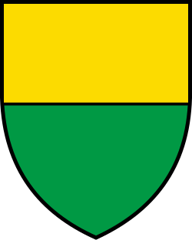
Coat of arms of Rolle
Per fess or and vert. The shield is divided horizontally, yellow above and green below. These arms appear in 1547.[10][4]
Founding of Rolle
Rolle is a Savoyard foundation. A castle, dated to 1264 by dendrochronology, probably already protected a landing place there. In 1319 Count Amadeus V of Savoy founded the town by a show of force: it was the last stage of the Savoyard establishment on the north shore of Lake Geneva. The plan of the new town comprised a main street parallel to the lake, crossed by perpendicular streets linking the port to the hinterland. The inhabitants received the franchises of Moudon. The medieval town never completed its walls, begun on the lakeshore, a sign of its secondary importance among the lakeside toll posts.[4]
History of Rolle
Late Bronze Age. Lakeshore settlements of the Late Bronze Age, notably at La Harpe and Fleur d'Eau.
1st-3rd century. Gallo-Roman villa at La Combe, excavated in 1984.
1264. Construction of the castle, dated by dendrochronology. It probably protected a landing place.[4]
1294. First written mention, in the form «Rotuli».
1319. Count Amadeus V of Savoy founds the town by a show of force, the last stage of the Savoyard establishment on the north shore of Lake Geneva. The inhabitants receive the franchises of Moudon.[4]
1347. Mention of the chapel of the Holy Sepulchre.
1366. The burghers are exempted from the Aubonne toll.
1425. The town obtains a weekly market.
1484. Rolle is raised to a barony.
1536. Bernese conquest of the Pays de Vaud. Rolle is incorporated into the bailiwick of Morges.
1558. Hans Steiger acquires the barony, which his descendants keep until the Revolution.
1688. Huguenot refugees found a Bourse française (relief fund).
1754. Birth in Rolle of Frédéric-César de La Harpe, future tutor of Tsar Alexander I and a figure of Vaudois independence. At the end of the 18th century the town is a hotbed of the Revolution.[5]
1789-1790. Construction of the present Reformed church.
1798. Under the Helvetic Republic the castle becomes an administrative seat (until 1974). Rolle is a district capital from 1798 until 31 December 2007, before joining the district of Nyon on 1 January 2008.[4]
1835-1841. Construction of the artificial island of La Harpe to protect the port.
1843. Construction of the Catholic church of Saint-Joseph, in neo-Gothic style.[6]
1880. The Carnal family founds two private international boarding schools, La Combe (girls) and Le Rosey (boys), merged in 1975 as the Institut Le Rosey.
1898-1938. Operation of a tramway linking Rolle to Gimel.[7]
2022. Death at his home in Rolle of the film director Jean-Luc Godard, who had lived there for years.[8]
Population of Rolle
Sources and references: [3]
| 1764 | 1'061 |
| 1803 | 1'323 |
| 1850 | 1'398 |
| 1900 | 2'025 |
| 1950 | 2'677 |
| 2000 | 4'235 |
| 2025 | 6'604 |
Families of Rolle
Burgher families before 1800. Collioud, de la Harpe and Favre appear with no precise date, as do the Biaudet, from France, the de Büren, from Bern BE, and the Rolaz, from Savoy. The Genicoud were received in 1550, the Vittel from Givrins VD in 1608, the Demartines from Perroy VD in 1635 and the Reymond from Saint-Sulpice NE in 1652. In the 18th century Rolle took in many families from France, the Chinet and the Vernet (1717), the Cabrol (1723), the Terrisse (1756), the Manuel (1758) and the Reigner (1764), and from Germany, the Reinhard (1757), the Brum von Seldeneck and the Brumm (1758), the Haas and the Loba (1782), the Baumann (1784) and the Widmayer (1793). To these were added the Kehrwand from Aarberg BE (1733), the Bugnot from Saint-Blaise NE (1748), the Euler (1754), the Monnard (1757), the de Tscharner from Bern BE (1775), the Keusen from Riggisberg BE (1777), the Burky from Biglen BE (1778) and the Tattet (1780).[11]
In the 19th century. Nine entries. The Eynard from Geneva GE (1810) and the Perret-Jeanneret from Le Locle NE (1847) opened the list. Five families then came from Germany: the Froelich (1855), the Post (1875), the Faasch and the Held (1892), and the Oelklaus (1895). From France came the Beck (1870) and the Bourgeois (1900).[11]
From 1901 to 1962. Sixty-four entries, from 1908 to 1962, twenty of them in 1956 alone. Bernese families are the most numerous (20), ahead of those from Fribourg and Italy (nine each) and France (six). The Carnal, from the United States, were registered in 1928.[11]
Notable people of Rolle
Frédéric-César de La Harpe. A man of Rolle and former tutor to Emperor Alexander I of Russia, he used his connections in Paris and St Petersburg to secure the independence of the canton of Vaud and its entry into the Confederation in 1803. After his death in Lausanne in 1838, the island by the harbour was named after him.[4]
Amédée de La Harpe. Lord of Yens and Les Uttins, he presided in 1791 over the second "banquet des Tilleuls", at which citizens of Rolle celebrated the anniversary of the storming of the Bastille. He then had to flee the town to escape Their Excellencies of Bern. Having become one of Bonaparte's generals, he was killed during the Italian campaign.[4]
Jean-Luc Godard (Paris 1930 - 2022). A critic at the Cahiers du cinéma and later a Franco-Swiss filmmaker, he had lived for years in Rolle, on Lake Geneva. He died at home in 2022, aged 91.[8]
Economy of Rolle, past and present
Port and lake. In the 18th and 19th centuries, alongside watchmaking, activity centred on the port. Market halls built in 1768 stored goods carried on the lake, such as wood, tiles, wine, cheese and building materials. From 1720 to 1830, ferruginous baths attracted visitors from Geneva.[1]
Factories, wine and antiques. Many factories, notably for pasta and precision instruments, developed industry at the expense of wine-growing. In 2000 eight wine estates remained. The wine trade is still well represented, among others by two large cellars. Crafts employ many people and Rolle's antique dealers draw buyers from far away. The town is also known for its petits pains de Rolle.[1][4]
Station, motorway and business centres. The station, built in 1858, shifted the economic centre. The A1 Geneva-Lausanne motorway opened in 1964. The Institut Le Rosey had 380 pupils in 2008. In the early 21st century Rolle presented itself as a new economic centre, with the Rolle Business Center at Les Uttins and the A-One Business Center.[1]
Disasters and major events in Rolle
The fires of 1530 and 1536. In 1530 and again in 1536 the Bernese set fire to the château du Rosey, owned by Claude d'Alliex, a member of the Confrérie de la Cuiller (Brotherhood of the Spoon). The château of Rolle suffered the same fate.[1]
The archives burned in 1802. In 1802 the Bourla-Papey burned a large part of the archives.[1]
Historic sites in Rolle
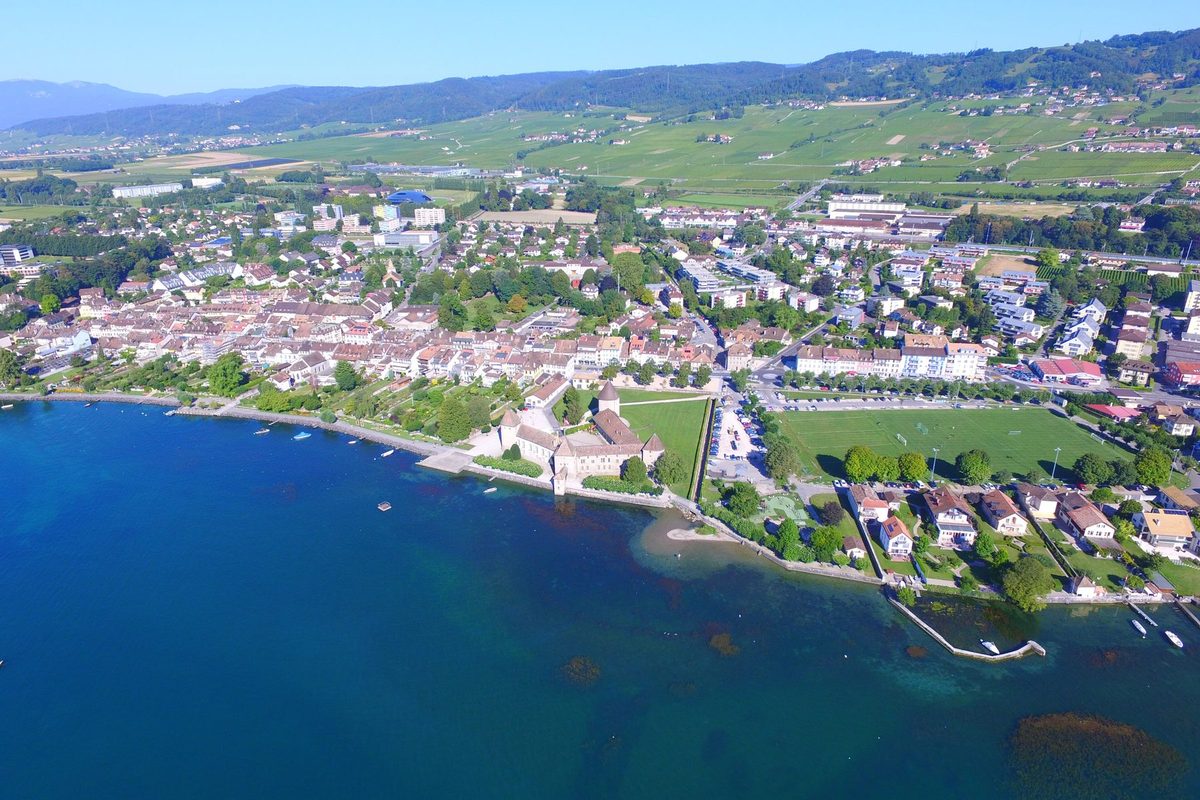
Rolle Castle. Savoyard castle on the lakeshore, dated to 1264 by dendrochronology, at the heart of the new town. Administrative seat from 1798 to 1974.[4]
Institut Le Rosey. International boarding school founded in 1880 by the Carnal family. Joined in 1975 with the girls' boarding school of La Combe, it had 380 pupils in 2008.
Reformed church. Reformed church (temple) built in 1789-1790.
Catholic church of Saint-Joseph. Neo-Gothic church built in 1843. It is one of the town's many protected buildings (16th-19th century).[6]
La Harpe island. Artificial island built in 1835-1841 to protect the port.
Remains in Rolle
Unfinished town wall. The medieval wall, begun on the lakeshore, was never completed. It shows the late and secondary character of the foundation.
Prehistoric and Roman sites. Late Bronze Age settlements at La Harpe and Fleur d'Eau. Gallo-Roman villa (1st-3rd century) excavated in 1984 at La Combe.
Protected heritage in Rolle
Cultural property of national significance (A objects in the PCP inventory)[9]
- Bibliothèque historique
- Château et fontaine
- Ile de La Harpe
Cultural property of regional significance (B objects)[9]
- Ancien Hôtel de la Couronne
- Ancienne maison d'Allinges
- Bellerive
- Casino
- Institut Le Rosey avec château, anciennes dépendances, fontaine, bassin, mur d'enceinte et portail
- Les Uttins, maison de maître et maison paysanne
- Pont CFF
- Temple
Sources
- Dictionnaire historique de la Suisse, « Rolle »
- Dictionnaire historique de la Suisse, « Vaud »
- Statistique Vaud, « Population résidante permanente au 31 décembre 2025 »
- Feuille des avis officiels du canton de Vaud (FAO), « Alphabet des communes vaudoises : Rolle »
- Dictionnaire historique de la Suisse, « La Harpe, Frédéric-César de » (Antoine Rochat, version du 27.08.2020)
- Église catholique dans le canton de Vaud (cath-vd.ch), « Histoire de l'église de Rolle », octobre 2022
- Musée suisse des transports, collection, « RG Rolle-Gimel » (1898-1938)
- Le Petit Journal, « Mort de Jean-Luc Godard, le dynamiteur du cinéma », 13.09.2022
- Federal Office for Civil Protection (FOCP), Swiss Inventory of Cultural Property (PCP), list for the canton of Vaud (as of 1.1.2026)
- IPI, Swissreg, emblems database: coat of arms of Rolle (no. 101753)
- Register of Swiss Surnames, 3rd edition (1989), search Commune "Rolle", Canton VD
Published by Sébastien Jörg ·
Other villages near Rolle
Missing information, or do you have a source? Suggest a correction or addition. Every submission is checked before it's published.
Suggest a change