Tartegnin
Small wine-growing village of La Côte, above Rolle, recorded from 1018 and long part of the lordship of Mont-le-Vieux.
Entry based on 7 sources · Our method · Reusable text (CC BY-SA)
Coat of arms: Public domain, Wikimedia Commons
Origin of the name Tartegnin
The place is recorded in 1018 in the form «Tritiniaco», then in 1214 in the form «Tertinins». The name is of Latin origin: it probably comes from the name of the first owner of a rural estate, Tritinius or Tertinius.[2]
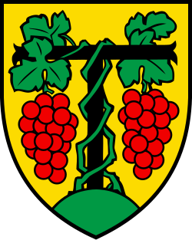
Coat of arms of Tartegnin
Or, two vine stocks vert on a mount vert, each fructed of one gules, supported by a common vine stake sable in the form of a tau. On a yellow field, two green vine stocks rise from green ground, each with one red fruit. They lean on a single black stake shaped like a T. Adopted in 1921, the arms bear the tinctures of Rolle, the district seat. The vines evoke the municipality's wines, and the tau-shaped stake the initial of the village's name.[6][3]
Founding of Tartegnin
Neither the date nor a founding charter of the village is known. Its name, formed from that of a landowner of the Roman period or the early Middle Ages (probably Tritinius or Tertinius), suggests that a rural estate lay at its origin. In the Middle Ages Tartegnin belonged to the lordship of Mont-le-Vieux. The abbeys of the Lac de Joux and of Bonmont and the priory of Bursins held property there. The village never had its own church and always belonged to the parish of Bursins.[2]
History of Tartegnin
1018. First mention of the place, in the form «Tritiniaco».[2]
1214. The name appears in the form «Tertinins».[2]
13th century. A noble family of Tartegnin is recorded.
Middle Ages. The village is part of the lordship of Mont-le-Vieux. The abbeys of the Lac de Joux and of Bonmont and the priory of Bursins hold property there.[2][3]
1536-1798. Under Bernese rule, Tartegnin is incorporated into the bailiwick of Morges and governed by a council of four members.
1764. The village has 112 inhabitants.
1798-2006. Tartegnin belongs to the district of Rolle.[2]
1823. Gravel pits and molasse quarries begin to be worked.[2]
1824. Construction of a new communal building.[2]
1849. A small bell turret is built on the communal building. In 1872 it is moved to the central axis of the roof.[2]
1889-1975. A dairy and cheese-making society operates in the village.[2]
1921. Land consolidation of the vineyard.[2]
1994. Founding of a cooperative for the promotion of wines.
2005. The primary sector provides 67 % of the jobs in the municipality.
2008. Under the 2006 law on territorial division, Tartegnin moves to the new district of Nyon, effective 1 January 2008.
Population of Tartegnin
Sources and references: [5]
| 1764 | 112 |
| 1803 | 162 |
| 1850 | 197 |
| 1900 | 174 |
| 1950 | 146 |
| 2000 | 194 |
| 2025 | 246 |
Families of Tartegnin
Burgher families before 1800. Caillat, Déruaz, Huguet, Maréchal, Mayor, Munier, Richard and Sordet, with no precise date.[7]
In the 19th century. The Matthey, from Le Locle NE, were received in 1843 and the Ziegenhagen, from Germany, in 1844.[7]
Economy of Tartegnin, past and present
The vineyard. In the 18th century the inhabitants live in equal parts from farming and wine-growing, and to a lesser extent from forestry. Wine-growing gains ground from the 19th century. In 1893 the Siegfried map shows the lower half of the municipality covered with vines. In 2002 the village still has eleven wine-growing estates. According to the FAO, nine cellars are in operation.[2][3]
Molasse and cheese. From 1823 gravel pits and molasse quarries are worked at Chomiaux, on the north-eastern edge of the municipality. In 1824 the ground floor of the new municipal building houses a dairy and a cheese dairy.[2]
Historic sites in Tartegnin
Communal house. New communal building erected in 1824. Its bell turret, built in 1849 at the western corner of the roof, was moved to the central axis in 1872.[2]
Former La Harpe house. House whose oldest core dates back to the early 16th century. It reportedly became the seat of the Tartegnin branch of the de La Harpe family.
Former de Mestral house. House reportedly enlarged around 1779 by Charles-Albert de Mestral.
Manor house (around 1690). Winegrower's house built around 1690, with a narrow, tall facade over three storeys, a half-hipped roof and large buttresses. It is reportedly the former de Martines house.[2]
The vineyard. At the heart of the La Côte wine region, viticulture grew from the 19th century, then took off again in the 20th century, when it came to cover a quarter of the territory. In 1921 a land consolidation rationalised access to the vineyard.[2]
Traditions and festivals in Tartegnin
The Mondial de fondue. The local winegrowers' group launched this contest for the best traditional cheese fondue in 2015. Professionals and amateurs compete in qualifying rounds and then a final, before a jury also made up of professionals and amateurs. Further editions followed in 2017 and 2019. During the festival visitors walk through the village under marquees where fondue is served at every table.[3]
Open cellars. During the grape harvest the winegrowers open their cellars and show their pressing, winemaking and harvesting equipment, whether manual or mechanical.[3]
Sources
- Dictionnaire historique de la Suisse (DHS), « Tartegnin »
- Inventaire fédéral des sites construits d'importance nationale à protéger en Suisse (ISOS), « Tartegnin », 2e version, mai 2012
- Feuille des avis officiels du canton de Vaud, « Alphabet des communes vaudoises : Tartegnin »
- État de Vaud, communiqué du 12.07.2007, « Les préfètes et les préfets sont attribués aux nouveaux districts »
- Statistique Vaud, « Population résidante permanente au 31 décembre 2025 »
- IPI, Swissreg, emblems database: coat of arms of Tartegnin (no. 101621)
- Register of Swiss Surnames, 3rd edition (1989), search Commune "Tartegnin", Canton VD
Published by Sébastien Jörg ·
Other villages near Tartegnin
Missing information, or do you have a source? Suggest a correction or addition. Every submission is checked before it's published.
Suggest a change