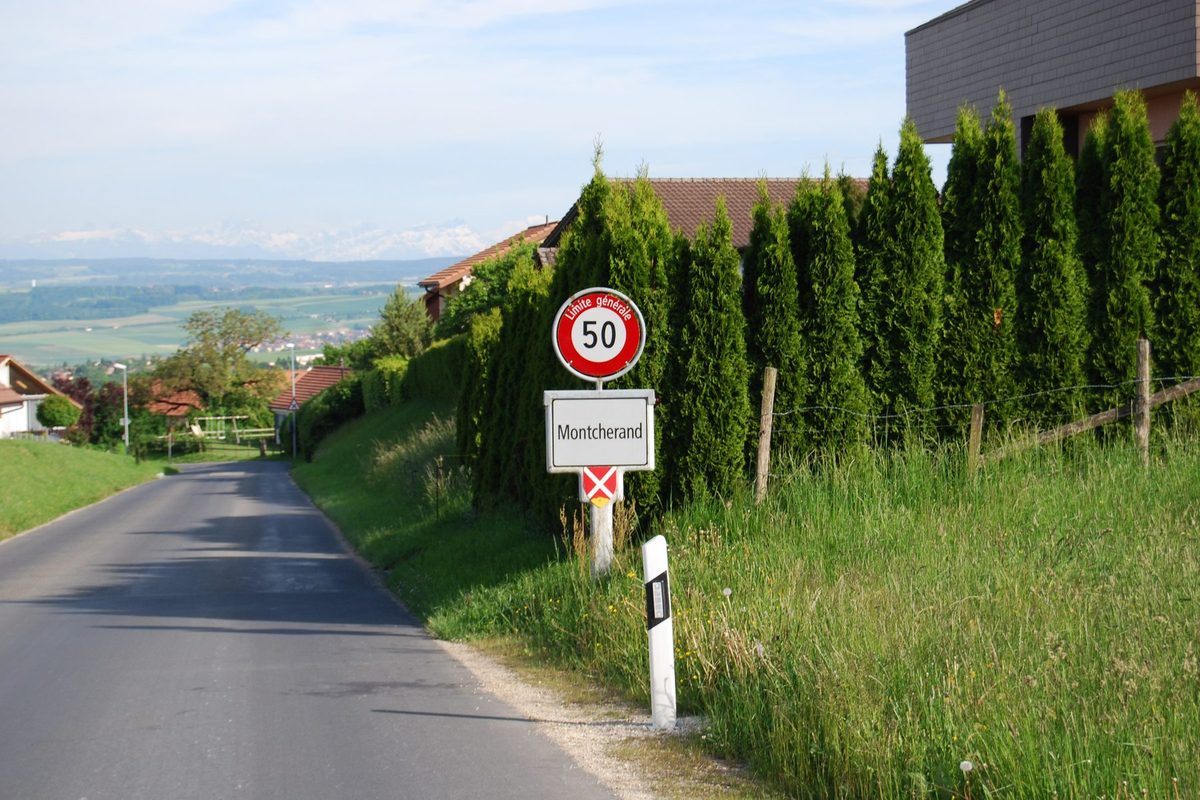
Montcherand
Its church holds Romanesque wall paintings from the late 11th or early 12th century, among the oldest in Switzerland, rediscovered in 1902 under the Reformation whitewash.
Entry based on 15 sources · Our method · Reusable text (CC BY-SA)
Origin of the name Montcherand
First written mention in 1324 in the form «Montcherant». The first element of the name is reportedly «mont» (mountain), recalled by the municipal coat of arms. The rest of the name remains unexplained.[1]
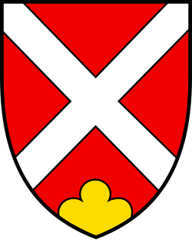
Coat of arms of Montcherand
Gules, a saltire argent, in base a mount of three peaks Or. On a red field, a white X-shaped cross runs across the shield. At the bottom rises a yellow mount with three peaks. The municipality adopted these arms in 1922. The saltire, taken from the arms of Baulmes, honours the village's old monastic ties. The mount recalls its name and its setting.[11][12]
Founding of Montcherand
The village grew up around its church, on a promontory above the Orbe. A first chapel reportedly stood there in the 10th century, replaced in the 11th century by a priory church, but this is not certain. The church depended on the priory of Baulmes, itself joined to the Cluniac monastery of Payerne, at an uncertain date between the 10th and the 12th century. Montcherand thus belonged to the network of Cluniac sites. In the Middle Ages the village was part of the lordship (terre) of Les Clées, and Baulmes, then Payerne, held substantial estates there. Pilgrims on the route to Santiago de Compostela and on the Via Francigena stopped here. Montcherand nevertheless long remained a very small settlement. Who founded Montcherand is unknown.[1][2][3][4]
History of Montcherand
7th-8th century. Bloomery furnaces for iron smelting operate at La Léchère.[1]
10th century. A chapel is said to have been built on the promontory overlooking the Orbe (date uncertain).[4]
11th century. Construction of the church of Saint-Étienne, dependent on the priory of Baulmes, then on the Cluniac monastery of Payerne. The original church reportedly burned at the end of the century and was rebuilt.[2][3]
late 11th-early 12th century. Execution of the apse wall paintings: Christ in glory surrounded by the symbols of the evangelists, and the college of the twelve apostles.[1][2][3]
late 13th century. The church of Saint-Étienne is a parish church.[1]
1324. First written mention of the village, in the form «Montcherant».[1]
1416. The village has 14 hearths.[1]
1453. The village has only 6 hearths left.[1]
16th century. A feudal castle reportedly watched over the passage of the road to Les Clées.[5]
1536. Bernese conquest of Vaud: Montcherand is attached to the castellany of Les Clées, in the bailiwick of Yverdon. With the Reformation the church becomes a Protestant temple and its paintings are covered with whitewash. A window is cut into the apse. The parish then becomes an annex of Rances.[4]
1662. The parish of Montcherand is joined to that of Orbe.[1]
1790. Construction of the present castle by Guignard of Orbe, modelled on the castle of Chamblon, on the site of the old feudal castle.[5]
1798. Montcherand is assigned to the district of Orbe, to which it belongs until 2006.[1]
1846. The parish is joined to Rances.[1]
1902. Discovery of the Romanesque wall paintings under the Reformation whitewash. They are restored from 1903, and the original layout of the church is re-established.[2][3][4]
1908. The Montcherand hydroelectric power station goes into operation.[1]
1931. The parish is joined to Lignerolle.[1]
1934. On 10 June, a far-right demonstration organised by Georges Oltramare, leader of the Union nationale, reportedly burned an effigy of the politician Léon Nicole in the village centre. The episode is known as the «Montcherand incident», but its details are not confirmed.
1949. Commissioning of the 45 m industrial funicular of the Montcherand power station, one of the steepest in Switzerland.[6]
1958. The castle is bought by Jean André, of Lausanne, who turns it into a reception centre for children.[5]
1970-1971. New restoration of the wall paintings, followed by a final one in 1991-1992 that gives them their present appearance.[2][4]
1990. Opening of the Orbe-Vallorbe motorway, which encourages new residents to settle.[1]
2000. The parish is joined to Ballaigues-Lignerolle.[1]
2008. Entry into force of the new Vaud districts (1 January): Montcherand moves from the district of Orbe to that of Jura-Nord vaudois.
Population of Montcherand
Sources and references: [1][7]
| 1416 | 14 hearths (households) |
| 1453 | 6 hearths (households) |
| 1764 | 135 |
| 1803 | 178 |
| 1850 | 289 |
| 1900 | 258 |
| 1950 | 262 |
| 2000 | 404 |
| 2025 | 494 |
Families of Montcherand
Citizen families before 1800. Chédel, Clerc, Conod, Crevot, Duvoisin, Grobet, Manganel, Martin, Nicole, Nicole soit Nicoulaz, Péclard and Roy, with no precise date.[13]
In the 19th century. The Hiertzeler family and the Dufour family of Orbe, with no precise date. The Dreyfus family, from France, was admitted in 1897.[13]
From 1901 to 1962. Ten entries, all from 1945 onwards. The Soler family, from Spain, opened the series in 1945. Italy gave the Rovero (1948), the Misenta (1954), the Compostella (1959) and the Rigoli, registered in 1957 and in 1960. The Radicevic came from Yugoslavia (1953). Three families came from other cantons: the Siegrist of Vordemwald AG (1956), the Marti of Sumiswald BE (1957) and the Kohli of Guggisberg BE (1959). The Lévy family, from France, was registered in 1960.[13]
Notable people of Montcherand
Ernest Manganel (Montcherand 1897 - Lausanne 1991). Born in Montcherand, he directed the Cantonal Museum of Fine Arts in Lausanne from 1951 to 1962, then the Cantonal School of Art in Lausanne until 1964.[15][12]
Bernard Barbey (Montcherand 1900 - 1970). A writer born in Montcherand. In 1939 he became head of General Henri Guisan's personal staff. He later represented Switzerland at UNESCO.[14][12]
Economy of Montcherand, past and present
Fields, forest and vines. Five farms work 160 hectares of farmland, and forest covers nearly 70 hectares. Only two farms carry on the wine-growing tradition. Material from the gravel pits was used, among other things, to build the Lausanne-Geneva motorway.[12]
The power station. Built by the CVE, now Romande Énergie, the power station generates electricity equivalent to the needs of more than 22'000 households. An inclined lift 45 metres long, in service since 1949, climbs a gradient of 56.92 degrees there.[12][6]
Historic sites in Montcherand
Church of Saint-Étienne. Romanesque church with a rectangular nave and apse, topped by a small bell turret perhaps dating from 1774 (date uncertain). Formerly the church of a priory dependent on Payerne, and a stage on the route to Santiago de Compostela and the Via Francigena, it became a Protestant temple at the Reformation. It is listed as a Swiss cultural property of national significance and is one of the Cluniac sites.[2][3][8]
Montcherand Castle. Long façade between two square towers, on a knoll overlooking the road from Orbe to Ballaigues. Built in 1790 by Guignard of Orbe, modelled on the castle of Chamblon, it belonged to Henri Guignard (1765-1819), captain of engineers in France and military commander at Orbe in 1802, who drew up a first route for the Simplon road in 1801. In the 19th century it was lived in by the Bernese patrician families de Stürler, de Muralt and de Mülinen. Restored in the early 20th century by the forestry expert Auguste Barbey, it became a reception centre for children in 1958.[5]
Village core. Village perched on a hill around its church, with characteristic farmhouses from the 17th to the 19th century. The village's listing in the Federal Inventory of Swiss Heritage Sites (ISOS) is not confirmed.
Orbe gorges. The southern boundary of the municipality follows the course of the Orbe, whose gorges are said to form a nature reserve. The Montcherand power station and its 1949 industrial funicular are located there.[1][6]
Remains in Montcherand
Romanesque wall paintings of the apse. Dated to the late 11th or early 12th century, they are among the oldest figurative painted ensembles in Switzerland. The upper register shows Christ in majesty surrounded by the creatures of the evangelists (only the winged ox of Luke remains visible). The lower register shows the college of the twelve apostles around a lost central figure. Covered with whitewash at the Reformation in 1536, they were rediscovered in 1902 and restored in 1903, 1970-1971 and 1991-1992.[2][3][4]
Bloomery furnaces of La Léchère. Bloomery furnaces for smelting iron ore operated at La Léchère, mainly in the 7th and 8th centuries.[1]
Protected heritage in Montcherand
Cultural property of national significance (A objects in the PCP inventory)[10]
- Eglise réformée Saint-Etienne
Traditions and festivals in Montcherand
The Abbaye des Volontaires. Founded in 1804, the Abbaye des Volontaires holds its festivities every two years.[12]
The Association for the Romanesque church. Founded in 1992, the Association for the Romanesque church of Montcherand received the Prix du Patrimoine culturel in 2024.[12]
Sources
- Dictionnaire historique de la Suisse, « Montcherand »
- Commune de Montcherand, « Église et fresques »
- Clunypedia, « Prieuré de Montcherand »
- Archeoplus, « Montcherand (VD) »
- Swisscastles, « Château de Montcherand »
- Standseilbahnen der Schweiz, « Montcherand Centrale »
- Statistique Vaud, « Population résidante permanente au 31 décembre 2025 »
- Office fédéral de la protection de la population, Inventaire PBC, liste du canton de Vaud (état au 1.1.2026)
- État de Vaud, communiqué du 12.07.2007, « Organisation des préfectures et adaptation au nouveau découpage territorial »
- Federal Office for Civil Protection (FOCP), Swiss Inventory of Cultural Property (PCP), list for the canton of Vaud (as of 1.1.2026)
- IPI, Swissreg, emblems database: coat of arms of Montcherand (no. 101292)
- Official Gazette of the Canton of Vaud (FAO), "Alphabet des communes vaudoises: Montcherand"
- Register of Swiss Surnames, 3rd edition (1989), search Commune "Montcherand", Canton VD
- Lausanne Cantonal and University Library, Patrinum, record "Barbey, Bernard"
- Lausanne Cantonal and University Library, Patrinum, record "Manganel, Ernest"
Published by Sébastien Jörg ·
Other villages near Montcherand
Missing information, or do you have a source? Suggest a correction or addition. Every submission is checked before it's published.
Suggest a change