Orbe
A residence of the Burgundian rulers in 888, later a common bailiwick of Bern and Fribourg, Orbe is the birthplace of the reformer Pierre Viret and keeps at Boscéaz the mosaics of a large Roman villa.
Entry based on 14 sources · Our method · Reusable text (CC BY-SA)
Origin of the name Orbe
The name appears around 280 in the form "Urba", then in 1179 in the phrase "versus Orbam". The river is mentioned in 916 as "fluvio Urba". It reportedly goes back to a pre-Roman form whose origin has not yet been explained. The old German name is "Orbach".
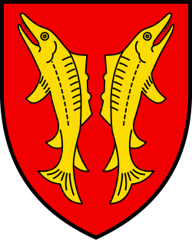
Coat of arms of Orbe
Gules two barbels addorsed or. On a red field, two yellow fish, barbels, are set back to back.[12]
Founding of Orbe
Orbe stands at a crossroads, between the routes from the Jura to the Alps and from the Rhine to the Rhône. In Roman times a large villa stood on the Boscéaz plateau. In the early Middle Ages two settlements controlled the river crossing: "villa Tavellis", with the church of Saint-Germain, and "villa Tabernis", with the church of Saint-Martin. In 888 Orbe was a royal estate and a residence of the Burgundian rulers, with a mint. After 1032 it passed to Count William II of Burgundy, then partly to the Montfaucon-Montbéliard family, who fortified the town.
History of Orbe
Roman period. Large villa of Boscéaz, whose mosaics form one of the most important Roman ensembles north of the Alps.[4][7]
around 280. First mention, in the form "Urba".
early Middle Ages. Two settlements, "villa Tavellis" (church of Saint-Germain) and "villa Tabernis" (church of Saint-Martin), control the river crossing.
888. Orbe is a royal estate and a residence of the Burgundian rulers, with a mint.
1076. The place passes to Count William II of Burgundy.
around 1168. Part of Orbe passes to the Montfaucon-Montbéliard family.
1233. Construction of the round keep.[5]
around 1235. Amadeus III of Montfaucon-Montbéliard fortifies the town.
1416. The town has 266 hearths (households).
1475. First capture of the town by the Confederates during the Burgundian Wars.[5]
1476. Charles the Bold receives Swiss envoys in Orbe.
1484-1798. Orbe forms a common bailiwick with Échallens, ruled by Bern and Fribourg.
1511. Birth in Orbe of the reformer Pierre Viret.[9]
1531. Guillaume Farel arrives. On 6 May (date uncertain), Pierre Viret preaches for the first time in his home town.
1554. The town adopts the Reformation.
1798. The town has 1'662 inhabitants.
1848. A brewery is founded.
1871. The mills are bought.
1894. Opening of the Orbe-Chavornay railway, presented as the first fully electrified line in Switzerland.[8]
1901. The Peter chocolate factory opens, raising the population by more than 1'000 in ten years.
1907. A strike requires army intervention.
1989. The opening of the A1 and A9 motorways speeds up development.
2002. Opening in Orbe of the first production centre entirely dedicated to Nespresso capsules.[10]
Population of Orbe
Sources and references: [3]
| 1416 | 266 hearths (households) |
| 1798 | 1'662 |
| 1850 | 1'923 |
| 1900 | 2'080 |
| 1950 | 3'565 |
| 1980 | 3'985 |
| 2000 | 5'139 |
| 2025 | 8'008 |
Families of Orbe
Chalon. Louis de Chalon, Prince of Orange, received the lordship of Orbe in 1410. After the Confederates took the town in 1475, Hugues de Chalon recovered it. The Chalon lost their Vaud fiefs in 1476, after the defeat of Charles the Bold.[1][14]
Citizen families before 1800. Forty-six families. Twelve have no date of registration, among them the Viret. The Combe family, registered in 1380, is the oldest dated one. The other entries run from 1577 to 1797. Of these, seventeen families came from other Vaud communes, six from other cantons, four from France and two from Germany.[13]
In the 19th century. In 1801 the Dubois of Buttes NE and the Ortlieb from France were admitted, in 1802 the Braun from Germany and the Guignard of Le Lieu VD. They were followed by the de Miéville of Rossens VD (1804), the Mébold from Germany (1805) and the Davall from Great Britain (1820). After the Dufour of Goumoens-la-Ville VD (1858) came the Mouthe from France (1862), then three German families, the Hausmann (1863), the Merz (1869) and the Fertig (1884).[13]
Show more families (1)
From 1901 to 1962. Eighty-five entries. The Alvazzi family, from Italy, opens the series in 1907. Most followed in 1956 (36 families) and 1957 (17). Bernese origins dominate (36), ahead of Fribourg (15), Italy and Neuchâtel (7 each). In 1962 the last to be registered were the Blattner of Küttigen AG, the Brunner of Oberried am Brienzersee BE, the Gasser of Rüschegg BE and the Schranz of Frutigen BE, along with the Dulac, from France, already registered in 1959.[13]
Notable people of Orbe
Girard Borrellier. A hermit. Thanks to his work, the Saint-Eloi bridge was built in stone in 1424.[1]
Jeanne de Montbéliard and Colette de Corbie. Jeanne de Montbéliard was behind the founding of the convent of Saint Clare in Orbe in 1427. Its direction was entrusted to Saint Colette of Corbie.[1]
Pierre Viret (Orbe 1511 - 1571). The son of the tailor Guillaume Viret, he went to study in Paris, at the Collège de Montaigu, in 1527. Back in Orbe in 1531, he settled in Lausanne in 1536 and became the main architect of the Reformation there. He ended his life in Béarn.[9]
Henri Perregaux. He built the Grand-Pont of Orbe between 1826 and 1830.[1]
Julien Rod. He acquired the Orbe mill in 1871. The firm Moulins Rod SA remained in business until 1999.[1]
Jacques Spalinger. A photographer, he captured the March 1907 strike at the Peter chocolate factory.[1]
Economy of Orbe, past and present
Nespresso capsules. Opened in 2002, the Orbe factory is the first production centre fully devoted to Nespresso capsules. It makes capsules for both consumers and businesses. According to Nespresso it employs more than 350 people, and the group has invested about 215 million francs there.[10]
The Orbe-Chavornay line. Opened in 1894, the 3.965 km line was the first electrified railway in the country. In 2023 nearly 320'000 passengers used it. Replaced by buses during its rebuilding, it is due to reopen in early 2027, run by the SBB. The new line is also meant to carry freight, starting with Nestlé, which has a major site in Orbe.[8]
Historic sites in Orbe
Roman mosaics of Boscéaz. The mosaics of the Gallo-Roman villa of Orbe-Boscéaz, protected in pavilions, form one of the most important Roman mosaic ensembles north of the Alps.[4][7]
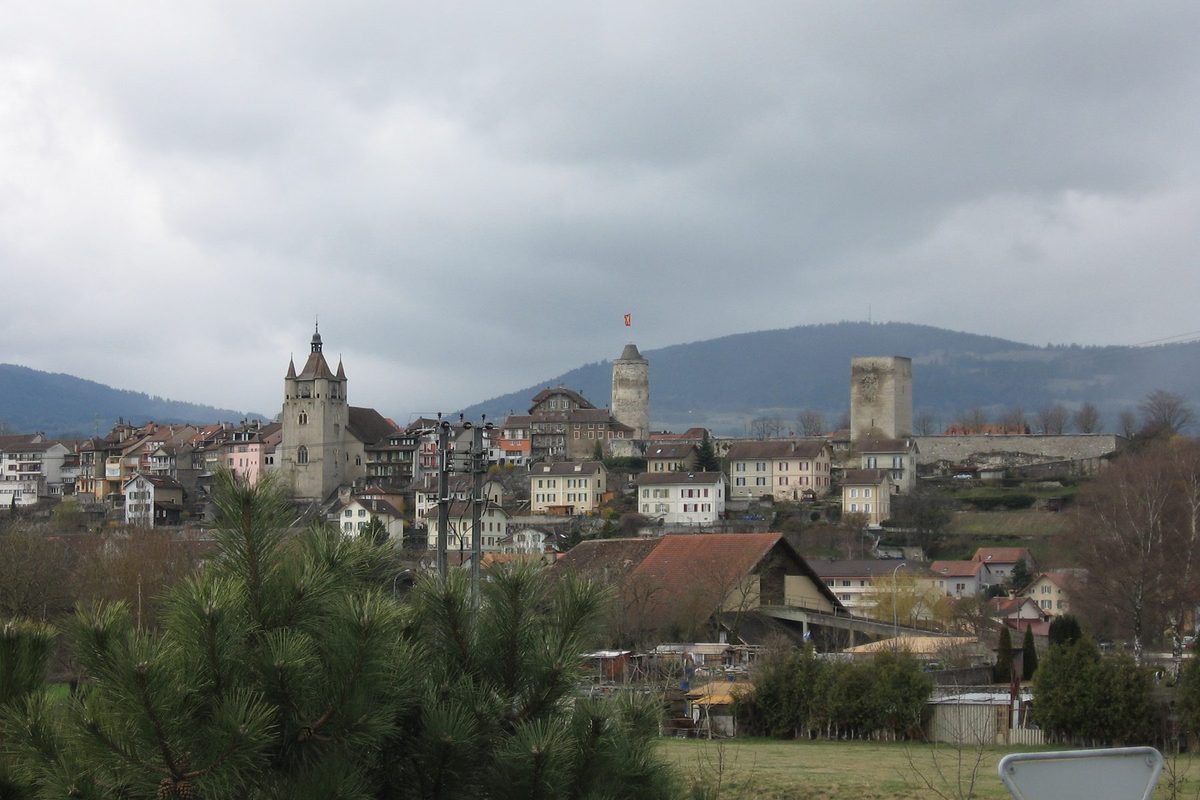
Old town. The old town, perched above the Orbe, keeps traces of its medieval past and of its role as capital of the common bailiwick of Orbe-Échallens.
Orbe-Chavornay railway. Opened in 1894, this short line is presented as the first fully electrified railway line in Switzerland.[8]
Remains in Orbe
Gallo-Roman villa of Boscéaz. Large Roman estate whose mosaics are among the most remarkable north of the Alps.[4][7]
Round keep. Round tower built in 1233, the main surviving part of the castle fortified by the Montfaucon-Montbéliard family around 1235.[5]
Protected heritage in Orbe
Cultural property of national significance (A objects in the PCP inventory)[11]
- Boscéaz, villa gallo-romaine avec mosaïques
- Eglise réformée Notre-Dame
- Hôtel de Ville
- Orbe, ruines du château avec deux tours et son esplanade - Moyen Age
Cultural property of regional significance (B objects)[11]
- Ancien hôpital
- Archives communales
- Fontaine du Banneret
- Hôtel des Deux-Poissons (ancien couvent Sainte-Claire)
- Le Prieuré, ancienne grange des dîmes et fontaine, maison d'habitation et laboratoire, maison d'habitation et garage
- Maison bourgeoise
- Maison Lebel
- Manoir de Mont-Choisi avec rural
- Musée d'Orbe
- Pont du Moulinet
- Pont Pichard
Sources
- Dictionnaire historique de la Suisse, « Orbe (commune) »
- Dictionnaire historique de la Suisse, « Vaud »
- Statistique Vaud, « Population résidante permanente au 31 décembre 2025 »
- Inventaire fédéral des biens culturels (PBC), fiche 06366 « Boscéaz, villa gallo-romaine avec mosaïques », texte de la Société d'histoire de l'art en Suisse
- Inventaire fédéral des biens culturels (PBC), fiche 06370 « Ruines du château avec deux tours et son esplanade », texte de la Société d'histoire de l'art en Suisse
- Office fédéral de la protection de la population, Inventaire PBC, liste du canton de Vaud (état au 1.1.2026)
- Swissinfo, « Mosaïques romaines : un trésor archéologique au milieu des champs », 22 août 2018
- Swissinfo, « Orbe-Chavornay : les adieux à une ligne historique », 13 décembre 2025
- Le Temps, « Pierre Viret, réformateur oublié »
- Nespresso, « Corporate Production Centres Factsheet »
- Federal Office for Civil Protection (FOCP), Swiss Inventory of Cultural Property (PCP), list for the canton of Vaud (as of 1.1.2026)
- IPI, Swissreg, emblems database: coat of arms of Orbe (no. 101314)
- Register of Swiss Surnames, 3rd edition (1989), search Commune "Orbe", Canton VD
- Historical Dictionary of Switzerland (HDS), article "Orbe (lordship, district)" (Patrick-R. Monbaron)
Published by Sébastien Jörg ·
Other villages near Orbe
Missing information, or do you have a source? Suggest a correction or addition. Every submission is checked before it's published.
Suggest a change