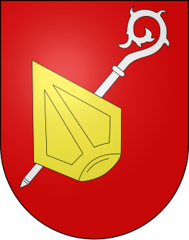
Mund
Origin of the name Mund
The oldest known mention is « Munt », in 1259. Until around 1800 the village was also called Wyler, a name last attested in 1850. The name is said to derive from Franco-Provençal « mont » or « munt », from Latin « mons » (mountain), but this origin is not certain.
Founding of Mund
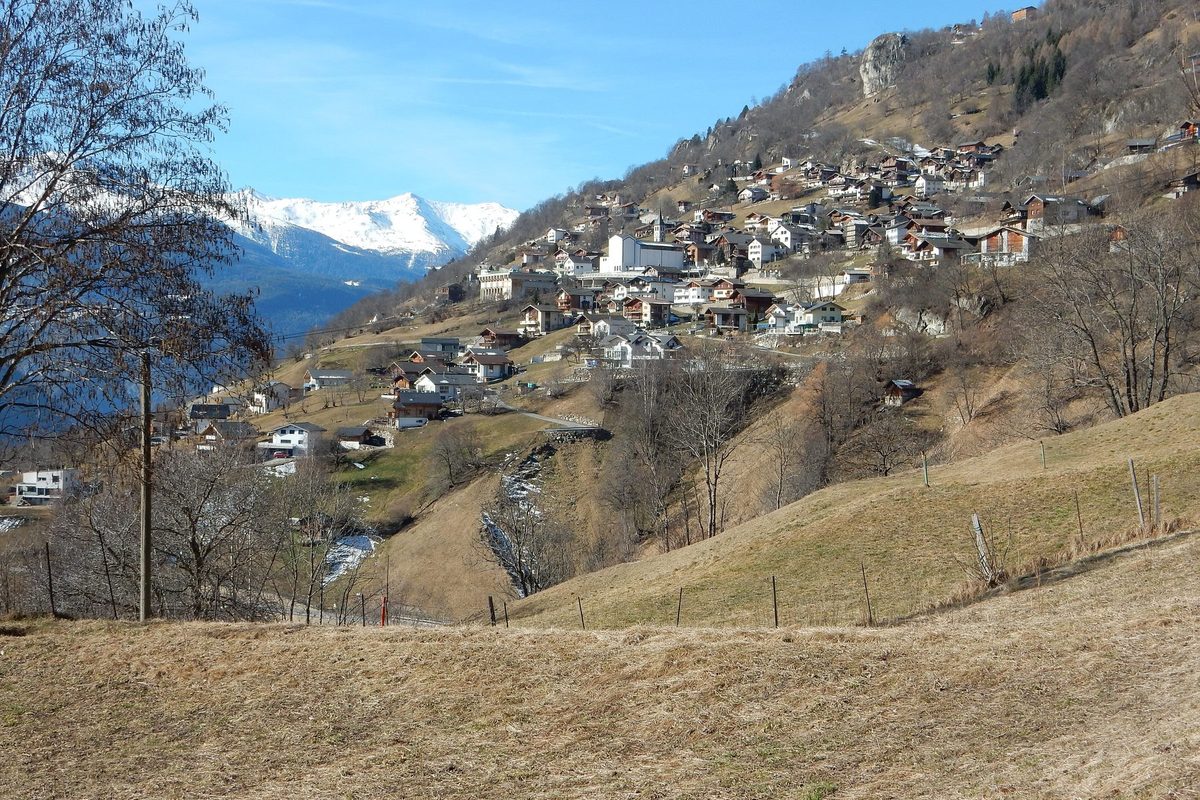
Mund took shape on the northern slope of the Rhone valley at an altitude of 1200 m, around a main village and hamlets such as Bodmen and Ferchen. In the 13th and 14th centuries the seigneurial rights belonged to the von Mund, von Urnavas and von Raron families. The community was born from the buying out of these rights: Mund, Finnen, Bodmen and « auf dem Biel » bought from Wilhelm von Raron the seigneurial rights, dues and labour services, and united as the « Freigericht Finnen » (free court of Finnen). It then adopted a forest regulation and communal regulations (Bauernzunft), was led by two procurators and formed one of the « Gumper » of the dizain of Brig. Ecclesiastically, Mund broke away from the parish of Naters when a rectorate was created. Long reachable only by a mule track, the village at the start of the 21st century relied on farming dominated by sheep rearing, mainly as a side occupation.[1]
History of Mund
1259. First mention as « Munt ».[1]
13th-14th centuries. The seigneurial rights are held by the von Mund, von Urnavas and von Raron families.[1]
1348. Creation of a rectorate; Mund separates from the parish of Naters.[1]
1395. Construction of a stone storehouse tower, the oldest surviving building.[1]
1427. Mund, Finnen, Bodmen and « auf dem Biel » buy the seigneurial rights from Wilhelm von Raron and form the « Freigericht Finnen ».[1]
1437. Construction of the wooden tithe barn (Zehntenstadel).[1]
1521. Forest regulation for the Munderberg.[1]
1538. Communal regulations (Bauernzunft), supplemented in 1591.[1]
around 1725. Construction of the church of St. James the Greater.[1]
1727. The rectorate is probably raised to a parish.[1]
1798. Until this date Mund forms one of the « Gumper » of the dizain of Brig.[1]
1799. A fire set by the French destroys the eastern part of the village.[1]
1854. Finnen ceases to be part of Mund.[1]
1863-1894. 135 inhabitants emigrate to North or South America.[1]
1887. Construction of the Gstein pilgrimage chapel, demolished in 1983-1984 and replaced by a grotto chapel.[1]
1951. Opening of a cableway to Gamsen, in service until 1984.[1]
1962-1964. Construction of a new church, remodelled in 2005-2007.[1]
1978. Opening of the road from Naters.[1]
1979. Foundation of the saffron guild, which revives cultivation.[1][2]
2007. Opening of a saffron museum in the tithe barn.[1]
2013. Mund is incorporated into the municipality of Naters.[1]
Population of Mund
Sources and references: [1]
| 1811 | 294 inhabitants |
| 1850 | 442 inhabitants |
| 1900 | 546 inhabitants |
| 1950 | 646 inhabitants |
| 2000 | 574 inhabitants |
Historic sites in Mund
Tithe barn and saffron museum. Wooden barn of 1437, one of the oldest buildings in the village. Since 2007 it has housed a saffron museum.[1]
Church of St. James the Greater. A first church was built around 1725. It was replaced in 1962-1964 by a new building, remodelled in 2005-2007.[1]
Saffron fields. The saffron guild, founded in 1979, has successfully revived this crop. Mund is the only place in Switzerland where saffron is traditionally grown. It is said to have been introduced in the 15th century by mercenaries returning from foreign service, which is not confirmed.[1][2]
Gstein grotto chapel. It replaces the Gstein pilgrimage chapel, built in 1887 and demolished in 1983-1984.[1]
Irrigation channels (Suonen). The meadows are irrigated by channels used since the Middle Ages.[1]
Remains in Mund
Storehouse tower of 1395. Stone storehouse tower built in 1395, together with the tithe barn of 1437 the oldest surviving building in Mund.[1]
Legends of Mund
The legendary battle of 1212. A coat of arms bearing the date 1212 is said to commemorate a legendary battle fought above Mund. This link is not confirmed.
Sources
- Historisches Lexikon der Schweiz, « Mund » (Philipp Kalbermatter, version de 2008, version allemande)
- Agroscope (Confédération suisse, DEFR), communiqué « Frischer Wind im Schweizer Safran-Anbau » (26.02.2015)
- geo.admin.ch, recherche de lieux (coordonnées)
Other villages near Mund
Missing information, or do you have a source? Suggest a correction or addition. Every submission is checked before it's published.
Suggest a change