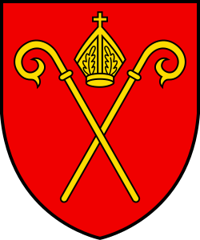
Naters
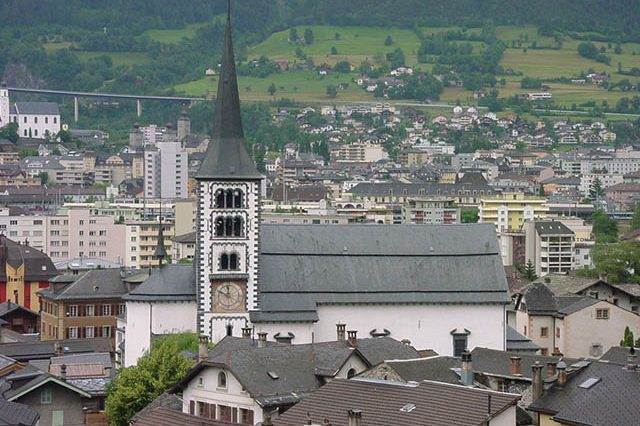
Origin of the name Naters
Naters first appears in 1018 as « Nares », when the St. Maurice church is mentioned. The meaning of the name is unknown.[1]
Founding of Naters
Naters grew up on the right bank of the Rhone, on the alluvial fan of the Kelchbach, and its territory covers the whole Natischer Berg between the Kelchbach and the Massa, from the base up to the ridges. In the early High Middle Ages the place belonged to the abbey of Saint-Maurice. The « curtis » of Naters then changed hands several times, three times after the imperial gift alone, before passing for good to the bishop of Sion. Naters thus became the episcopal administrative centre of the dizain (Zenden) of Brig: the vidomne lived in the Ornavasso tower, the major in the Auf der Flüe castle. The St. Maurice church headed a large parish, probably formed before the year 1000, which covered the whole dizain except Eggerberg and the Gondo-Zwischbergen area. Hegdorn, Geimen, Mehlbaum, Rischinen and Blatten were autonomous communities in the Middle Ages. Naters and Rischinen were two of the six and a half « Gumper » of the dizain. In the 19th century whole families emigrated in waves to Argentina (San Jerónimo Norte).[1]
History of Naters
before the year 1000. Probable formation of the large parish of Naters.[1]
1018. First mention of the St. Maurice church and of the name « Nares ».[1]
1079. Emperor Henry IV gives the « curtis » of Naters to the bishop of Sion.[1]
1148. The bishopric of Sion obtains definitive possession through an arbitration by the archbishop of Tarentaise.[1]
late 12th century. Probable construction of the Auf der Flüe castle (today Supersaxo).[1]
1214. The office of major passes to the Manegoldi family.[1]
around 1260. Construction of the Ornavasso tower, residence of the vidomne.[1]
1345. The vidomnat passes to the Chevron-Villette family.[1]
1446. Bishop Wilhelm III of Raron has to grant the « articles of Naters » at the Auf der Flüe castle, limiting his temporal power. They remain in force for only five years.[1]
1514. Ulrich Ruffiner builds the ossuary.[1]
1518. The dizain court is moved to Brig.[1]
1617. After a plague epidemic, Naters and Rischinen unite and adopt common statutes, while keeping separate administrations until 1852.[1]
1659-1664. Balthasar and Peter Bodmer, from Alagna and Riva (Prismell, Valsesia), rebuild the church, except the bell tower.[1]
1799. During the French invasion most hamlets of the Natischer Berg are burned.[1]
1857. The Furka road is built along the southern edge of the village.[1]
1873-1876. First Rhone embankments (then 1899-1900), followed by the draining of the Natischer Grund.[1]
1898-1906. The building of the Simplon tunnel (enlarged in 1912-1921) boosts the economy. The Feld quarter, made of huts, houses the workers, mostly Italian.[1]
1957. A new Furka road is built further south.[1]
1978-1980. Private investors build the Tschuggen holiday village between Blatten and Belalp.[1]
2013. Birgisch and Mund are joined to the municipality of Naters.[1]
Population of Naters
Sources and references: [1][2]
| 1798 | 700 inhabitants approximately |
| 1850 | 763 inhabitants |
| 1900 | 3'953 inhabitants |
| 1950 | 3'243 inhabitants |
| 2000 | 7'515 inhabitants |
| 2025 | 10'788 inhabitants |
Historic sites in Naters
St. Maurice church. Recorded from 1018, centre of a parish that covered almost the whole dizain of Brig. The Romanesque bell tower probably dates from the 12th century. The rest of the building was rebuilt in 1659-1664 by Balthasar and Peter Bodmer.[1]
Ossuary. Built in 1514 by Ulrich Ruffiner, it holds more than 30'000 stacked skulls.[1]
Auf der Flüe castle (Supersaxo). Probably built at the end of the 12th century, residence of the major. In the 15th and 16th centuries it was at times an episcopal residence. Here in 1446 Bishop Wilhelm III of Raron had to grant the « articles of Naters ».[1]
Ornavasso tower. Built around 1260 by the lords of Augusta, then passed by inheritance to the lords von Urnavas, it was the residence of the vidomne.[1]
Burgher houses of the old village. The Megetschen, Lergien and Michel Supersaxo houses bear witness to the wealth of the burgher families.[1]
Blatten and Belalp. Blatten was an autonomous community in the Middle Ages. The Belalp ski area extends from 2000 to 3100 m.[1]
Legends of Naters
Saint Kummernis. Kummernis, a pious girl from Naters, refused to marry the local lord, a brutal man who never went to church. Promised to him by force, she spent a fortnight in prayer. On the wedding day the lord lifted her veil and found a long red beard. When she declared that Christ alone was her bridegroom, he had her nailed to a cross.[4]
Sources
- Historisches Lexikon der Schweiz, « Naters » (Anton Riva, version de 2008, version allemande)
- Office fédéral de la statistique (OFS), STATPOP, chiffres provisoires au 31.12.2025, via citypopulation.de
- geo.admin.ch, recherche de lieux (coordonnées)
- Solandieu, Légendes valaisannes, 1919, « Sainte Kummernis, vierge et martyre »
Localities of the municipality with a page
Other villages near Naters
Missing information, or do you have a source? Suggest a correction or addition. Every submission is checked before it's published.
Suggest a change