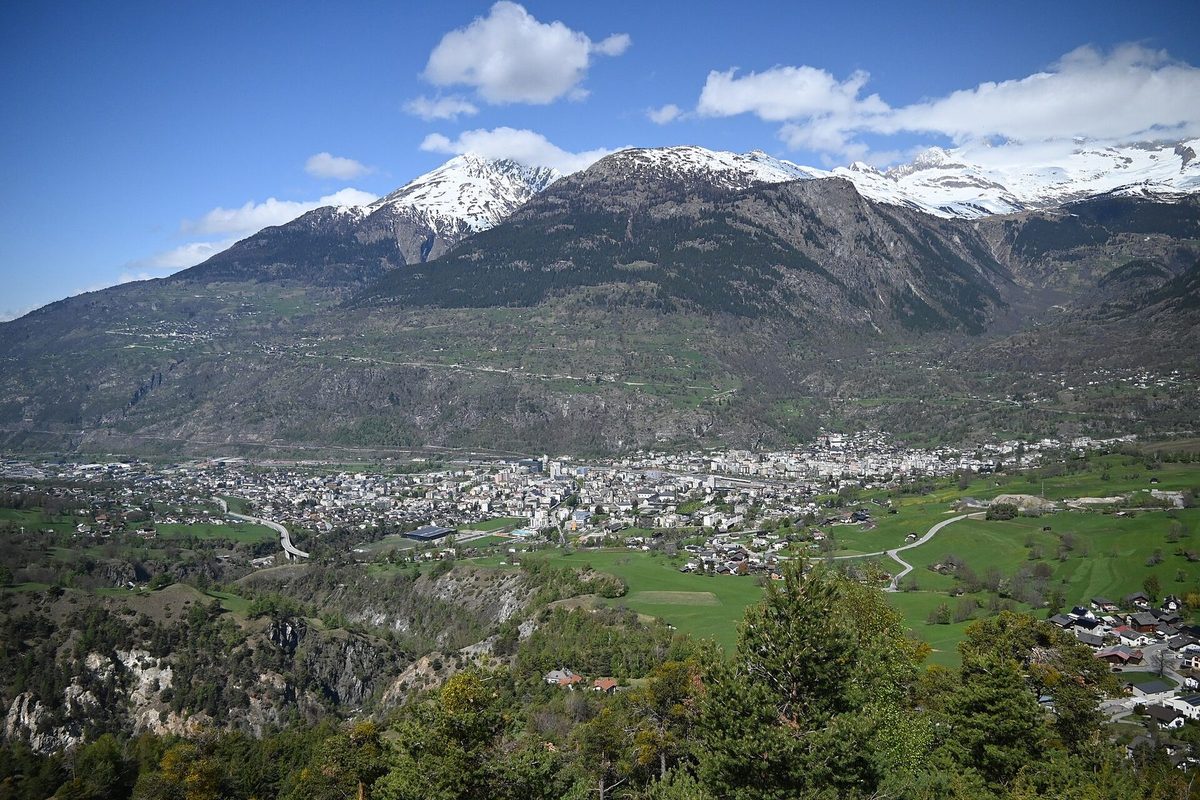
Brig-Glis
Origin of the name Brig-Glis
Brig appears in 1215 as « Briga » (French Brigue, Italian Briga), Glis in 1230 as « Glisa ». Brigerbad is recorded in 1297 as « Baden, zum Bad ». In French it was formerly called Brigue-les-Bains. The origin of the names Brig and Glis has not yet been explained.[3][4]
Founding of Brig-Glis
The small town of Brig, at the foot of the Simplon Pass, was probably founded by the bishop of Sion. A 12th-century tower with a ring wall, then a 13th-century tower (demolished in 1970), are likely at the origin of the settlement. The « de Briga » family, recorded from 1215, was probably a branch of the Mangoldi attested in Naters in 1181. From the mid-13th century a sust served as warehouse, transshipment point and toll station for Simplon traffic. Glis, which also included Holz and Gamsen, formed a third of the « Gumper » (compra) of Brig. It had its own religious life from the 12th-13th centuries, while belonging to the parish of Naters until 1642. Brigerbad, on the plain between the Rhone and the northern valley slope near Visp, is known for its thermal springs. The three municipalities merged in 1972: Glis contributed reserves of building land and a large industrial company, the Swiss Explosives Company, founded in Gamsen in 1894. Today the chancellery and most municipal departments are housed in the Stockalper castle, while the building office and the school administration are in Glis.[2][3][4]
History of Brig-Glis
Bronze Age. First traces of human presence in Brig: a bracelet and a dagger. From the La Tène period come two skeletons, two Valais bracelets and two fibulae.[2]
2nd century. An enamelled bronze fibula of this period was found in Gamsen, site of the Gallo-Roman village of Brig-Glis/Waldmatte.
around 500. An early Christian single-nave church with baptistery and annexes is built in Glis.[3]
1215. First mention of Brig as « Briga » and of the « de Briga » family.[2]
1230. First mention of Glis as « Glisa ».[3]
13th century. From the middle of the century a sust serves as warehouse and toll station for Simplon traffic. The rights belong to the bishop of Sion until the 16th century.[2]
1297. First mention of Brigerbad as « Baden ».[4]
1304. Foundation of the St. Anthony hospital in Brig, which exists until 1908.[2]
14th century. At the beginning of the century a wall blocks the Rhone valley at Gamsen, probably against Savoyard raids.[3]
1471. Anton Walker (re)discovers the thermal springs of Brigerbad, which reach their heyday in the 16th century.[4]
1518. Brig becomes the chief town of the dizain and seat of its court.[2]
1642. Glis becomes an independent parish, separated from Naters. Brig, Brigerbad, Ried-Brig, Termen, Gamsen and Eggerberg belong to it.[3]
1658-1678. Kaspar Stockalper vom Thurm has the Stockalper castle built, with three towers, an arcaded courtyard and a park.[2]
1662. Opening of the Jesuit college (building 1663-1673, church 1673-1687).[2]
1799. French troops plunder Brig and burn the archives.[2]
1801-1805. Construction of the new Simplon road.[2]
1906. Opening of the Simplon railway tunnel (second tunnel in 1921). First crossing of the Simplon by car from Brig.[2]
1972. Merger of Brig, Glis and Brigerbad into a single municipality, Brig-Glis.[3][4]
1991. A research institute on the history of the Alpine region and an institute of multilingualism move into the Stockalper castle.[2]
1993. Another devastating flood of the Saltina, after that of 1920, when the Rhone also burst its banks.[2]
Population of Brig-Glis
Sources and references: [2][5]
| 1798 | 468 inhabitants (Brig only) |
| 1850 | 721 inhabitants (Brig only) |
| 1900 | 2'182 inhabitants (Brig only) |
| 1950 | 3'854 inhabitants (Brig only) |
| 1970 | 5'191 inhabitants (Brig only) |
| 1980 | 9'608 inhabitants (Brig-Glis) |
| 1990 | 10'602 inhabitants |
| 2000 | 11'590 inhabitants |
| 2025 | 14'192 inhabitants |
Historic sites in Brig-Glis
Stockalper castle. Built from 1658 to 1678 for Kaspar Stockalper vom Thurm, with three towers, an arcaded courtyard and a park, it shapes the skyline of Brig. It houses the chancellery and most municipal departments and, since 1991, a research institute on the history of the Alpine region and an institute of multilingualism. Kaspar Stockalper also had the small Matteni castle built outside the town in 1677 for Georg Christoph Mannhaft.[2]
Church of Our Lady of Glis (Glisacker). Pilgrimage centre of Upper Valais since the 14th century. The present church combines Renaissance and late Gothic: Peter and Christian Bodmer, from Prismell, completed in the mid-17th century the plans drawn up by Ulrich Ruffiner in 1519.[3]
Jesuit college and church. The Jesuits ran the college from 1662 to 1773 and from 1814 to 1847 (building 1663-1673, church 1673-1687), the Piarists from 1773 to 1814. Since 1848 the grammar school has been cantonal.[2]
Ursuline convent. Founded in 1661; its church dates from 1732. A teacher training college for women opened there in 1853.[2]
Patrician houses and old residences of Brig. Tower of Kaspar Metzelten (1526), old Stockalper house (around 1533), Wegener houses (17th century), Mannhaft house (1709) and Fernanda von Stockalper house (1727).[2]
Chapels of Brig. St. Sebastian chapel built in 1636-1637 by the Burgerschaft (restored in 1972-1973); St. Anthony chapel with a vault keystone dated 1494.[2]
Brigerbad baths. Thermal springs (re)discovered in 1471, flourishing in the 16th century under Peter Owlig, in decline from the 17th century, revived in 1934-1935 and developed on a large scale from 1956-1960. A chapel of Brigerbad dated 1721 is mentioned.[4]
Remains in Brig-Glis
Early Christian church of Glis. The 1984 excavations in and around the church uncovered a single-nave church of around 500 with baptistery and annexes, as well as parts of four other churches.[3]
Gamsen excavations. Since 1992, excavations on the motorway route at Gamsen have yielded important traces of Bronze Age and Iron Age settlement. Gamsen was also the site of the Gallo-Roman village of Brig-Glis/Waldmatte, which produced an enamelled bronze fibula of the 2nd century.[3]
Gamsen wall (Landmauer). Wall built across the Rhone valley in the early 14th century, probably against Savoyard raids; parts of it survive.[3]
Tower of the lords of Baden and « Bischofsstadel » in Brigerbad. The tower of the Junker von Baden (13th century ?) and the so-called bishop's barn (15th century ?) perhaps date back to the Middle Ages (uncertain dating).[4]
Sources
- Historisches Lexikon der Schweiz, « Brig-Glis » (version de 1998, version allemande)
- Historisches Lexikon der Schweiz, « Brig (Stadt) » (Louis Carlen, version de 1998, version allemande)
- Historisches Lexikon der Schweiz, « Glis » (Bernard Truffer, version de 2004, version allemande)
- Historisches Lexikon der Schweiz, « Brigerbad » (Philipp Kalbermatter, version de 1998, version allemande)
- Office fédéral de la statistique (OFS), STATPOP, chiffres provisoires au 31.12.2025, via citypopulation.de
- geo.admin.ch, recherche de lieux (coordonnées)
Localities of the municipality with a page
Other villages near Brig-Glis
Missing information, or do you have a source? Suggest a correction or addition. Every submission is checked before it's published.
Suggest a change