Pierre Percée
Origin of the name Pierre Percée
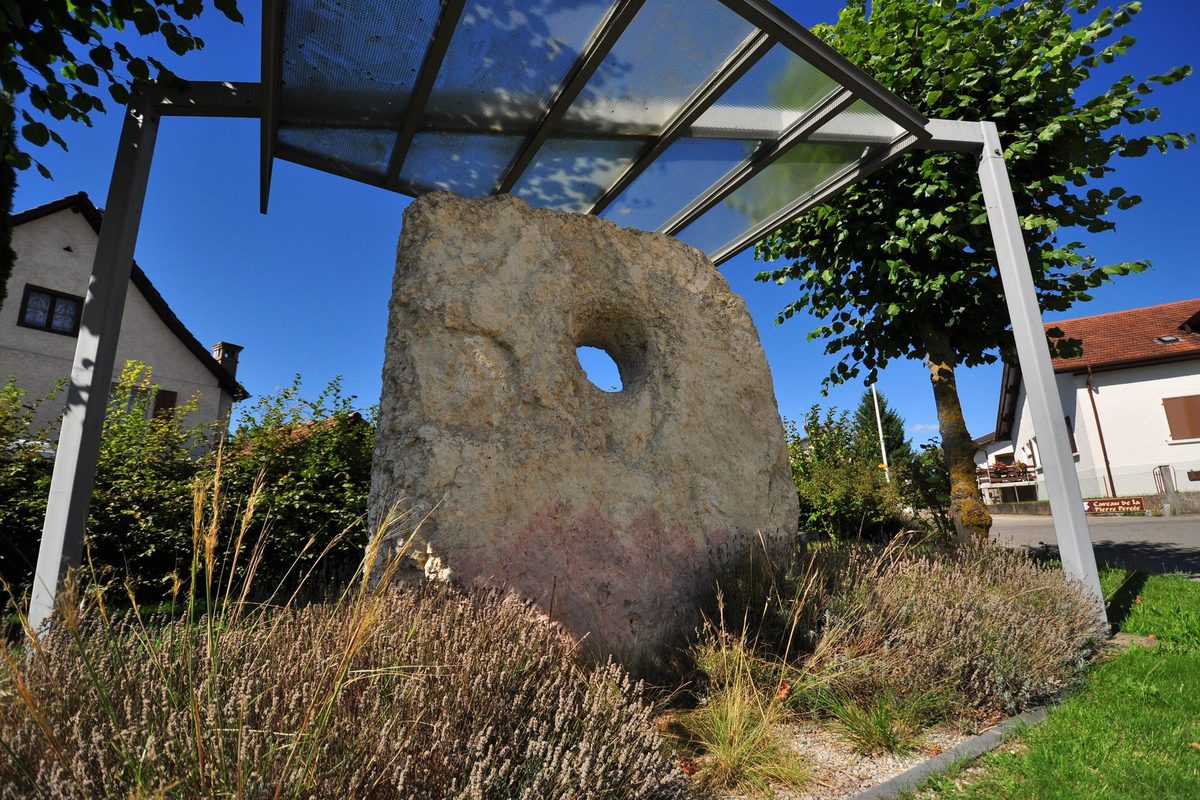
The name (« pierced stone ») describes the monument: a limestone slab pierced by an opening in its upper third. « Pierre-Percée » is also used. No dated first mention of the name is known. The archivist Maldoner described the stone in 1760.[3]
Founding of Pierre Percée
Around 3000 BC Neolithic people erected a dolmen in the Ajoie plain, at the foot of the northern slope of the Jura, in what is now the municipality of Courgenay. This type of megalith is found from Schaffhausen to Besançon. Only the front survives, a porthole slab of local limestone that has always stood upright. Studied since the 18th century, it was listed as a historic monument in 1908 and is in category A (national significance) of the Swiss inventory of cultural property.[1][2][3][5]
History of Pierre Percée
Around 3000 BC. Erection of the dolmen, whose front slab survives.[1][2]
1760. On 13 June, the archivist Maldoner writes a description of the Pierre Percée.[3]
18th century. The stone is seen as a monument raised in 58 BC by the Germanic leader Ariovistus after his victory over the Gauls.[1]
1803-1804. Request for information on the Pierre Percée (19 December 1803), visit to the monument (24 January 1804) and report on excavations around it (4 February 1804).[3]
1849. On 13 April, plan to build a fountain near the Pierre Percée.[3]
1861. On 24 November, the Courgenay municipal assembly debates building a fountain at the Pierre Percée.[3]
1904. Plan for a fence around the stone.[3]
1908. On 7 March, the Pierre Percée is listed as a historic monument. A grant of 300 francs is awarded for a protective railing.[3]
Historic sites in Pierre Percée
Pierre Percée. Neolithic monument in the Ajoie plain, listed in category A (national significance) of the Swiss inventory of cultural property as « Pierre-Percée, dolmen néolithique ». The neighbouring district of Courgenay bears its name.[5]
Remains in Pierre Percée
Porthole slab. The only remnant of the dolmen: a local limestone slab 2.60 m high, 2.57 m wide and 50 cm thick at the base, pierced in its upper third by an opening of about 41 by 35 cm.[1]
Legends of Pierre Percée
Ariovistus's monument. In the 18th century, the Pierre Percée was seen as a monument raised in 58 BC by the Germanic leader Ariovistus after his victory over the Gauls.[1]
The healing stone. Until recent times, the Pierre Percée was reputed to cure colic in people who passed through its hole.[1]
Sources
- Dictionnaire historique de la Suisse, « Pierre Percée » (François Schifferdecker), version du 20.07.1998
- Dictionnaire historique de la Suisse, « Courgenay » (Dominique Prongué), version du 18.05.2020
- Denis Moine, Chronologie jurassienne, « Courgenay »
- geo.admin.ch (swisstopo), recherche de lieux « Pierre-Percée »
- Office fédéral de la protection de la population (OFPP), Inventaire PBC, liste cantonale du canton du Jura (état au 1.1.2026)
Other villages near Pierre Percée
Missing information, or do you have a source? Suggest a correction or addition. Every submission is checked before it's published.
Suggest a change