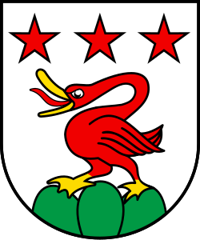
Courgenay
Origin of the name Courgenay
The village first appears in 1139 as « Corgennart ». What the name means is not yet known.[1]
Founding of Courgenay
Nobody knows who founded Courgenay or when, but the site was inhabited long before the first records: the Pierre Percée, the front slab of a dolmen raised around 3000 BC, and later a Roman villa at La Condemène show it. In the Middle Ages two religious houses held property here: the chapter of Saint-Ursanne, which owned a plot in 1139, and the abbey of Lucelle, with extensive estates including a grange at Courtemautruy. First linked to the county of Ferrette, Courgenay joined the advocacy of Ajoie, in the prince-bishopric of Basel, at the end of the 13th century. The municipality includes the hamlet of Courtemautruy. Two other settlements, Courtemblin and Courtari, were abandoned before or during the Thirty Years' War.[1][2]
History of Courgenay
Around 3000 BC. Erection of a dolmen, of which the Pierre Percée survives.[2]
Roman period. A Roman villa is built at the place called La Condemène. It will be partly explored in the 19th century.[1]
1139. First mention: « Corgennart ». The chapter of Saint-Ursanne owns a piece of land there.[1]
1254. Lucelle Abbey, which owns extensive property in Courgenay, obtains the right of patronage over the church.[1]
Late 13th century. Courgenay, until then linked to the County of Ferrette, passes to the advocacy of Ajoie, incorporated into the Prince-Bishopric of Basel.[1]
1314. Ruling in the dispute with Alle over the use of the Montagne d'Alle. The final judgement is only given in 1865.[1]
17th century. The settlements of Courtemblin and Courtari are abandoned before or during the Thirty Years' War.[1]
1730-1740. Courgenay is at the heart of the Pétignat revolt. One of the leaders of the rebel peasants, Pierre Péquignat, comes from the village.[1]
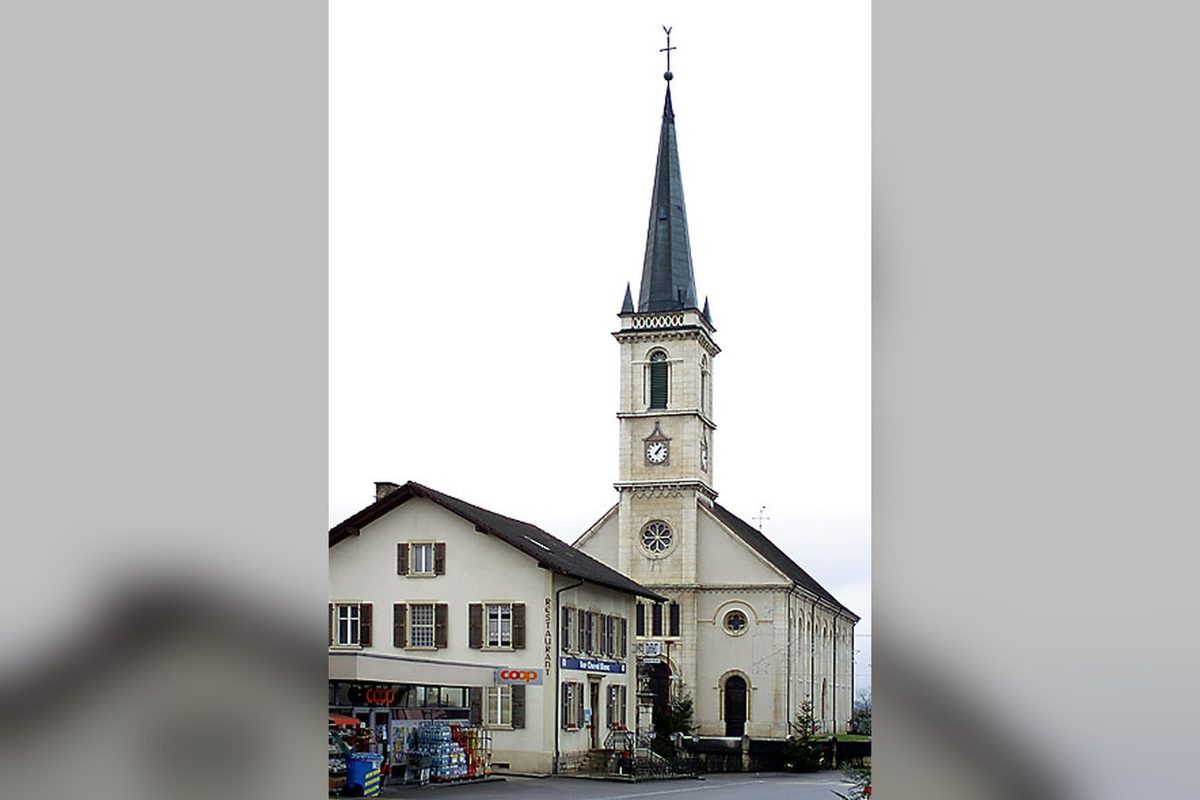
1761. Rebuilding of the church of Notre-Dame-de-l'Assomption.[1]
1779. The parish passes from the diocese of Besançon to that of Basel.[1]
1783. Construction of the chapel of Saint-Éloi at Courtemautruy.[1]
1792. Courgenay ceases to belong to the great mayoralty of Alle, of which it had been part under the Ancien Régime.[1]
1793-1814. Courgenay is part of the French departments of Mont-Terrible and Haut-Rhin.[1]
1815-1978. Courgenay belongs to the Bernese bailiwick, then district, of Porrentruy.[1]
1836. Adoption of the status of mixed municipality.[1]
1854-1856. The church is rebuilt again.[1]
1865. Final judgement in the Montagne d'Alle dispute.[1]
1877. Arrival of the railway, which encourages industrialisation (watchmaking, knitwear, cigars).[1]
1914-1918. Gilberte Montavon, who serves in her parents' restaurant, becomes the adored figure of the troops stationed in Ajoie. The song « La petite Gilberte de Courgenay » by Hanns In der Gand (1917) makes her famous throughout Switzerland.[1][3]
1941. Release of the film « Gilberte de Courgenay ».[3]
1979. An association is founded to buy back the restaurant de la Gare. It becomes a foundation in 1998.[3]
1983. Opening of an intermunicipal industrial zone (precision engineering, microtechnology).[1]
1985. Land consolidation.[1]
Population of Courgenay
Sources and references: [1]
| 1770 | 739 |
| 1818 | 823 |
| 1850 | 1'098 |
| 1900 | 1'568 |
| 1950 | 1'511 |
| 1990 | 2'088 |
| 2000 | 2'062 |
| 2010 | 2'154 |
| 2025 | 2'463 |
Historic sites in Courgenay
Church of Notre-Dame-de-l'Assomption. Parish church whose right of patronage was held by Lucelle Abbey from 1254. Rebuilt in 1761 and again in 1854-1856.[1]
Hôtel de la Gare. Restaurant run by Gilberte Montavon's parents, where the young woman served the soldiers during the First World War. An association set up in 1979 to buy it back became a foundation in 1998 and renovated the building.[3]
Courtemautruy. Hamlet of the municipality, where Lucelle Abbey owned a grange. Chapel of Saint-Éloi built in 1783.[1]
Montagne d'Alle. Forest disputed between Courgenay and Alle from 1314 until the final judgement of 1865.[1]
Remains in Courgenay
Pierre Percée. Ruin of a Neolithic dolmen erected around 3000 BC on the Ajoie plain, a type of megalith known from Schaffhausen to Besançon. Only the facade survives: a porthole slab of local limestone, 2.60 m high, 2.57 m wide and 50 cm thick at the base, pierced in its upper third by an opening of 41 by 35 cm. The stone has always remained standing.[2]
La Condemène Roman villa. Roman villa partly explored in the 19th century.[1]
Legends of Courgenay
Ariovistus's monument. In the 18th century the Pierre Percée was regarded as a monument erected in 58 BC by the Germanic leader Ariovistus after his victory over the Gauls.[2]
The healing stone. Until fairly recently, the Pierre Percée had a reputation among local people for curing colic in those who passed through its hole.[2]
Sources
- Dictionnaire historique de la Suisse, « Courgenay » (Dominique Prongué), version italienne
- Dictionnaire historique de la Suisse, « Pierre Percée » (François Schifferdecker)
- Dictionnaire historique de la Suisse, « Gilberte de Courgenay » (Dominique Prongué)
- Statistique Jura, tableau JU-T.01.01.03, population résidante permanente au 31 décembre 2025
- geo.admin.ch (swisstopo), recherche de lieux « Courgenay »
Localities of the municipality with a page
Other villages near Courgenay
Missing information, or do you have a source? Suggest a correction or addition. Every submission is checked before it's published.
Suggest a change