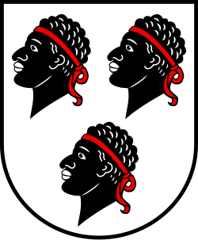
Cornol
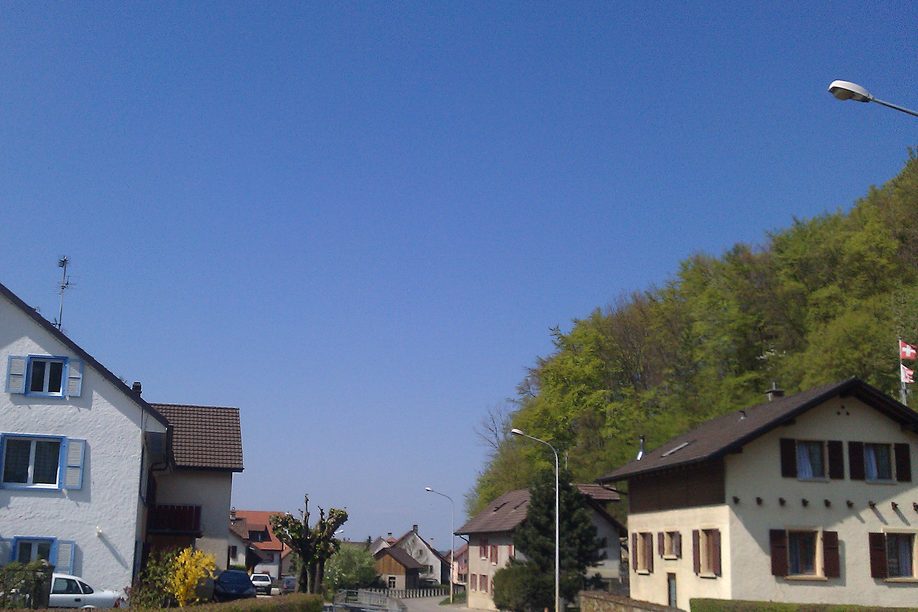
Origin of the name Cornol
The village first appears in 1136 as « Coronotum ». What the name means is not yet known.[1]
Founding of Cornol
Nobody knows who founded Cornol or when. People have nevertheless frequented the site since the Neolithic, above all the Mont-Terri, whose summit plateau was fortified several times between the Bronze Age and the 4th century AD. The village stands on the road over Les Rangiers. When it appears in the records, in the 12th century, religious houses already held rights there: the abbey of Lucelle a manor (colonge) with tithe, the chapter of Saint-Ursanne the tithes and the church of Saint-Julien. Cornol later passed from the counts of Ferrette and the Montbéliard family to the bishop of Basel.[1][2]
History of Cornol
Neolithic. Polished axes and flint arrowheads indicate a human presence on Mont-Terri.[2]
Around 1250 BC. First fortification of the northern and eastern edges of the Mont-Terri summit, at the beginning of the Late Bronze Age.[2]
Early 1st century BC. A Celtic settlement occupies the summit of Mont-Terri. Destroyed, it is replaced by a major rampart, events possibly linked to the exodus and return of the Helvetii and Rauraci in 58 BC.[2]
Around 260. New fortification of Mont-Terri (wooden palisade) at the time of the first great Alemannic invasions. A Roman garrison is stationed there in the mid-4th century.[2]
1136. First mention: « Coronotum ». Lucelle Abbey owns a manor with tithe in Cornol.[1]
1139. The chapter of Saint-Ursanne holds the tithes and the church of Saint-Julien.[1]
1147. First mention of the chapel of Saint-Vincent.[1]
1271-1386. Cornol belongs to the Bishop of Basel, having previously depended on the Ferrette and Montbéliard families. At the end of the 13th century it is attached to the advocacy of Ajoie.[1]
1461. Cornol returns to the Bishop of Basel. Under the Ancien Régime it belongs to the great mayoralty of Alle.[1]
17th century. Mont-Terri serves as a refuge during the Thirty Years' War. The church of Saint-Julien afterwards takes the dedication of Saint-Gilles.[1][2]
1701. Rebuilding of the chapel that survives from the first parish church.[1]
1779. The parish passes from the diocese of Besançon to that of Basel.[1]
1785-1786. Rebuilding of the chapel of Saint-Vincent, which becomes the parish church.[1]
1793-1814. Cornol is part of the French departments of Mont-Terrible, then Haut-Rhin.[1]
1815-1978. Cornol belongs to the Bernese bailiwick, then district, of Porrentruy.[1]
1836. Status of mixed municipality.[1]
18th-19th centuries. Beginning of industrialisation (faience, watchmaking), of which only a few workshops remain in the 20th century.[1]
1984-1987. Archaeological test excavations on Mont-Terri (1984, 1985 and 1987).[2]
Population of Cornol
Sources and references: [1]
| 1770 | 613 |
| 1818 | 674 |
| 1850 | 786 |
| 1900 | 1'145 |
| 1930 | 789 |
| 1950 | 831 |
| 1970 | 855 |
| 1980 | 708 |
| 2000 | 797 |
| 2010 | 914 |
| 2025 | 1'082 |
Historic sites in Cornol
Mont-Terri. Massif rising to 800 m, detached on the northern flank of the Jura range, near the Rangiers pass. Its summit, a 4-hectare plateau bordered by cliffs to the south and west, overlooks Ajoie and the Belfort Gap. Classified as of national importance, it has attracted researchers since the 18th century.[2]
Parish church of Saint-Vincent. Chapel mentioned from 1147, rebuilt in 1785-1786 and made the parish church.[1]
Chapel of Saint-Gilles. Only remnant of the first parish church of Saint-Julien (called Saint-Gilles after the Thirty Years' War), rebuilt in 1701. It houses a sarcophagus of undetermined date.[1]
Remains in Cornol
Mont-Terri fortifications. The summit was fortified several times: around 1250 BC (northern and eastern edges), then in the 1st century BC by a major dry-stone rampart with a timber frame, and finally around AD 260 by a wooden palisade. A Roman garrison was stationed there in the mid-4th century. A Hallstatt grave is also recorded.[2]
Medieval tower on Mont-Terri. The highest point of the plateau holds the scant ruins of a medieval tower that may date back to Carolingian times, though this is not certain.[2]
Late Bronze Age remains. Late Bronze Age remains in a small cave, and an unexcavated site of the same period.[1]
Sources
- Dictionnaire historique de la Suisse, « Cornol » (Dominique Prongué)
- Dictionnaire historique de la Suisse, « Mont-Terri » (François Schifferdecker)
- Statistique Jura, tableau JU-T.01.01.03, population résidante permanente au 31 décembre 2025
- geo.admin.ch (swisstopo), recherche de lieux « Cornol »
Localities of the municipality with a page
Other villages near Cornol
Missing information, or do you have a source? Suggest a correction or addition. Every submission is checked before it's published.
Suggest a change