Porrentruy
Origin of the name Porrentruy
The name appears in 1136 as « Purrentru ». In German the town is called « Pruntrut ». The name remains unexplained.[1]
Founding of Porrentruy
The site has been frequented since the Mesolithic. In Roman times a Gallo-Roman settlement already occupied the site of the future town, along the road linking Augst to Mandeure through the Allaine valley. In the early Middle Ages a first settlement formed around the church of Saint-Germain. The town itself was the work of the counts of Ferrette. To make it the seat of their lordship of Ajoie, they built a castle there on an easily fortified site. One borough grew at its foot (today's faubourg de France), another on the hill to the south, and ramparts joined them. Porrentruy then passed to the bishop of Basel. The count of Montbéliard, who held the town in pledge, had to give way to the army of Emperor Rudolf of Habsburg, and the town then received its imperial charter of liberties.[1]
History of Porrentruy
Mesolithic. Tools found in the back courtyard of the Hôtel-Dieu are the oldest evidence of human presence.[1]
1st century. A Roman road with a relay station, linking Augst to Mandeure (Epomanduodurum), crosses the area. A Gallo-Roman settlement occupies the site of the future town.[1]
10th-11th centuries. A building whose charred remains were found in the courtyard of the Hôtel-Dieu. First building of the church of Saint-Germain in the 11th century.[1]
1136. First recorded: « Purrentru ».[1]
1140. The church of Saint-Germain, around which the first settlement grew, is recorded. The archbishop of Besançon holds the right of patronage until 1781.[1]
1236. The counts of Ferrette, founders of the castle and the town, pledge Porrentruy to the count of Montbéliard.[1]
1281. The Ferrette counts cede their rights over the Ajoie to the bishop of Basel.[1]
1283. After a six-week siege by the imperial army, the count of Montbéliard submits. On 20 April the emperor grants the town a charter of liberties taking over the rights of Colmar and establishing a Thursday market.[1]
1321-1333. Construction of the church of Saint-Pierre, which only becomes a parish church in 1475.[1]
1386-1461. The town and the Ajoie are again pledged to the counts of Montbéliard, who confirm the liberties.[1]
1406. Foundation of the hospital, replaced in the 18th century by the present Hôtel-Dieu.[1]
1528. The prince-bishop of Basel and his court settle in Porrentruy, which remains their residence until 1792.[1]
1555-1580. The Reformation enjoys partial success, crushed by Prince-Bishop Jacques Christophe Blarer de Wartensee.[1]
1591. Blarer establishes a Jesuit college and brings in a printer. The Ursulines (1619), the Annonciades (1646) and the Capuchins (1663) follow.[1]
1730-1740. The « Troubles »: the burghers, led by Jean Georges Bruat and Pierre François Choullat, oppose the prince and are severely repressed.[1]
1792. On 27 April French troops drive out the prince-bishop. In 1793 Porrentruy becomes the chief town of the department of Mont-Terrible, then a sub-prefecture of Haut-Rhin from 1800 to 1814.[1]
1815. Union with the canton of Bern. Porrentruy becomes the seat of a bailiwick, then of a district from 1831.[1]
1842. A watchmaking apprenticeship workshop is set up. Some sixty watch firms around 1870 and a watchmaking school in 1884.[1]
1872. Opening of the railway line to Delle, then to Delémont in 1877 and Bonfol in 1901.[1]
1979. Entry into the Republic and Canton of Jura. The town hosts several cantonal institutions, including the cantonal grammar school.[1]
1988. Porrentruy receives the Wakker Prize of the Swiss Heritage Society.[7]
1998. The A16 motorway (Transjurane) links Porrentruy to Delémont.[1]
Population of Porrentruy
Sources and references: [1]
| 1380 | 1'400 (estimate) |
| around 1480 | 1'000 (estimate) |
| around 1540 | 1'600 (estimate) |
| 1770 | 2'408 |
| 1809 | 2'355 |
| 1818 | 1'896 |
| 1850 | 2'280 |
| 1900 | 6'959 |
| 1950 | 6'523 |
| 2000 | 6'753 |
| 2010 | 6'687 |
| 2025 | 6'597 |
Historic sites in Porrentruy
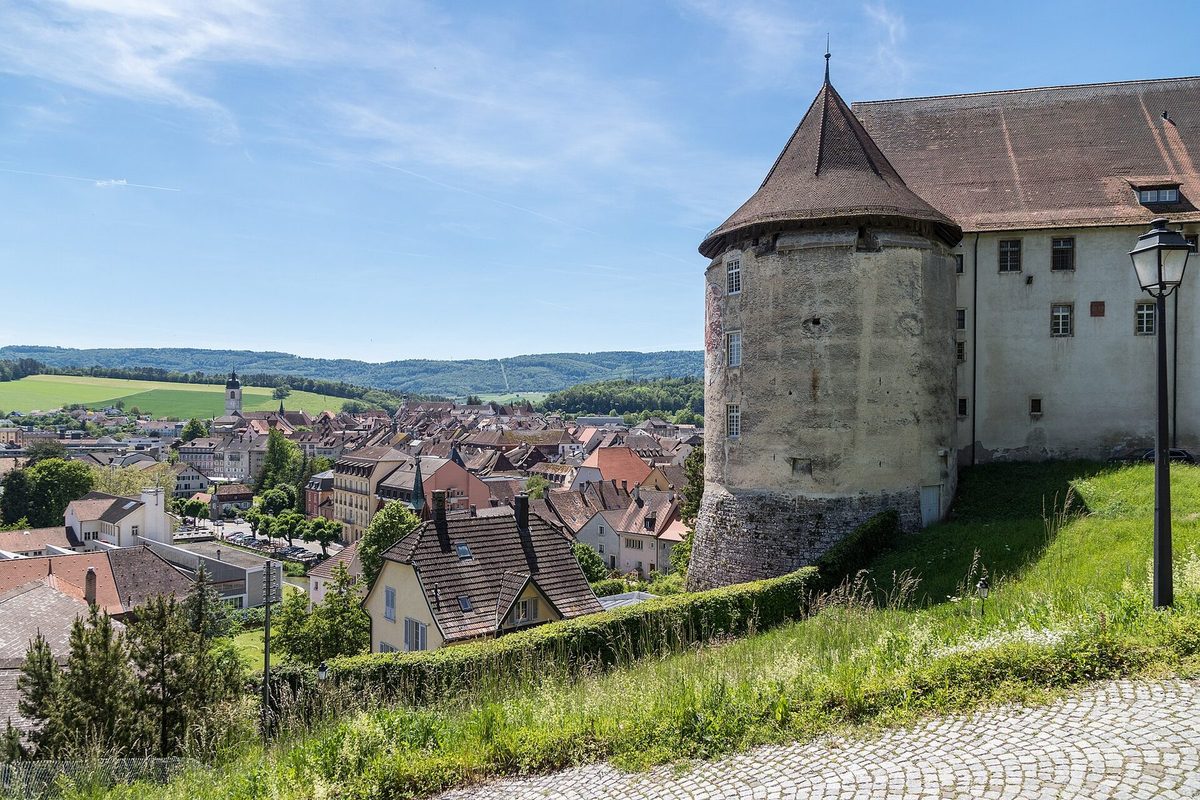
Porrentruy Castle. A group of buildings erected from the 13th to the early 18th century, overlooking the town to the north. Built by the counts of Ferrette, it was the residence of the prince-bishops of Basel from 1528 to 1792. Its round Réfous Tower, about 32 m high and dated to around 1271, is the oldest surviving part. Cultural property of national significance.[1][4]
Church of Saint-Pierre. Built between 1321 and 1333, a parish church from 1475. The Gothic chapel of Saint-Michel was added between 1450 and 1487.[1]
Church of Saint-Germain. First sanctuary in the 11th century, rebuilt in the early 13th century. Left outside the ramparts, it marks the core of the first settlement.[1]
Jesuit college and church of the Assumption. College founded in 1591 by Prince-Bishop Blarer. It later housed a major seminary (1716) and a faculty of theology (1760). Cultural property of national significance.[1][4]
Hôtel de ville, Hôtel-Dieu and Hôtel des Halles. Three 18th-century buildings by the architect Pierre-François Paris. The Hôtel-Dieu, a former hospital, now houses a museum.[1]
Hôtel de Gléresse. Aristocratic residence in the prince-bishops' town, home of the archives of the former prince-bishopric of Basel.[1][4]
Banneret and Samaritaine fountains. Renaissance-style fountains erected around 1560.[1]
Porte de France. Of the five gates the town had until the late 18th century, only the two of the faubourg de France survive.[1]
Chapel of Notre-Dame-de-Lorette. Chapel built around 1650, a place of pilgrimage.[1]
Remains in Porrentruy
Roman road. A 1st-century AD road with a relay station, excavated for more than a kilometre towards Alle. It linked Augst to Mandeure via Alsace and the Allaine valley, with a branch to Besançon via Damvant.[1]
Fanum of En Solier. Small Gallo-Roman temple identified in 1983 at the place called En Solier.[1][4]
Ramparts. Town wall probably built before 1283, which joined the castle borough and the hill borough but left the church of Saint-Germain outside.[1]
Sources
- Dictionnaire historique de la Suisse, « Porrentruy (commune) » (François Kohler), version du 19.05.2020
- Statistique Jura, tableau JU-T.01.01.03, population résidante permanente au 31 décembre 2025
- geo.admin.ch (swisstopo), recherche de lieux « Porrentruy »
- Office fédéral de la protection de la population (OFPP), Inventaire PBC, liste cantonale du canton du Jura (état au 1.1.2026)
- Inventaire PBC (OFPP), fiche KGS 03567 « Château (Porrentruy) », texte de la Société d'histoire de l'art en Suisse (Guide artistique de la Suisse)
- Inventaire PBC (OFPP), fiche KGS 03568 « Lycée cantonal, ancien collège des Jésuites (Porrentruy) », texte de la Société d'histoire de l'art en Suisse
- Patrimoine suisse (Schweizer Heimatschutz), « Wakkerpreis », liste des lauréats
Other villages near Porrentruy
Missing information, or do you have a source? Suggest a correction or addition. Every submission is checked before it's published.
Suggest a change