Prangins
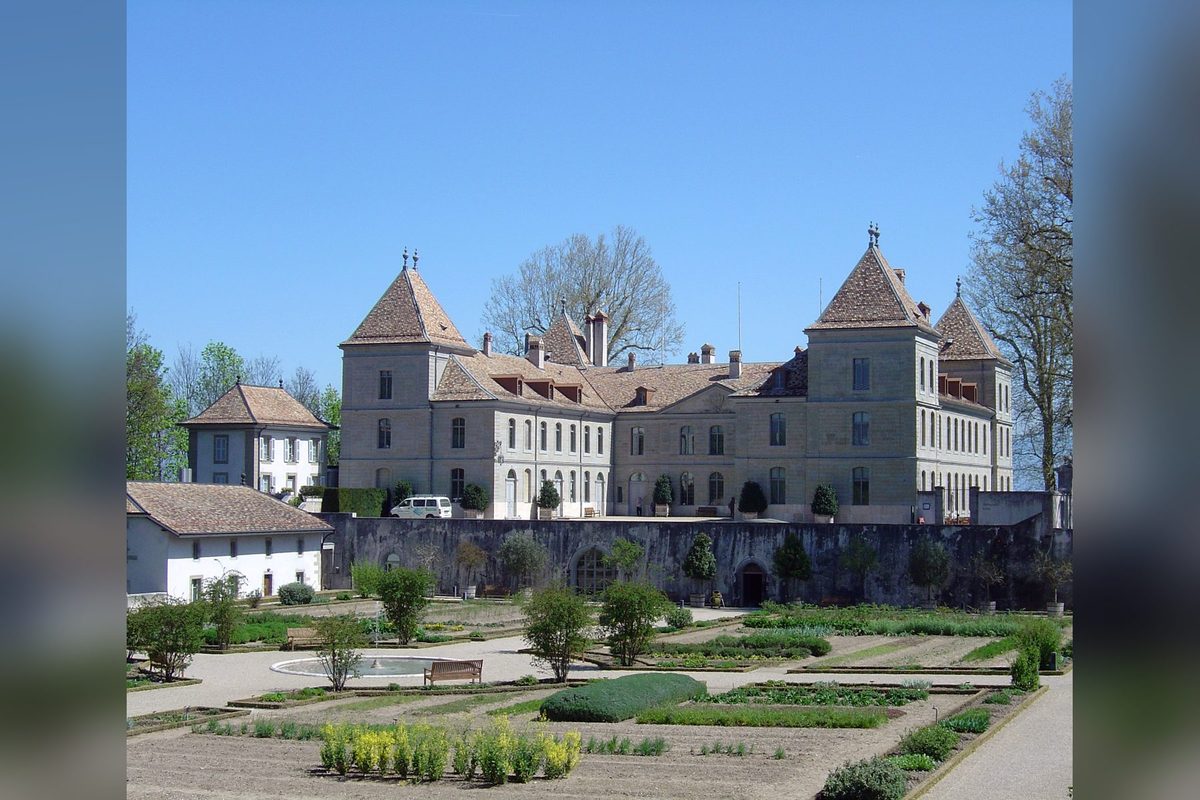
Built for the banker Louis Guiguer in 1732-1739, the castle of Prangins belonged to Joseph Bonaparte before becoming the French-speaking branch of the Swiss National Museum.
Entry based on 8 sources · Our method · Reusable text (CC BY-SA)
Origin of the name Prangins
The name appears in the form «Prengins» between 1135 and 1185. The etymology of «Prangins» has yet to be found.[1]
Coat of arms of Prangins
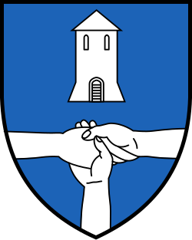
Azure, three dexter arms clasping hands, issuing from the flanks and the base, surmounted by a tower, all argent. On a blue field three white right arms come from both sides and from the bottom of the shield, their hands clasped. A white tower stands above them. The three hands symbolise the union, in 1527, of Prangins, Bénex and Promenthoux.[5][6]
Founding of Prangins
Nobody knows who founded Prangins or when. The village enters history in the 12th century, already the seat of a lordship bearing its name, on the terrace overlooking the entrance to the Petit-Lac. Today the municipality includes the hamlets of Bénex and Promenthoux.[1]
History of Prangins
1135-1185. First mention of the place in the form «Prengins».[1]
1154. Prangins is the seat of the lordship of the same name.[1]
before 1236. The church dedicated to Saint Pancras is a parish church.[1]
1293. The lordship is conquered by the House of Savoy.[1]
1671. The church becomes a parish church again, until 1834.[1]
1723. The banker Louis Guiguer acquires the barony of Prangins.[1]
1732-1739. Louis Guiguer has the present castle built.[1][2]
1757-1761. The church is demolished and rebuilt on another site by Jean-Louis Bovet the elder.[1]
1764. The village has 341 inhabitants.[1]
1814. The castle is sold to Joseph Bonaparte.[1]
1860. The church's porch tower is altered.[2]
1974. The castle is bought by the cantons of Vaud and Geneva to house the French-speaking branch of the Swiss National Museum.[1]
1998. Opening of the French-speaking branch of the Swiss National Museum in the castle.[1]
2000. The municipality has 3'133 inhabitants. The chemical industry has become the main employer and 80% of the working population commutes outside the municipality.[1]
2008. Prangins becomes part of the new district of Nyon, created by the Vaud territorial reorganisation that came into force on 1 January 2008.
Population of Prangins
Sources and references: [1][3]
| 1764 | 341 |
| 1850 | 440 |
| 1900 | 754 |
| 1950 | 858 |
| 1970 | 1'466 |
| 1990 | 2'559 |
| 2000 | 3'133 |
| 2025 | 4'243 |
Families of Prangins
Citizen families before 1800. Thirteen families. Boru, Denogent, Dessous-l'Eglise, Goncerut, Guiger de Prangins, Hermanjat, Hermenjat, Léger, Leyduz, Maire, Michaud and Treboux are citizens with no precise date. The Rapp, from Germany, are admitted in 1767.[7]
In the 19th century. Five families, with no precise date: Canel, Goutroux and Moser, as well as the Bryand, from France, and the Finaz, from Nyon VD.[7]
From 1901 to 1962. Fourteen registrations. The Grandval (1932) and the Fontaine (1935), from France, then the Eisner, from Germany (1948), come before a busy year: in 1955 the Bader of Holderbank SO, the Beck of Geneva, the Heller of Thal SG, the Isch of Etzelkofen BE, the Scherrer of Marbach LU, the Stöckli of Guggisberg BE and the Molnar, from Hungary, join. Then come the Beyeler of Wahlern BE in 1960, the Dummermuth of Buchholterberg BE and the Ueltschi of Därstetten BE in 1961. The last family registered, in 1962, is the Kovacs, also from Hungary.[7]
Notable people of Prangins
Charles-Jules Guiguer de Prangins (Prangins 1780 - Lausanne 1840). Son of Louis-François, baron of Prangins and an officer in French service. As former lord of Prangins, he sells his estate in 1814 to Joseph Bonaparte, brother of Napoleon I. In December 1830, facing the threat of a European war, the Diet elects him commander-in-chief of the federal army.[8]
Economy of Prangins, past and present
Land and vines. For a long time the village draws its living from the surrounding land and from vineyards. On the 1836 plan, vines cover a large part of the territory. From the 1950s villas and blocks of flats multiply, and in the 1960s farmland gives way to housing. In 2012 the ISOS inventory records only one vineyard plot left, west of the old village.[2][1]
Chemicals. The chemical company Zyma SA is founded in 1895. It joins the Basel group Ciba-Geigy in 1991 and becomes Novartis with the 1996 merger. Around 2000 it is a windfall for the whole region's secondary sector, and the chemical industry is Prangins' main employer.[2][1]
Rail, road and services. The Geneva-Lausanne line arrives in 1858 and speeds up the village's development. Its halt has since been closed. The population grows after the opening of the A1 motorway between Geneva and Lausanne. The municipality has an airfield, and the regional psychiatric hospital is among the employers of the service sector.[2][1]
Disasters and major events in Prangins
The destruction of the castle in 1293. When it conquers the lordship, the House of Savoy destroys the castle of Prangins.[2]
The castle fire of 1536. In the year of the Bernese conquest of Vaud, the castle burns. It is rebuilt afterwards.[2]
Historic sites in Prangins
Prangins Castle. Built in 1732-1739 for the banker Louis Guiguer, Baron of Prangins since 1723, the castle was sold in 1814 to Joseph Bonaparte. Bought in 1974 by the cantons of Vaud and Geneva, it has housed the French-speaking branch of the Swiss National Museum since 1998.[1]
Prangins church. The former church of Saint Pancras, a parish church before 1236 and again between 1671 and 1834, was demolished and rebuilt on another site in 1757-1761 by Jean-Louis Bovet the elder. Its square porch tower was altered in 1860.[1][2]
Hamlets of Bénex and Promenthoux. The municipality includes these two hamlets. Fine estates stretch below the village terrace towards the lake.[1]
Protected heritage in Prangins
Cultural property of national significance (A objects in the PCP inventory)[4]
- Château avec annexe, communs, bûcher, grilles et murs, deux fontaines, jardin et abords
- Château, Musée national
- Villa Les Bleuets, jardins et port
Cultural property of regional significance (B objects)[4]
- Promenthoux, nouvelle villa Prangins et son pavillon
- Temple
Sources
- François Christe, « Prangins », Dictionnaire historique de la Suisse (DHS), version du 06.07.2010
- Office fédéral de la culture, ISOS, « Prangins » (n° 4608), 2e version, février 2012
- Statistique Vaud, « Population résidante permanente au 31 décembre 2025 »
- Federal Office for Civil Protection (FOCP), Swiss Inventory of Cultural Property (PCP), list for the canton of Vaud (as of 1.1.2026)
- IPI, Swissreg, emblems database: coat of arms of Prangins (no. 101598)
- Official Gazette of the Canton of Vaud (FAO), "Alphabet des communes vaudoises: Prangins"
- Register of Swiss Surnames, 3rd edition (1989), search Commune "Prangins", Canton VD
- Historical Dictionary of Switzerland (HDS), "Guiguer de Prangins, Charles-Jules", version of 13.03.2008
Published by Sébastien Jörg ·
Localities of the municipality with a page
Other villages near Prangins
Missing information, or do you have a source? Suggest a correction or addition. Every submission is checked before it's published.
Suggest a change