Nyon
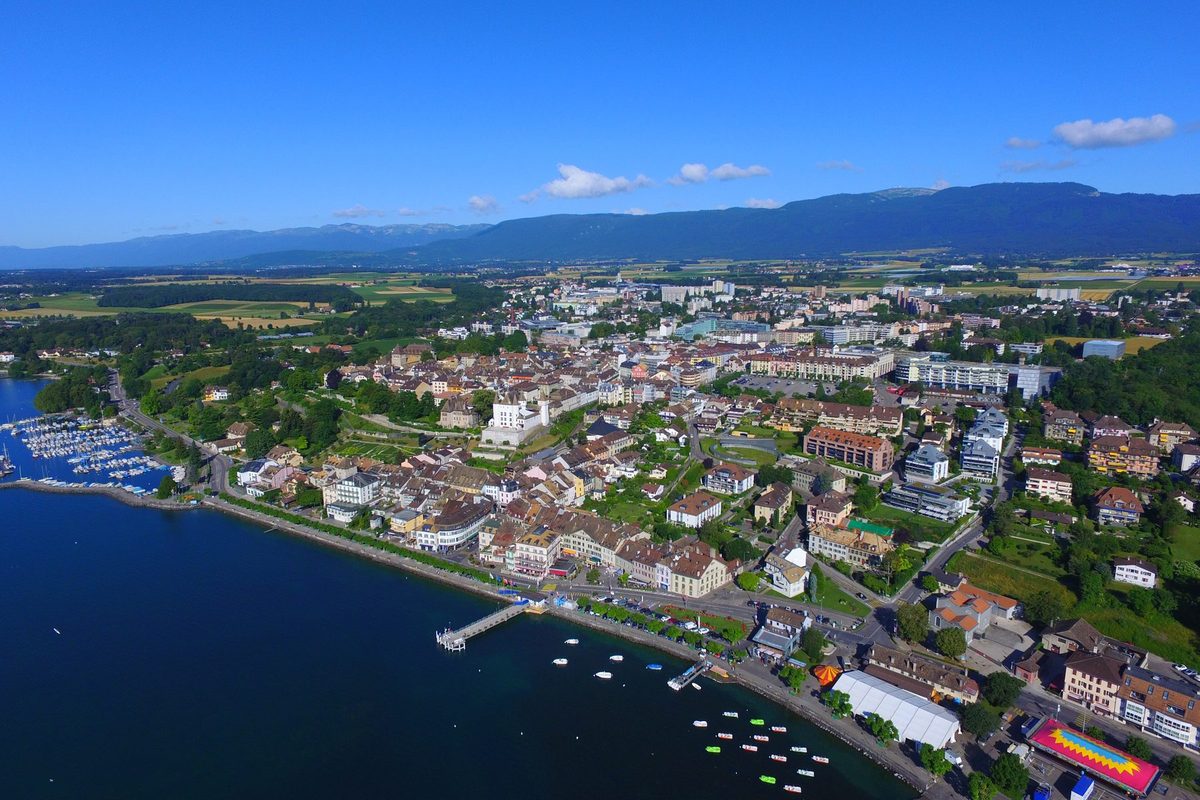
Founded as a Roman colony by Julius Caesar around 45 BC, then a Savoyard town around its castle, Nyon is now home to UEFA and the Paléo Festival.
Entry based on 22 sources · Our method · Reusable text (CC BY-SA)
Origin of the name Nyon
The name goes back to the town's Celtic name, "Noviodunum", which reportedly means "new fortress". In late Antiquity it appears in the phrase "civitas Equestrium id est Noiodunus" (the city of the Equestres, that is Noviodunum), then as "Neveduni" in 1236 and "Nyons" in 1292. The old German name is "Neuss".[4]
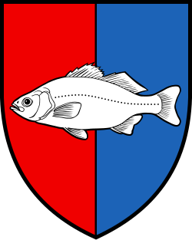
Coat of arms of Nyon
Per pale gules and azure, a fish argent fesswise overall. The shield is divided vertically, red on the left and blue on the right. A white fish, set horizontally, crosses both halves. The arms of Nyon date from 1546. The fish, which shows no particular species, recalls the nearby lake.[14][15]
Founding of Nyon
Nyon was founded by Rome. Between 46 and 44 BC Julius Caesar created the Colonia Iulia Equestris to settle former cavalrymen of his army. The town received a forum, a basilica and later an amphitheatre. Occupation continued into the early Middle Ages. In the Middle Ages the town first belonged to the lords of Prangins, then passed in 1293 to Savoy (Amadeus V and his brother Louis), which made it one of the towns of Savoyard Vaud.[4][8]
History of Nyon
46-44 BC. Julius Caesar founds the Colonia Iulia Equestris, a colony of cavalry veterans.
late Antiquity. The town is described as "civitas Equestrium id est Noiodunus".
5th-8th century. Continuous occupation of the site during the Christian early Middle Ages.
1236. The name appears in the form "Neveduni".
1272. First mention of the castle.
1286-1350. A mint of the barons of Vaud operates in Nyon.
1293. The town, until then held by the lords of Prangins, passes to Savoy (Amadeus V and Louis I of Vaud).[4][8]
1412. The town has 160 hearths (households).
1536. Taken without resistance by the Bernese. Nyon becomes the seat of a bailiwick until 1798.[4]
1764. The town has 1'734 inhabitants.
1781-1813. Operation of the porcelain factory founded by Jacob Dortu and Ferdinand Müller.[9]
1798. Nyon becomes a district capital.
1858. Opening of the Lausanne-Geneva railway line.
1916. Opening of the Nyon-Saint-Cergue-Morez line (terminating at La Cure since 1958).
1958. Three Roman columns from the forum are re-erected on the Esplanade des Marronniers.[7]
1976. Creation of the Paléo Festival.[10]
1979. Opening of the Roman Museum.[5]
1995. UEFA moves its headquarters to Nyon.[11]
1996. Discovery of the Roman amphitheatre.[6]
2000. The town has 16'182 inhabitants.
Population of Nyon
Sources and references: [3]
| 1412 | 160 hearths (households) |
| 1550 | 151 hearths (households) |
| 1764 | 1'734 |
| 1850 | 2'471 |
| 1900 | 4'882 |
| 1950 | 6'064 |
| 2000 | 16'182 |
| 2025 | 23'732 |
Families of Nyon
Citizen families before 1800. Boissier, Canel, Cuchet, Duvillard, Finaz, Galliard and Munier are listed with no precise date, as are the Du Fresne and Quiblier families, from Savoy, and the Roquerbre family, from Germany. Dated entries begin with the Bory family in 1572. Then came the Buvelot, the Gignoux of Givrins VD and the Henry in 1648, the Monnier of Eclépens VD in 1700, the Durand in 1725, the Frossard in 1754, the Bonnard of Arnex-sur-Nyon VD in 1763 and the Bachelard of Pampigny VD in 1765.[16]
In the 19th century. Baup, of Coinsins VD, de Richaud and Scolari, with no precise date. The Juillerat-Chasseur of Châtelat BE were admitted in 1818, the Dupont from Savoy in 1824, the Perret of Le Locle NE and the Wagner from Germany in 1830, the Ernst from Germany in 1833. In 1860 came the Charbonnet, as well as the Manthe and Richard families from France, then the Montant, also from France, in 1864. They were followed by the Wellauer of Thundorf TG in 1883, the Trembelland from France in 1889 and the Menzel from the Netherlands in 1891. The last years of the century brought families from France (Baud and Sigwart in 1894, Treyer in 1896, Perros in 1899), Italy (Cordin in 1894) and Germany (Happersberger in 1896). Two Pfeiffer entries, from Germany, appear in the register, one from 1894 and 1897, the other from 1900.[16]
From 1901 to 1962. One hundred and seventy-nine entries, eighty-eight of them in 1955 alone. The families came mainly from the canton of Bern (50), France (21), Italy (20) and the canton of Fribourg (17). The series opens in 1902 with the Colla family, from Italy. The last entries, in 1962, are the Chavaillaz of Ecuvillens FR, the Donzé of Les Breuleux JU, the Jysch from Germany and the Suard of Progens FR.[16]
Notable people of Nyon
Jacques Dortu (1749-1819). A painter and porcelain manufacturer of French Protestant origin, he ran the Nyon porcelain factory throughout its thirty years of existence.[19]
Karl Viktor von Bonstetten (Bern 1745 - Geneva 1832). A Bernese statesman and philosopher, he became bailiff of Nyon in 1787. His friend Matthisson moved in with him and stayed two years, and the writer Friederike Brun visited him in Nyon.[18]
Édouard Rod (Nyon 1857 - Cannes 1910). A citizen of Ropraz, he was born in Nyon on 29 March 1857. Settled in Paris from 1883, he moved from the naturalist novel to the introspective novel with La Course à la mort. He taught comparative literature at the University of Geneva from 1886 to 1893 and published his Nouvelles vaudoises in 1904.[17]
Edgar Pelichet. As curator of the Nyon museum, he organised the Exposition nationale de porcelaines de Nyon in 1947.[9]
Moritz de Hadeln. Born in England in 1940, he founded the International Documentary Film Festival in Nyon in 1969 with his wife Erika von dem Hagen. He went on to run the Locarno festival from 1972 to 1977 and the Berlinale from 1980 to 2001, before becoming artistic director of the Venice festival in 2002.[20]
André Borschberg (Zurich 1952). Co-founder of Solar Impulse, which he ran from 2004 to 2016, he lives in Nyon. In 2015 the town made him an honorary citizen for designing the first solar aircraft with unlimited endurance.[22][15]
Economy of Nyon, past and present
Porcelain and faience. The Nyon manufactory produced porcelain from 1781 to 1813. Faience was then made there until 1979, when the Manufacture de poterie fine closed.[9]
The UEFA headquarters. UEFA settled in Nyon in 1995, at first in temporary premises. The House of European Football, designed by the architect Patrick Berger, was inaugurated on 22 September 1999. According to UEFA, about 230 people worked there when the headquarters turned ten.[11]
Historic sites in Nyon
Nyon Castle. Mentioned from 1272 and remodelled by the Savoyards, seat of the Bernese bailiffs from 1536 to 1798, it now houses the history museum and a collection of Nyon porcelain.[8][9]
Roman Museum. Opened in 1979 on the remains of the forum basilica, it presents the history of the Colonia Iulia Equestris.[5]
Roman columns. Three columns from the ancient forum were re-erected in 1958 on the Esplanade des Marronniers, overlooking the lake.[7]
Musée du Léman. Museum devoted to Lake Geneva, its navigation and its natural life.[12]
Remains in Nyon
Forum, basilica and amphitheatre of the Colonia Iulia Equestris. The remains of the colony founded by Caesar (forum, basilica) are partly visible at the Roman Museum. The amphitheatre, discovered in 1996, confirms the importance of the ancient town, one of the main Roman colonies on Swiss territory.[5][6]
Protected heritage in Nyon
Cultural property of national significance (A objects in the PCP inventory)[13]
- Château
- Collège de 1790
- COLONIA IULIA EQUESTRIS, ville romaine / Nyon, ville médiévale - Époque contemporaine
- Eglise réformée Notre-Dame
- Manoir
- Musée du Château de Nyon
- Musée du Léman
- Musée romain
- Union des associations européennes de football (UEFA)
Cultural property of regional significance (B objects)[13]
- Ancienne porcelainerie
- Archives communales
- Château de Changins avec pavillon, orangerie, bûcher et fontaine
- Fontaine de Maître Jacques
- Halle aux machines, matériel ferroviaire et installations anciennes de la ligne Nyon- Saint- Cergue-La Cure
- La Métairie, hôpital psychiatrique
- Maison
- Maison aux arcades
- Maison Boisot
- Maison Bonnard avec porte Sainte-Marie
Show the other 5
- Maison Burnier
- Maison de jardin et conciergerie au siège de l'UEFA
- Musée du Léman (ancien hôpital)
- Tour César
- Tour de l'Horloge
Traditions and festivals in Nyon
From the First Folk Festival to Paléo. The festival began in 1976 as the First Folk Festival, together with the Folk Club de l'Escalier association. From 1977 to 1989, as the Nyon Folk Festival, it grew at Colovray, then moved to the Plaine de l'Asse.[10]
Visions du Réel. The first Nyon International Documentary Film Festival was held in 1969. In 1995 a new management took over and the festival became Visions du Réel.[21]
Honorary citizenship. Since 1719 Nyon has granted its honorary citizenship to only eleven people. The most recent, in 2015, was André Borschberg.[15]
"Lè Medze-Fedzo". The people of Nyon go by the nickname "Lè Medze-Fedzo", the liver eaters.[15]
Sources
- Dictionnaire historique de la Suisse, « Nyon (commune) »
- Dictionnaire historique de la Suisse, « Vaud »
- Statistique Vaud, « Population résidante permanente au 31 décembre 2025 »
- Inventaire fédéral des biens culturels (PBC), fiche 09696 « Nyon », texte de la Société d'histoire de l'art en Suisse (Guide artistique de la Suisse)
- Musée romain de Nyon, « The history of the Roman museum »
- Musée romain de Nyon, « The amphitheatre »
- La Côte Tourisme, « Roman columns in Nyon »
- Château de Nyon, « The castle and its history »
- Château de Nyon, exposition « Amours et chasse. Porcelaine de Nyon : dons, acquisitions et prêts »
- Paléo Festival Nyon, « A little history »
- UEFA, « L'UEFA fête les dix ans de son siège », 2 octobre 2009
- Association des musées suisses (museums.ch), « Musée du Léman »
- Federal Office for Civil Protection (FOCP), Swiss Inventory of Cultural Property (PCP), list for the canton of Vaud (as of 1.1.2026)
- IPI, Swissreg, emblems database: coat of arms of Nyon (no. 101895)
- Official Gazette of the Canton of Vaud (FAO), "Alphabet des communes vaudoises: Nyon"
- Register of Swiss Surnames, 3rd edition (1989), search Commune "Nyon", Canton VD
- Cantonal and University Library of Lausanne, Patrinum, biographical note on Édouard Rod (2014)
- Deutsche Biographie (NDB and ADB), "Bonstetten, Karl Viktor von"
- Château de Nyon, "Nyon porcelain"
- Swissinfo, "Moritz de Hadeln, founder of Visions du Réel, has died aged 85" (2026)
- Canton of Vaud, intangible heritage inventory, "Visions du Réel"
- André Borschberg, official website, "Biography"
Published by Sébastien Jörg ·
Other villages near Nyon
Missing information, or do you have a source? Suggest a correction or addition. Every submission is checked before it's published.
Suggest a change