Raron
Origin of the name Raron
Early forms are « Rarogni » (1101-1200) and « Rarun » (1146). The French name is Rarogne. Where does the name come from? That is still unknown.[1][2]
Founding of Raron
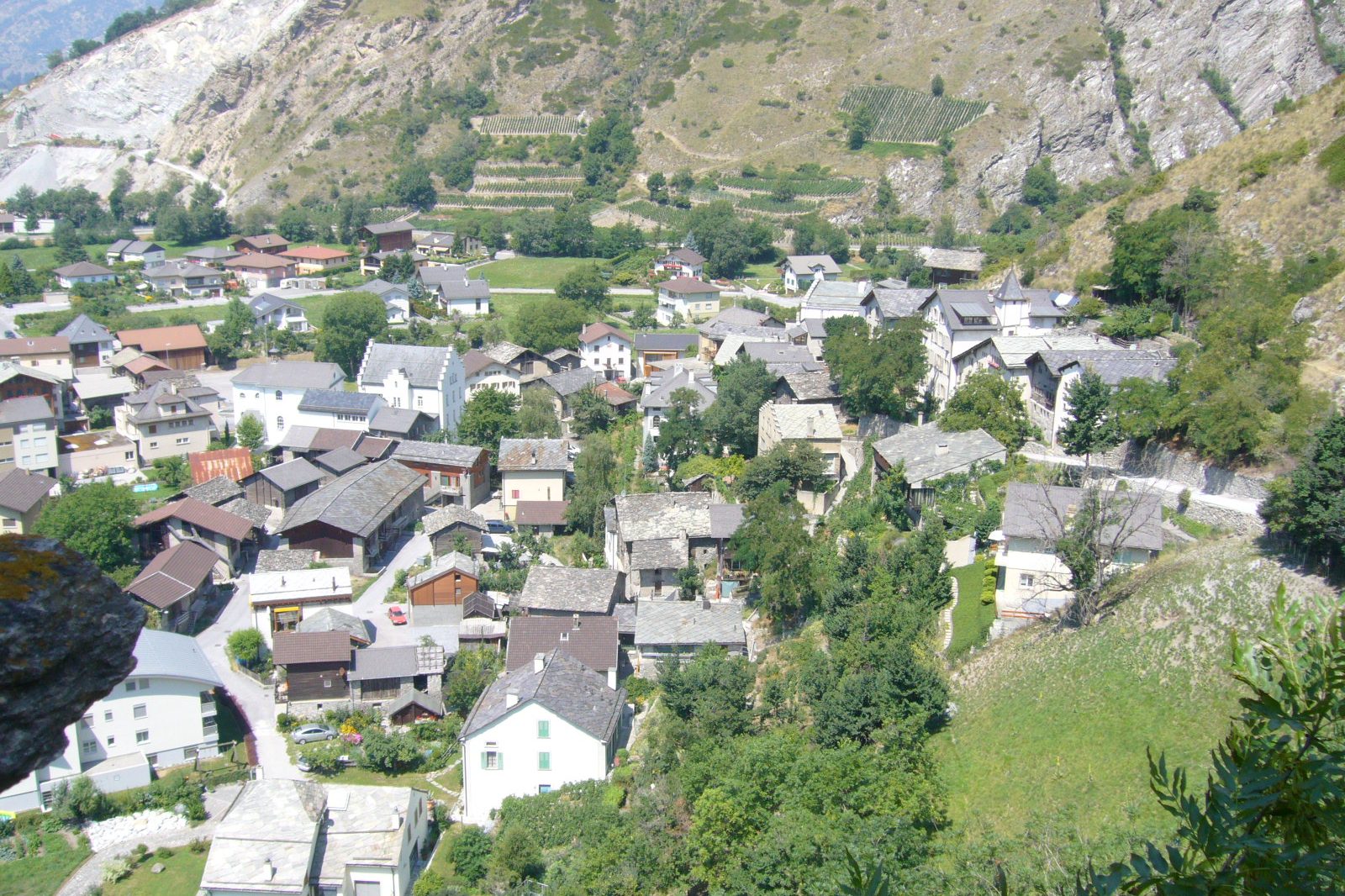
Raron (Rarogne) lies on the right flank of the Rhone valley, at the entrance to the Bietschtal, west of Visp. The municipality includes the villages of Raron and St. German (Saint-Germain) and the hamlets of Turtig and Rarnerchumma. The site was occupied from the Neolithic to the La Tène period, as shown by a settlement on the Heidnischbiel, a cemetery at Blatt and scattered finds in the vineyards. It seems to have been abandoned in Roman times. The first spiritual centre was St. German, whose church dates back to the 8th or 9th century. In the 12th century a Romanesque residential tower, seat of the vidomnes, was built on the hill west of the Heidnischbiel. The hill, later fortified, became the emblem of the place. The Bishop of Sion granted the vidomnat as a fief to the Raron, Asperlin and de Chevron-Villette families. Raron's church apparently became a parish church only in 1299. The large parish covered the four municipalities of the middle third of the Raron dizain. The place produced a bishop and a series of grand bailiffs, hence its nickname « Raronia prudens ».[1]
History of Raron
Neolithic to La Tène. Occupation of the site: settlement on the Heidnischbiel, cemetery at Blatt, scattered finds in the vineyards. The site seems to have been abandoned in Roman times.[1]
8th-9th century. A church exists at St. German, the first spiritual centre of the place.[1]
1101-1200. Mentioned as « Rarogni ».[1][2]
1146. Mentioned as « Rarun ».[1][2]
12th century. Construction of a Romanesque residential tower, seat of the vidomnes, on the hill west of the Heidnischbiel.[1]
13th century. Construction of the majorie tower, home to the Asperlin family among others.[1]
1299. Raron's church apparently becomes a parish church.[1]
1417. The residential tower is partly destroyed during the Raron affair.[1][2]
1494. The church of St Romanus is destroyed by the Bietschbach torrent; only its tower survives.[1][2]
1508-1514. Ulrich Ruffiner turns the castle church set up in the majorie tower into a Gothic building.[1][2]
1538. The municipality buys the residential tower, which serves as the dizain house and as a prison.[1][2]
1554. Unterbäch and Bürchen separate from the parish of Raron.[1]
1865-1885. Drainage of the plain, after the embankment of the Rhone and the Bietschbach.[1]
1867. Ausserberg also separates from the parish.[1]
1920. Construction of the Lonza drainage canal.[1]
1927. Early in the year, the poet Rainer Maria Rilke is buried, as he had wished, south of the castle church.[3]
1974. Opening of a church hewn into the rock at the foot of the castle. The castle church, restored in the 1970s, is no longer used for worship.[1][2]
1980. Air Zermatt uses the former military airfield, built in the 1940s, as a helicopter base.[1]
2000. More than three fifths of the working population work outside the municipality, mainly in Visp, Brig-Glis and Steg.[1]
2007. Opening of the southern portal of the Lötschberg base tunnel, east of Raron.[1]
Population of Raron
Sources and references: [1][2][4]
| around 1800 | 360 inhabitants |
| 1850 | 411 inhabitants |
| 1900 | 553 inhabitants |
| 1950 | 969 inhabitants |
| 2000 | 1'672 inhabitants |
| 2025 | 2'030 inhabitants |
Historic sites in Raron
Castle church (Burgkirche). Set up in the early 16th century in the majorie tower to replace the church of St Romanus destroyed in 1494, it was turned into a Gothic building by Ulrich Ruffiner in 1508-1514. Restored in the 1970s, it has not been used for worship since 1974.[1][2]
Grave of Rainer Maria Rilke. The poet, who had settled in Veyras near Sierre in 1921, was buried early in 1927, as he had wished, south of the castle church.[3]
Rock church. Church hewn into the rock at the foot of the castle, opened in 1974.[1][2]
Residential tower of the vidomnes. Romanesque tower of the 12th century, seat of the vidomnes, partly destroyed in 1417 during the Raron affair, bought by the municipality in 1538 and used as the dizain house and prison. It is now privately owned.[1][2]
Majorie tower. Tower of the 13th century, home to the Asperlin family among others, in which the castle church was set up.[1]
Patrician houses. Wealthy stone houses of the 17th and 18th centuries belonging to the Maxen, Zentriegen, Zmilacher, von Roten and Kalbermatt families (the latter at Turtig), and a tower house at Rotigoblatt, witnesses to the prosperity drawn from transit traffic on the old valley road.[1]
St. German (Saint-Germain). Village of the municipality and first spiritual centre of the area, with a church dating back to the 8th or 9th century.[1]
Remains in Raron
Heidnischbiel and Blatt. Prehistoric settlement on the Heidnischbiel hill and cemetery at Blatt, evidence of occupation from the Neolithic to the La Tène period.[1]
Church of St Romanus. Destroyed by the Bietschbach in 1494. Its tower, the only remnant, was demolished in 1938.[1][2]
Sources
- Dictionnaire historique de la Suisse, « Rarogne (commune) » (Anton Riva, trad. André Naon, version du 16.12.2011)
- Historisches Lexikon der Schweiz, « Raron (Gemeinde) » (Anton Riva, version du 16.12.2011)
- Südostschweiz, « Zum 100. Todestag von Rilke will Raron VS zum Kulturort werden » (inhumation de Rilke)
- Office fédéral de la statistique (OFS), STATPOP, chiffres provisoires au 31.12.2025, via citypopulation.de
- geo.admin.ch, recherche de lieux (coordonnées)
Localities of the municipality with a page
Other villages near Raron
Missing information, or do you have a source? Suggest a correction or addition. Every submission is checked before it's published.
Suggest a change