Ruines de Rouelbeau
Origin of the name Ruines de Rouelbeau
The castle bore several names: Bâtie-Compey, Bâtie-Cholay, Soubeyron, Sonneyro, Rouelbeau and Roillebot. The etymology of Rouelbeau is not established. Soubeyron is said to mean « supérieur, d'en haut, situé en hauteur ».[6]
Founding of Ruines de Rouelbeau
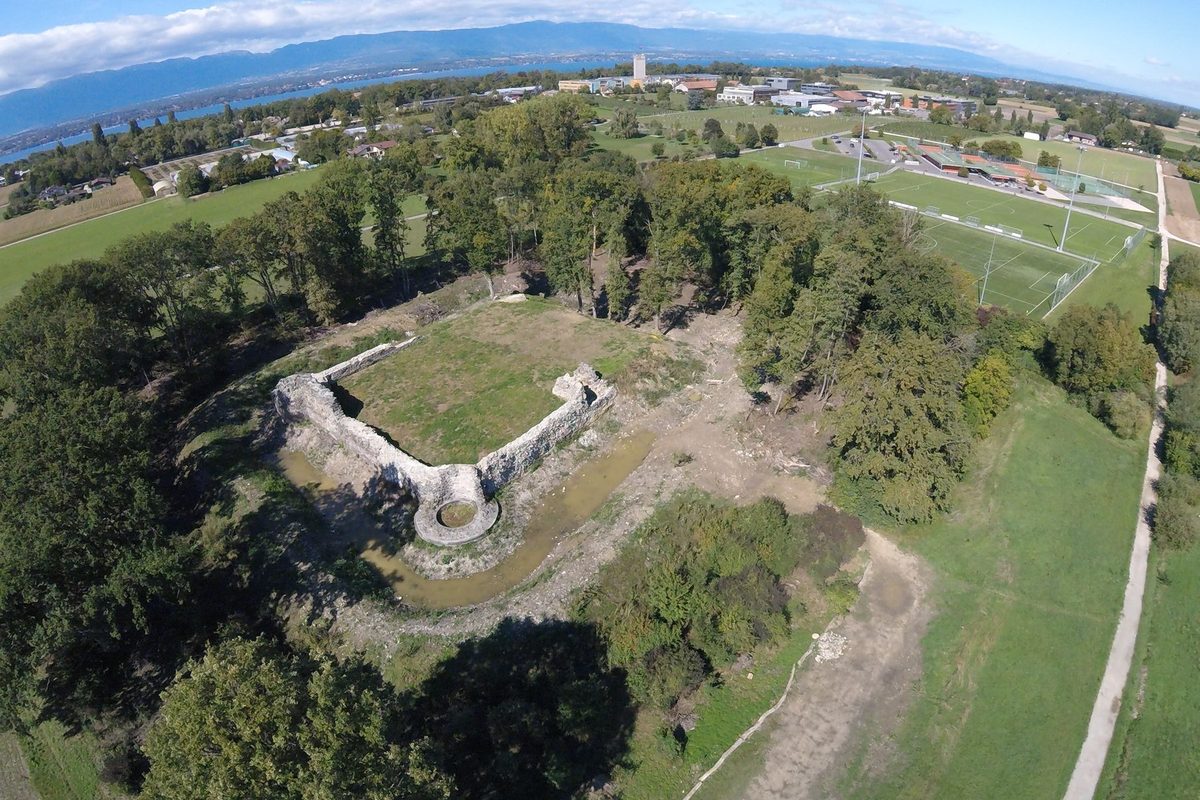
The castle was born of the need to control a road. In the early 14th century the lords of Faucigny sought to hold the route to their new town of Hermance and to Lake Geneva. Their agent, the knight Humbert de Cholay, built a wooden fort (bâtie) in the marshy plain of the Seymaz, on what is now the territory of Meinier. It was completed in July 1318. The following year Hugues Dauphin, lord of Faucigny, bought it. Between 1339 and 1355 the fort was replaced by a stone castle, a quadrilateral of about 40 m by 50 m with towers, protected by a double moat fed by the marshes. When the Faucigny was integrated into the County of Savoy in 1355, the castle lost its purpose.[1][4][5]
History of Ruines de Rouelbeau
1318. In July, after a year of work, the knight Humbert de Cholay completes a wooden fort in the middle of the marshes.[5]
1319. Hugues Dauphin, lord of Faucigny, buys the fort, which probably becomes the seat of a castellany.[5]
1339. A document of this year describes the original wooden fortress.[5][6]
1339-1355. Construction of the stone castle whose ruins are visible today.[4][5]
1355. The Faucigny is integrated into the County of Savoy. The castle, ceded to Savoy, loses its purpose.[5]
1536. The castle is spared by the Bernese.
1683. The castle passes to Jacques de Loys, who lets it fall into ruin.
After 1798. The ruins are used as a quarry. A cantonal press release dates this use, for the houses of nearby villages, back to the abandonment after 1355.
1921. The site is the first placed under protection by the canton of Genève. It heads the list of the first sixty protected objects.[4][5]
2001. The cantonal archaeology service starts a programme of excavation and restoration. The excavations reveal the wooden building that preceded the castle.[5][6]
2005. Redevelopment of the site begins, together with the renaturation of the Seymaz and the Sionnet marshes.[4]
2014. End of the excavations; most excavated areas are then covered over to preserve them.[5]
2016. On 3 and 4 September the ruins are reopened to the public during a medieval-themed weekend.[5][7]
Historic sites in Ruines de Rouelbeau
Educational trail. An educational trail explains the history of the monument. A bronze model, made after 3D topographic surveys, shows the original interior on site.[4][7]
Seymaz and Sionnet marshes. The marshes that protected the castle, drained in the 20th century, were partly restored by the renaturation of the Seymaz begun in 2005.[4]
Remains in Ruines de Rouelbeau
Stone castle. Quadrilateral of about 40 m by 50 m, with four round towers and a square tower at the east entrance, once surrounded by a double moat. Large sections of wall, the outline of the main gate and the foundations of two of the four corner towers survive.[7]
Wooden fort. The excavations begun in 2001 uncovered traces of the wooden fort that preceded the stone castle.[6]
Legends of Ruines de Rouelbeau
The White Lady. According to a tradition, a White Lady haunts the ruins. She is said to have been the repudiated wife of Humbert de Cholay.
Sources
- Dictionnaire historique de la Suisse, « Meinier » (Jean Terrier)
- L'Echo Magazine, « Une ruine près de Genève » (château de Rouelbeau, non daté)
- Office fédéral de la protection de la population, Inventaire PBC, « Ruines de Rouelbeau » (d'après le Guide artistique de la Suisse)
- République et canton de Genève, Archéologie genevoise, « Le château de Rouelbeau - Meinier »
- République et canton de Genève, « La Bâtie-Rouelbeau : les ruines du château médiéval s'ouvrent au public les 3 et 4 septembre 2016 », 15.08.2016
- Commune de Meinier, « Histoire & Armoiries »
- Commune de Meinier, « Château de Rouelbeau »
- geo.admin.ch, service de recherche de swisstopo (Château de Rouelbeau, Meinier, coordonnées)
Other villages near Ruines de Rouelbeau
Missing information, or do you have a source? Suggest a correction or addition. Every submission is checked before it's published.
Suggest a change