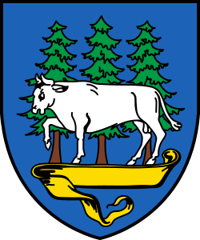
Saint-Luc
Origin of the name Saint-Luc
The name appears as « Lus » in 1267, then « Luc » in 1304, which remained the official name until 1904. The form « Saint-Luc » appears around 1850. « Luc » reportedly comes from the Latin « lucus », a sacred grove and later simply a wood, and « Saint-Luc » would be a pious reinterpretation of that name.[1]
Founding of Saint-Luc
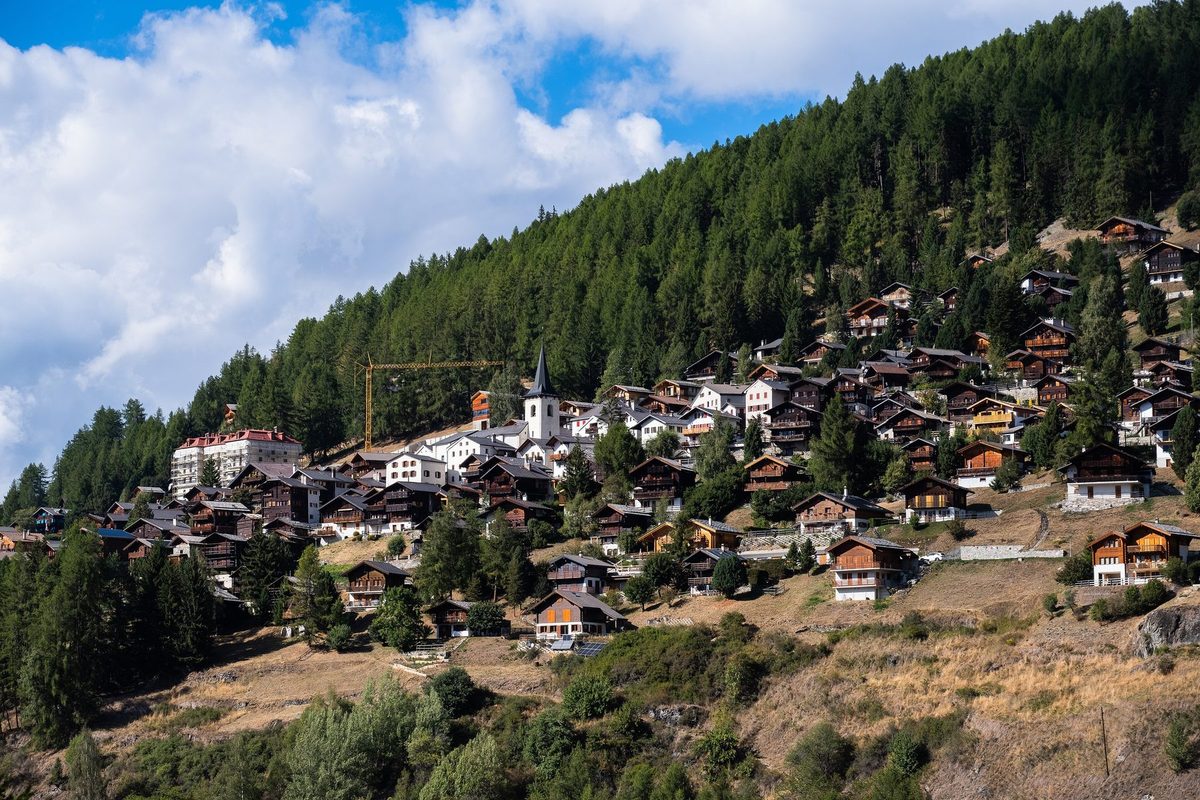
Saint-Luc, on the right bank of the Navisence in the Val d'Anniviers, comprised the village of Saint-Luc and the enclave of Niouc. Subject to the bishop of Sion, the locality formed with Chandolin one of the four quarters of the Val d'Anniviers recorded from 1327, in the dizain (district) of Sierre. It became a municipality in 1798. Chandolin broke away in 1821. Part of the parish of Vissoie until 1805, it then saw its chapel, dedicated to Saint Luke since the 16th century, become a parish church. The parish included Chandolin until 1884. Copper and nickel deposits were worked until the second half of the 19th century. The village was devastated by two serious fires in 1845 and 1858. The Hotel Bella Tola, built in 1859 and rebuilt in 1883, marks the beginnings of tourism, which dominates the economy at the start of the 21st century. A former municipality of the district of Sierre, Saint-Luc is now in the municipality of Anniviers (merger of 1 January 2009).[1][4]
History of Saint-Luc
1267. Mention in the form « Lus ».[1]
1304. The form « Luc » appears. It remains the official name until 1904.[1]
1327. Luc and Chandolin form one of the four quarters of the Val d'Anniviers, in the dizain of Sierre.[1]
16th century. The village chapel is dedicated to Saint Luke.[1]
1798. Luc becomes a municipality.[1]
1805. The chapel becomes a parish church. Luc leaves the parish of Vissoie.[1]
1821. Chandolin breaks away from the municipality.[1]
1845. Serious fire in the village.[1]
around 1850. The form « Saint-Luc » appears.[1]
1858. Second serious fire in the village.[1]
1859. Construction of the Hotel Bella Tola, the first sign of tourism.[1]
1883. New building for the Hotel Bella Tola.[1]
1884. Chandolin leaves the parish of Saint-Luc.[1]
second half of the 19th century. End of the working of the copper and nickel deposits.[1]
1904. « Luc » ceases to be the official name.[1]
1989. The Planet Trail between the Hotel Weisshorn and Tignousa is reportedly opened this year.
1995. Inauguration of the François-Xavier Bagnoud observatory, at 2'200 m above the village, near the upper station of the Tignousa funicular.[5]
2005. The tertiary sector provides 82 % of the jobs in the municipality.[1]
2009. On 1 January, Saint-Luc merges with Ayer, Chandolin, Grimentz, Saint-Jean and Vissoie into the municipality of Anniviers.[1][4]
Population of Saint-Luc
Sources and references: [1]
| 1850 | 385 |
| 1900 | 501 |
| 1950 | 240 |
| 2000 | 319 |
Historic sites in Saint-Luc
Hotel Bella Tola. Built in 1859, the first sign of tourism in the valley, the hotel was given a new building in 1883.[1]
Church of Saint-Luc. Former chapel dedicated to Saint Luke in the 16th century, made a parish church in 1805. Its parish included Chandolin until 1884.[1]
Niouc. Enclave of the former municipality, lying lower down the valley.[1]
Tignousa and the François-Xavier Bagnoud observatory. Above the village, at 2'200 m near the upper funicular station, stands the observatory inaugurated in 1995. From there the Planet Trail presents the planets of the solar system over 6 km. It was reportedly opened in 1989.[5]
Remains in Saint-Luc
Pierre des Sauvages. In the forest above the village, at 1'714 m, a 14 m gneiss block bears more than 300 cup marks. It is known as the largest cup-marked stone recorded in Switzerland.[2]
Legends of Saint-Luc
The two women of Saint-Luc. A poor, pious woman was gathering pine cones in the forest when a storm broke. A little man said to her: «What devilish weather!» She replied that the good Lord knows better than we do what weather we need. He carried her sack to the village cross, and at home it was full of gold. A jealous neighbour did the same but cursed the weather and «these wretched mountains»: her sack was full of beasts that devoured her.[6]
The lost souls of the Garboula. On the Garboula alp above Saint-Luc, a young herdsman saw thousands of souls in procession, punished for small faults. They would be saved once a squirrel had carried a Swiss stone pine seed up there, the tree had grown and been made into a cradle, and the first child laid in it, having become a priest, said his first mass.[6]
Sources
- Dictionnaire historique de la Suisse, « Saint-Luc » (David Rey, version du 23.12.2016)
- Val d'Anniviers Tourisme, « Pierre des Sauvages »
- geo.admin.ch, recherche de lieux (coordonnées)
- Feuille fédérale 2008, p. 4542, Direction fédérale des mensurations cadastrales, changements de noms de communes (10.06.2008) : réunion de six communes en Anniviers au 1er janvier 2009
- Fondation François-Xavier Bagnoud, « Observatoire FXB de Saint-Luc (Valais, Suisse) »
- Ch. Souvairan, Les légendes du Val d'Anniviers, 2e éd., Delachaux et Niestlé, 1928, « Les deux femmes de Saint-Luc » et « Les âmes en peine »
Localities of the municipality with a page
Other villages near Saint-Luc
Missing information, or do you have a source? Suggest a correction or addition. Every submission is checked before it's published.
Suggest a change