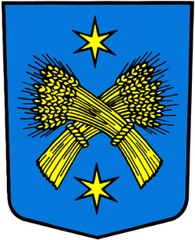
Salins
Coat of arms: Public domain, Wikimedia Commons
Origin of the name Salins
The oldest known forms are « Salaig », before 1200, and « Salen » in 1227. Then come « Salein » (1232), « Salino » (1308), « Salins » (1352) and « Sallens » (1484). The form « Salins » reportedly prevailed from 1831. In German the village was once called « Schalein ». Where the name comes from is not explained.[1]
Founding of Salins
Salins, on the left bank of the Rhône above Sion, was made up of the village of Salins and several hamlets. In the Middle Ages the place belonged to the bishop of Sion. Jean de la Tour held the tithe there in fief, and the treaty between Peter II of Savoy and the bishop put Salins on the western edge of the episcopal lands. A communal organisation is attested in 1338, justice lay with the episcopal sautier, and the commune gave itself statutes in 1541. When the town of Sion took over the seigneurial rights, exercised by a vice-castellan, tensions arose between the town and the rural community. After belonging to the dizain of Hérémence and then to that of Sion, Salins became part of the district of Sion, and merged with the municipality of Sion on 1 January 2013.[1][2]
History of Salins
before 1200. Mentioned in the form « Salaig ».[1]
1227. Mentioned in the form « Salen ». The tithe is held in fief by Jean de la Tour.[1]
1260. The treaty between Peter II of Savoy and the bishop of Sion places Salins on the western border of the episcopal possessions.[1]
1338. First attested communal organisation.[1]
1339. Justice lies with the episcopal sautier.[1]
1541. Statutes of the community.[1]
1604. The town of Sion henceforth exercises the seigneurial rights over Salins, represented by a vice-castellan.[1]
1686. A chapel exists at Salins.[1]
1795. Dedication of another chapel.
1798-1802. Salins is attached to the dizain of Hérémence, then to the dizain of Sion.
1837. A rector serves at Salins, which remains attached to the parish of Sion until 1893.[1]
1848. Salins is part of the district of Sion.[1]
around 1890. Construction of the present church.[1]
1893. End of the attachment to the parish of Sion.[1]
2005. The tertiary sector accounts for 57 % of jobs and the primary sector for 33 %.[1]
2013. On 1 January Salins merges with the municipality of Sion.[1][2]
Population of Salins
Sources and references: [1]
| 1802 | 232 |
| 1850 | 258 |
| 1900 | 504 |
| 1950 | 636 |
| 2000 | 883 |
Historic sites in Salins
Church of Salins. The present church was built around 1890. Before that, a chapel had existed since 1686 and another was dedicated in 1795.[1]
Hamlets of Salins. Besides the village of Salins, the territory includes several hamlets, among them Pravidondaz, Turin, Misériez and Arvillard, as well as the Mayens de Salins.
Bisse de Salins. Irrigation channel about 12 km long, fed by the Printse, which still irrigates the meadows, orchards and crops of Beuson, Les Bioleys and Salins.[3]
Sources
- Dictionnaire historique de la Suisse, « Salins (VS) » (David Rey, version du 23.12.2016)
- Office fédéral de la statistique (OFS), Répertoire officiel des communes de Suisse, mutation n° 3400 (Salins rattachée à Sion, 01.01.2013)
- Nendaz Tourisme, « Bisse de Salins »
- geo.admin.ch, recherche de lieux (hameaux et coordonnées)
Other villages near Salins
Missing information, or do you have a source? Suggest a correction or addition. Every submission is checked before it's published.
Suggest a change