
Sion
Origin of the name Sion
The Latin form « Sedunum » is attested in 859. In German the town is called « Sitten », after the quarter of the « Sitta » or Cité, on the left bank of the Sionne. What the name means is not yet known.[1]
Founding of Sion
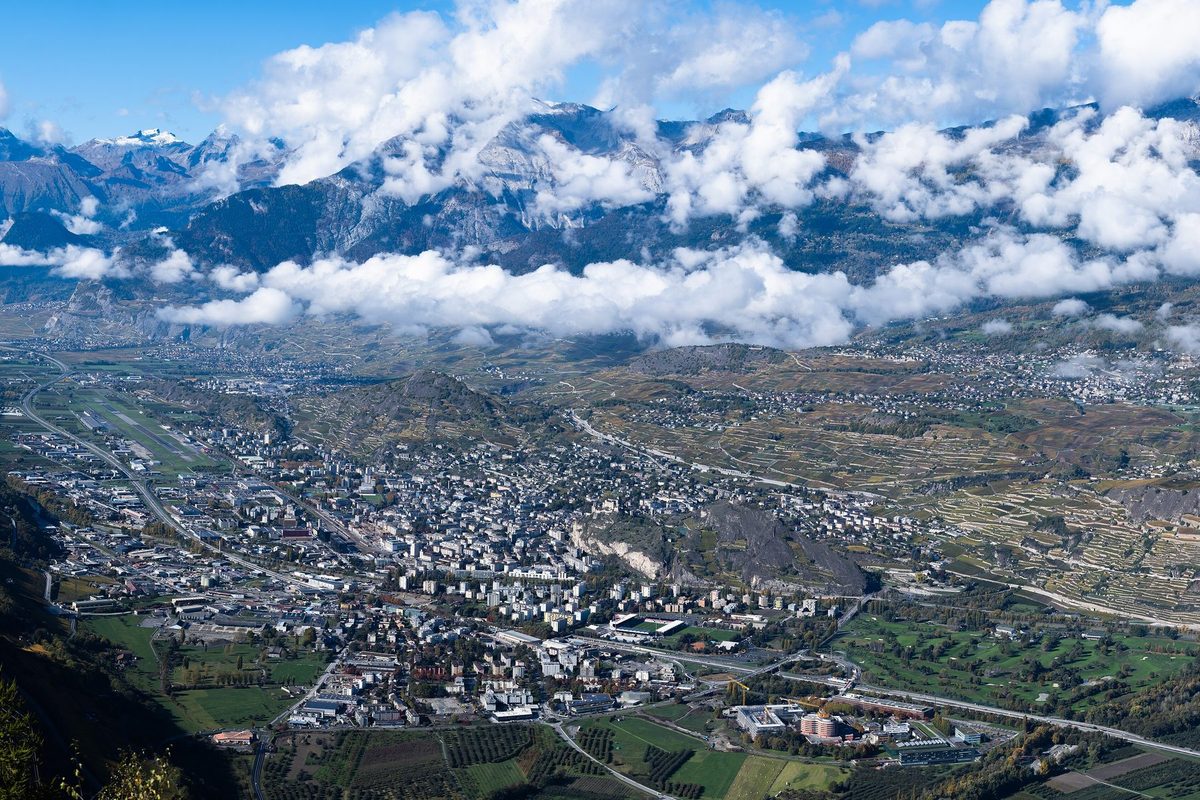
Sion has no dated founding: the site, on the Sionne at the foot of the hills of Valère and Tourbillon, has been occupied almost without interruption since people first settled there. Numerous necropolises bear witness to this, including the Petit-Chasseur dolmens. At the end of the 1st century BC Sion is the chief town of the Seduni. Martigny then becomes the capital of the civitas Vallensium, but notables still favour Sion as a residence. The episcopal see is moved here from Martigny. Later the bishop receives the county of Valais and makes Sion the capital of the country. The town obtains franchises; its institutions evolve from a democratic administration towards a patrician oligarchy, without Sion ever forming a territorial lordship. Today the municipality also includes the villages of Uvrier, La Muraz and Châteauneuf.[1]
History of Sion
around 6200 BC. The oldest trace of human presence on the site reportedly dates from this time, in the Late Mesolithic.[1]
8/7 BC. The civitas of the Seduni, whose chief town is Sion, honours the emperor Augustus with an inscription.[1]
end of the 6th century. The episcopal see is moved from Martigny to Sion.[1]
859. Mentioned in the form « Sedunum ».[1]
999. The king of Burgundy gives the county of Valais to the bishop, who makes Sion the capital of the country.[1]
11th century. Construction of the church of Sainte-Catherine at Valère, probably originally the church of the cathedral chapter.[1]
around 1100. The church of Saint-Théodule is built on the ruins of Roman baths.[1]
1217. First charter of franchises of the town.[1]
1338-1339. The vicar general confirms the town's rights in 1338 with a charter of franchises, which the bishop renews in 1339.[1]
1352. The town is taken, burned and plundered by Savoyard knights.[1]
second half of the 15th century. Rebuilding of the cathedral of Notre-Dame-du-Glarier, destroyed in the wars of the 14th century.[1]
1540. German becomes the official language and remains so until 1798.[1]
1560. The burghers buy the office of vidomne.[1]
1657-1665. Construction of the town hall at the Grand-Pont.[1]
1788. Great fire: the castles of the Majorie and Tourbillon and 115 of the 284 houses are affected.[1]
1848-1851. The cantonal constitution of 1848 and then the 1851 law on municipalities separate the political municipality and the burgher community.[1]
1860. Arrival of the railway.[1]
1935. The airfield, planned since 1913, is built. Since 1943 it has been mixed, civil and military.[1]
1968. Sion merges with Bramois, on the left bank of the Rhône.[1]
2013. Merger with Salins.[1]
2017. Merger with Les Agettes.[1]
Population of Sion
Sources and references: [1][2]
| 1610 | 1'835 |
| 1798 | 2'201 |
| 1846 | 2'815 |
| 1850 | 3'307 |
| 1900 | 6'751 |
| 1950 | 11'770 |
| 1970 | 21'925 |
| 2000 | 27'171 |
| 2025 | 37'831 |
Historic sites in Sion
Valère hill and church of Sainte-Catherine. On the hill of Valère, the church of Sainte-Catherine, built in the 11th century, was probably originally the church of the cathedral chapter.[1]
Tourbillon castle. Castle overlooking the town on the hill of Tourbillon. It was a victim of the great fire of 1788.[1]
Cathedral of Notre-Dame-du-Glarier. Destroyed in the wars of the 14th century, the cathedral was rebuilt only in the second half of the 15th century.[1]
Church of Saint-Théodule. Mentioned from the 13th century, it was built around 1100 on the ruins of Roman baths.[1]
La Majorie. Castle which a bishop made his residence. Affected by the fire of 1788, it served as barracks from 1842 to 1942 and has housed the fine arts since 1947.[1]
Town hall. Built at the Grand-Pont between 1657 and 1665.[1]
Maison du Diable. House built in 1515-1528, acquired by the burgher community in 2008.[1]
Remains in Sion
Petit-Chasseur dolmens. Large collective tombs on dry-stone platforms, in front of which engraved anthropomorphic stelae were set up.[1]
Roman baths of Saint-Théodule. The church of Saint-Théodule was built around 1100 on the ruins of Roman baths.[1]
Inscription in honour of Augustus. Inscription by which the civitas of the Seduni honoured the emperor Augustus in 8/7 BC.[1]
Sous-le-Scex site. A semi-sunken hut was uncovered here, evidence of early medieval occupation.
Legends of Sion
Saint Theodul's bell. According to legend, Bishop Theodul, warned that the pope was in danger, promised his soul to the fastest of three devils if it carried him to Rome and back to Sion before cockcrow. The grateful pope gave him a bell, which the devil also had to carry. But the bishop's white cockerel crowed first, as they reached the Planta. In a rage, the devil hurled the bell to the ground so hard that it sank deep into it. At the saint's call it rose again, ringing. This is why Saint Theodul is shown with a bell carried by the devil.[4]
Sources
- Dictionnaire historique de la Suisse, « Sion (commune) » (François Wiblé, Bernard Truffer, Lucienne Hubler, version du 16.11.2017)
- Office fédéral de la statistique (OFS), STATPOP, chiffres provisoires au 31.12.2025, via citypopulation.de
- geo.admin.ch, recherche de lieux (coordonnées)
- Walliser Sagen, Historischer Verein von Oberwallis, Brig, 1907, n° 4
Localities of the municipality with a page
Other villages near Sion
Missing information, or do you have a source? Suggest a correction or addition. Every submission is checked before it's published.
Suggest a change