Savigny
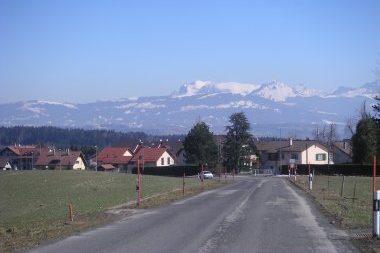
On this plateau above 900 m, Dean Bridel reportedly saw in 1815 a « large and wild parish » without a village. Its farmers only split from Lutry in 1823.
Entry based on 9 sources · Our method · Reusable text (CC BY-SA)
Origin of the name Savigny
First written mention in 1224 in the form « Savignie », then « Savinie » in the Cartulary of Lausanne, « Saguignie » in 1274, « Savignetum » in 1300 and « Savigny » from 1453. The name probably comes from the Benedictine abbey of Savigny-en-Lyonnais, on which the priory of Lutry depended. The inhabitants are the Savignolans, nicknamed « Bon-Ozî » (« good birds », the sparrowhawks in Vaud patois).[1][2][4]
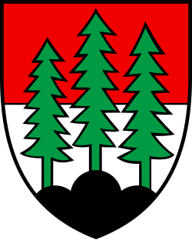
Coat of arms of Savigny
Per fess gules and argent, three fir trees vert overall, each issuing from a mount sable. The shield is red above and white below. Three green fir trees, each on a small black hill, lie over both parts. The commune created its arms in 1923. The colours recall those of Lutry, the firs and hills the Jorat and its forests.[8][4]
Founding of Savigny
Nobody knows who founded Savigny. The wooded land was cleared from the 13th century by settlers from Haute-Savoie and the valleys of Lombardy, later from the Bernese Oberland. Savigny formed a parish early on, but long remained part of the large municipality of Lutry, with no real village. The farmers of the plateau, who lived from crops, livestock and forest, eventually split from the wine-growers and wine merchants of Lutry to form their own municipality. Only afterwards did a village core take shape.[1]
History of Savigny
1224. First written mention: « Savignie ».[1]
1228. Savigny forms a parish with its church of Sainte-Marie-Madeleine.[1]
13th century. The clearing of the territory begins, by settlers from Haute-Savoie and the valleys of Lombardy, then from the Bernese Oberland.[1]
before 1494. The bishop of Lausanne Aymon de Montfalcon founds at Savigny a convent of the Third Order of Saint Francis.[1]
1536. Secularisation of the convent; with the Reformation Savigny becomes a dependency of the parish of Lutry.[1]
1598. Savigny becomes an independent parish again, together with Forel (Lavaux).[1]
1789. On 17 May four schools (« régences ») are created on the initiative of the pastor Jean-Pierre Loys de Correvon, apparently after a dispute with Lutry over their heating.
1815. Dean Bridel is said to have described a « large and wild parish » without a village, where « the snow is so deep that one would think oneself in Siberia ».
1823. On 17 May (or 7 May, date uncertain) the Vaud Grand Council decrees the division of Lutry into two municipalities, Lutry and Savigny. The new municipality belongs to the district of Lavaux until 31 December 2007.[1][2][4]
1825. On 22 March the act of separation from Lutry is signed after two years of negotiations. A decree of 21 May, signed by Landammann J. Muret, approves it.[2][4][5]
1835-1844. Construction of the Lausanne-Oron road. Crafts and small industry settle there.[1]
1885-1905. The Les Meguettes sandstone quarry employs 20 to 25 Piedmontese workers. Its stone was reportedly used to restore Lausanne cathedral and the church of Saint-François in Lausanne.
1902. Opening of a tramway line.[1]
1974. Opening of the A9 motorway. In the 1980s Savigny becomes a residential municipality of the Lausanne conurbation.[1]
2005. The primary sector still provides 20% of jobs.[1]
2008. On 1 January Savigny joins the new district of Lavaux-Oron.[6][7]
2025. Celebration of the municipality's 200th anniversary (28 February and 1 March).[2]
Population of Savigny
Sources and references: [1][2][3]
| 1550 | 179 |
| 1764 | 507 |
| 1821 | 925 |
| 1850 | 1'042 |
| 1900 | 1'072 |
| 1950 | 980 |
| 1980 | 2'339 |
| 2000 | 3'084 |
| 2022 | 3'418 |
| 2025 | 3'598 |
Families of Savigny
Citizen families before 1800. Thirty-four families, all with no precise date: Aguet, Amaudruz, Bastian, Bessat, Bolomey, Bovet, Brélaz, Bron, Carnian, Chappuis, Cordey, Cornut, Crot, Delessert, Détraz, Diserens, Dizerens, Ducros, Favre, Fayet, Joly, Jordan, Lavanchy, Marguerat, Mercanton, Muller, Noverraz, Parisod, Paschoud, Porta, Regamey, Richard, Rouge and Testuz.[9]
In the 19th century. The Décombaz, the Devaud, the Roggen and the Zahler of St. Stephan BE are entered with no precise date. The others arrived between 1824 and 1838, mostly from Germany: the Zoël in 1824, the Meyer in 1827, the Ganter in 1830 and the Herter in 1831. They were joined by the Zimmermann of Wattenwil BE (1827), the Nobs of Seedorf BE (1831) and the Gerster, from France (1838).[9]
From 1901 to 1962. Thirty-two entries. The Chollet opened the series in 1928, followed by the Hugonet from France (1930), the Goldschmidt from Germany (1931), the Gessler and the Keller (1936), then the Gabella from Italy, admitted in 1937, 1943 and 1948. Next came the Huguenin (1944), the Uldry (1946), the Soubeyran and the Zürrer (1947), the Merlin from France (1948), the Massa from Italy (1951), the Bezençon and the Doyer from the Netherlands (1952) and the Schwegel from Austria (1954). The year 1956 saw eight entries: Fischer of Grossaffoltern BE, Gevisier of Posieux FR, Perroulaz of Oberschrot FR, Simonet of Galmiz FR, Thönen of Zwieselberg BE, Vuille of La Sagne NE, Wegmuller of Walkringen BE and Willi of Gais AR. In 1957 came the Hanhardt of Neuchâtel, the Jegerlehner of Biglen BE, the Meichtry of Erschmatt VS and the Michel of Egnach TG, in 1958 the Béguin and the Trabichet from France, and in 1959 the Badoud and the Fossati from Italy. The last family entered, in 1960, was the Budkov, from the Soviet Union.[9]
Economy of Savigny, past and present
The sandstone quarries. In the early 20th century Savigny still lived mainly from farming. Its industrial past began with the molasse and sandstone quarries, worked throughout the 19th century and into the early 20th by labourers from Piedmont. Savigny molasse was used in the early 20th century to restore Lausanne's cathedral of Notre-Dame.[4][5]
Firms and farms. In its presentation published in the FAO on 25 August 2020, the commune counts more than 240 firms with just over 1'440 jobs, and still a large number of farms. The biggest firms are grouped in the Claie-aux-Moines business zone, which is reaching saturation.[5]
Historic sites in Savigny
Savigny church (Reformed church). Successor to the parish church of Sainte-Marie-Madeleine recorded in 1228. The present church was reportedly built in 1599 on the site of the former convent, rebuilt after a fire, given a bell in 1659 and restored in 1917.[1]
Hamlets of Mollie-Margot, La Goille, Le Martinet and La Claie-aux-Moines. Main hamlets of a municipality with scattered settlement, whose centre only formed after 1823.[1]
Quarries of Nialin, Roussaz, Palaz and Les Meguettes. In the 19th century molasse quarries reportedly supplied door and window surrounds and cornices sold from Lausanne to Montreux. To these is added the Les Meguettes sandstone quarry (1885-1905).
Traditions and festivals in Savigny
The animated film festival. Since 2017 the Forum in Savigny has hosted the animated film festival, which awards prizes.[4]
Markets and the raisinée night. The Société de développement de Savigny organises several activities every year, including the raisinée night. The village market is held on the first Saturday of September, the Christmas market on the last weekend of November.[4]
Sources
- Historisches Lexikon der Schweiz (version allemande du Dictionnaire historique de la Suisse), « Savigny »
- Le Courrier (Lavaux-Oron), « Commémoration du 200e anniversaire de la commune de Savigny », 6 mars 2025
- Statistique Vaud, « Population résidante permanente au 31 décembre 2025 »
- Feuille des avis officiels du canton de Vaud, « Alphabet des communes vaudoises : Savigny »
- Commune de Savigny, présentation de la commune (texte de la FAO, 25.08.2020)
- État de Vaud, Loi du 30 mai 2006 sur le découpage territorial (LDecTer)
- État de Vaud, communiqué « Organisation des préfectures et adaptation au nouveau découpage territorial », 12 juillet 2007
- IPI, Swissreg, emblems database: coat of arms of Savigny (no. 102061)
- Register of Swiss Surnames, 3rd edition (1989), search Commune "Savigny", Canton VD
Published by Sébastien Jörg ·
Localities of the municipality with a page
Other villages near Savigny
Missing information, or do you have a source? Suggest a correction or addition. Every submission is checked before it's published.
Suggest a change