Forel (Lavaux)
Cleared in the 12th century by the Cistercians of Hautcrêt, the Monts de Villette became the municipality of Forel in 1826, run from the hamlet of Les Cornes-de-Cerf.
Entry based on 8 sources · Our method · Reusable text (CC BY-SA)
Origin of the name Forel (Lavaux)
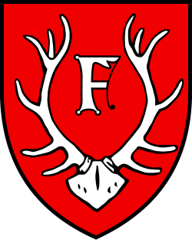
The name appears as « Fores » in 1274, then « Forel » in 1300. The name « Forel » still awaits an explanation. The place name Les Cornes-de-Cerf, the administrative centre of the municipality, reportedly owes its name to a stag trophy displayed in an inn, though this is not certain. The coat of arms is said to combine a stag's antlers and a Gothic F.[1]
Coat of arms of Forel (Lavaux)
Gules a stag's attires on a scalp Argent supporting a Gothic letter F of the same. On a red field, white stag's antlers, still joined to a piece of skull, hold up a white Gothic letter F.[7]
Founding of Forel (Lavaux)
In the 12th century the Cistercians of Hautcrêt began to clear and settle the area. The bishop of Lausanne and the House of Savoy then disputed it, until Bishop Guillaume de Champvent bought it back from Count Louis I of Savoy. For a long time the inhabitants belonged to the parish and the large municipality of Villette, in Lavaux. The « Monts de Villette », farming hamlets of the uplands, eventually became an independent municipality under the name of Forel.[1]
History of Forel (Lavaux)
1140. A deed of gift by the bishop of Lausanne Guy de Maligny in favour of the abbey of Lac de Joux is reportedly the oldest document naming Forel.
12th century. The Cistercians of Hautcrêt begin to clear and settle the area.[1]
1274. First mention of the form « Fores ».[1]
1298. Pierre and Garnier de Palézieux reportedly cede the hamlet of Forel to Louis of Savoy.
1300. The area is bought back by Guillaume de Champvent, bishop of Lausanne, from Count Louis I of Savoy.[1]
14th century. The large municipality of Villette, to which the inhabitants belong, is incorporated into Lavaux.[1]
1536. After the Bernese conquest the territory comes under the bailiwick of Lausanne.[1]
1598. Savigny and Forel together form an independent parish, separated from Lutry.[2]
1798. Forel is part of the district of Lavaux; 815 inhabitants.[1]
1824. On 15 May 1824, after two refusals in 1823, the Grand Council approves by decree the division of the municipality of Villette into six municipalities, including Forel.[4]
1826. The Monts de Villette become an independent municipality under the name of Forel. The same year a possibly Roman road is uncovered.[1]
1837. A decree plans to create an assistant parish at Forel, which never materialises.[1]
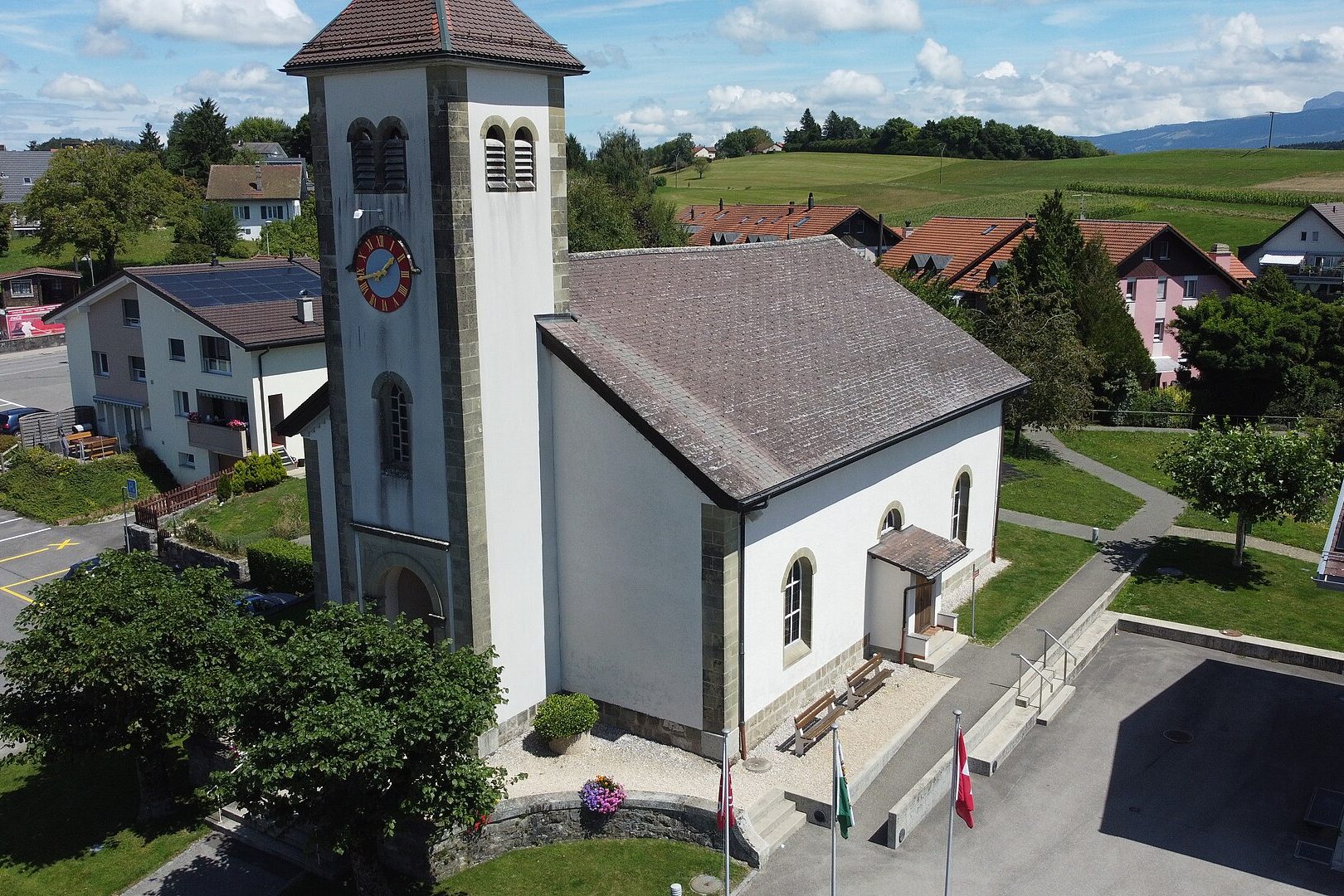
1869. Construction of the church at Les Cornes-de-Cerf, which still belongs to the parish of Savigny.[1]
1929. The Council of State reportedly made the municipal coat of arms official that year.
1982. The syndic is reportedly elected directly by the people from now on.
2008. Forel (Lavaux) joins the new district of Lavaux-Oron.[5][6]
Population of Forel (Lavaux)
Sources and references: [1][3]
| 1798 | 815 |
| 1850 | 1'029 |
| 1900 | 1'053 |
| 1950 | 948 |
| 2000 | 1'704 |
| 2025 | 2'113 |
Families of Forel (Lavaux)
Burgher families before 1800. Forty-two families, with no precise date.[8]
In the 19th century. The Bujard of Lutry VD were registered in 1824, the Brunner, from Austria, in 1834 and the Burnier, also of Lutry, in 1866. The Destraz (of Essertes VD), the Gavin (of Brenles VD) and the Roggen were registered with no precise date.[8]
From 1901 to 1962. Twenty families. Italy provided the most: Casotto and Pellegrino in 1919, Fama in 1928, Mino and Parnisari in 1942, Sellie in 1954. Others came from Turkey (Congos, 1926), Germany (Cossmann in 1947, Müller in 1954), Spain (Orteu-y-Fabregat, 1948) and Hungary (Zöldhegyi, 1957). The Flotron of Saint-Imier BE and the Jegerlehner of Biglen BE arrived in 1956, the Biedermann of Jens BE in 1957. Gruaz (1924), Keller (1936), Zumbrunnen (1937), Vaney (1944), Soubeyran (1947) and Reverchon (1961) complete the list. The last entry, in 1962, is a second Müller entry.[8]
Economy of Forel (Lavaux), past and present
A village without vines. Around 1820 the Monts de Villette shared the same rural economy, on which a generally poor population depended. Forel, which had no vines, had no winegrowers' brotherhood either. In 1827, after the large commune of Villette had been divided, most of the woodland lay within its territory.[4]
The industrial zone. Once a farming commune, Forel has become residential, with a small industrial zone.[1]
Historic sites in Forel (Lavaux)
Church of Les Cornes-de-Cerf. Built in 1869 in the administrative centre of the municipality, it still belongs to the parish of Savigny. It was reportedly planned from 1838 by the Lausanne architect Henri Perregaux and completed after his death under the direction of Louis Vuillemin.[1]
Chaufferossaz farm. Farm that belonged to Major Davel.[1]
Hamlets of En Forel and Les Cornes-de-Cerf. The municipality groups many hamlets in four sections. Les Cornes-de-Cerf houses the administration, the church and the schools.[1]
Remains in Forel (Lavaux)
Ruins of a medieval castle. The ruins of a castle from the Middle Ages are still visible in the Petit-Jorat forest.[1]
Possibly Roman road. A stretch of road, possibly from the Roman period, was uncovered at Forel in 1826.[1]
Sources
- Dictionnaire historique de la Suisse, « Forel (Lavaux) »
- Dictionnaire historique de la Suisse, « Savigny » (version allemande)
- Statistique Vaud, « Population résidante permanente au 31 décembre 2025 »
- Étienne Hofmann, « Forel en route vers son indépendance : 1823-1826 », conférence du 30 avril 2026 (site du bicentenaire de la commune de Forel)
- Canton de Vaud, Loi sur le découpage territorial (LDecTer, RSV 132.15) du 30 mai 2006
- État de Vaud, communiqué du 12.07.2007, « Organisation des préfectures et adaptation au nouveau découpage territorial »
- IPI, Swissreg, emblems database: coat of arms of Forel (Lavaux) (no. 101499)
- Register of Swiss Surnames, 3rd edition (1989), search Commune "Forel (Lavaux)", Canton VD
Published by Sébastien Jörg ·
Other villages near Forel (Lavaux)
Missing information, or do you have a source? Suggest a correction or addition. Every submission is checked before it's published.
Suggest a change