Essertes
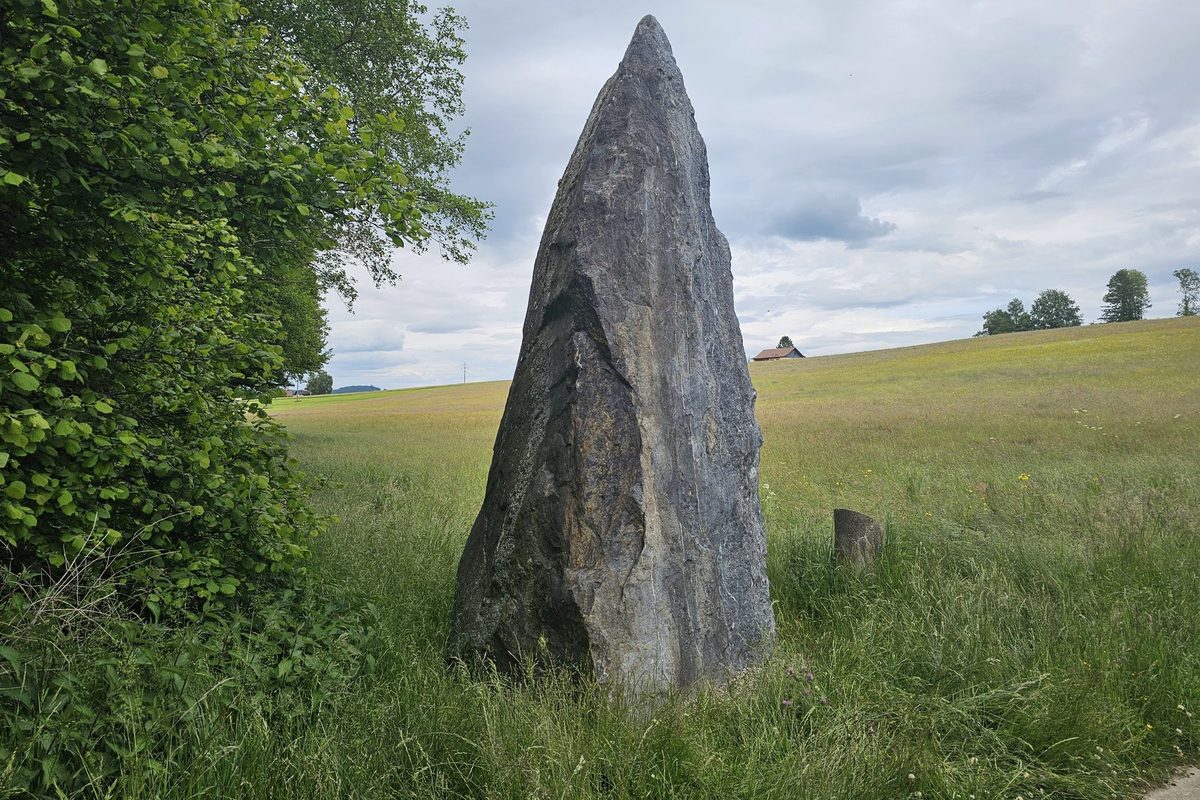
Essertes keeps the «Pierre du dos à l'âne», the largest known megalith in Switzerland: 5.6 metres high and weighing 25 tonnes.
Entry based on 7 sources · Our method · Reusable text (CC BY-SA)
Origin of the name Essertes
In the 12th century the estate is called «Sartis», and in 1218 there is mention of the «hommes de Sertes». The name reportedly comes from the Old French «essart», cleared land, recalling the clearing of the Jorat forests.[1]
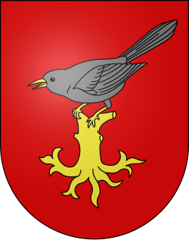
Coat of arms of Essertes
Gules, a tree trunk eradicated and couped of its branches or, topped by a cuckoo proper. These are the arms of the former municipality. On a red field stands a yellow trunk with its roots and lopped branches. A cuckoo in natural colours perches on top.[5]
Founding of Essertes
Essertes began in the mid-12th century, when the lord of Palézieux gave the estate of Sartis to the Cistercian abbey of Haut-Crêt. The monks later granted the «hommes de Sertes» the use of the Jorat woods in return for a due in wheat. They also founded the parish of Palézieux-Oron-Châtillens, to which Essertes still belongs.[1][4]
History of Essertes
Mid-12th century. The lord of Palézieux gives the estate of Sartis to the Cistercian abbey of Haut-Crêt. The history of the village begins.[1][4]
1218. The monks of Haut-Crêt grant the «hommes de Sertes» the use of the Jorat woods, in return for one measure of wheat per family per year.[1]
1537. Under Bernese rule, the due for the use of the woods is reduced to seven measures of wheat for all the inhabitants together.[1]
1801 to 1814. Negotiations lead to the separation of Essertes, Châtillens and Les Tavernes, which until then formed a single municipality. Essertes becomes an independent municipality in 1814.[1][4]
30 May 1996. The Essertes-Auboranges menhir is re-erected at its current site.[2]
28 September 2020. The authorities of Essertes and Oron approve the merger agreement between the two municipalities.[3][4]
29 November 2020. The people of Essertes and Oron approve the merger in a popular vote (Essertes: 143 yes, 50 no).[4]
1 January 2022. Essertes officially merges with the commune of Oron and becomes a locality of that commune.[1][3][4]
Population of Essertes
Sources and references: [4]
| 2019 | 380 |
Families of Essertes
Citizen families before 1800. Décosterd, Destraz, Guignet and Rogivue, without a precise date.[7]
In the 19th century. The Clerc family obtains citizenship in 1801 and the Guye family in 1864.[7]
From 1901 to 1962. From Switzerland come the Hauert family from Grossaffoltern BE (1956) and the Aeschbacher family from Eggiwil BE, the Niederhauser family from Wyssachen BE, the Pulfer family from Rüeggisberg BE and the Wuillemin family from Courgevaux FR (1957). The last registrations date from 1957 (Aeschbacher, Niederhauser, Pulfer and Wuillemin).[7]
Economy of Essertes, past and present
A rural village. From the late 12th century the village grew around a grange of Hautcrêt abbey, along the Vevey-Moudon road. In 1271 Pierre de Palézieux granted grazing rights on his newly cleared land and the use of woods in the Jorat. Essertes has kept its rural character, with milk production and crops.[6]
Historic sites in Essertes
The Essertes-Auboranges menhir. Known as the «Pierre du dos à l'âne», it is the largest megalith currently known in Switzerland: 5.6 metres high and weighing 25 tonnes. Shaped into a menhir in prehistoric times, it marked the boundary between the cantons of Vaud and Fribourg from at least the early 19th century. It was re-erected at its current site on 30 May 1996.[2]
Remains in Essertes
The prehistoric menhir. The Essertes-Auboranges menhir, shaped in prehistoric times, shows an early human presence. It was re-erected on 30 May 1996 at its current site, on the boundary between the cantons of Vaud and Fribourg.[2]
The estate of the abbey of Haut-Crêt. The village grew up from the mid-12th century on the estate of Sartis, given to the Cistercian abbey of Haut-Crêt by the lord of Palézieux.[1][4]
Sources
- Commune d'Oron, « Essertes »
- Commune d'Oron, « Le menhir »
- Le Courrier, « Oron : un programme fusionnel à valeur architecturale », 1.10.2020
- Conseil d'État du canton de Vaud, exposé des motifs et projet de décret sur la fusion des communes d'Essertes et d'Oron, février 2021
- IPI, Swissreg, emblems database: coat of arms of Essertes (no. 101494)
- Historical Dictionary of Switzerland, Olivier Frédéric Dubuis, "Essertes", version of 30.05.2022
- Register of Swiss Surnames, 3rd edition (1989), search Commune "Essertes", Canton VD
Published by Sébastien Jörg ·
Other villages near Essertes
Missing information, or do you have a source? Suggest a correction or addition. Every submission is checked before it's published.
Suggest a change