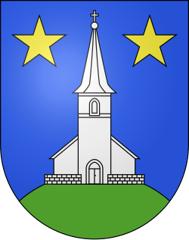
Châtillens
In 1361 a pig that had devoured a young child at Châtillens was tried in Lausanne, sentenced to death and hanged.
Entry based on 8 sources · Our method · Reusable text (CC BY-SA)
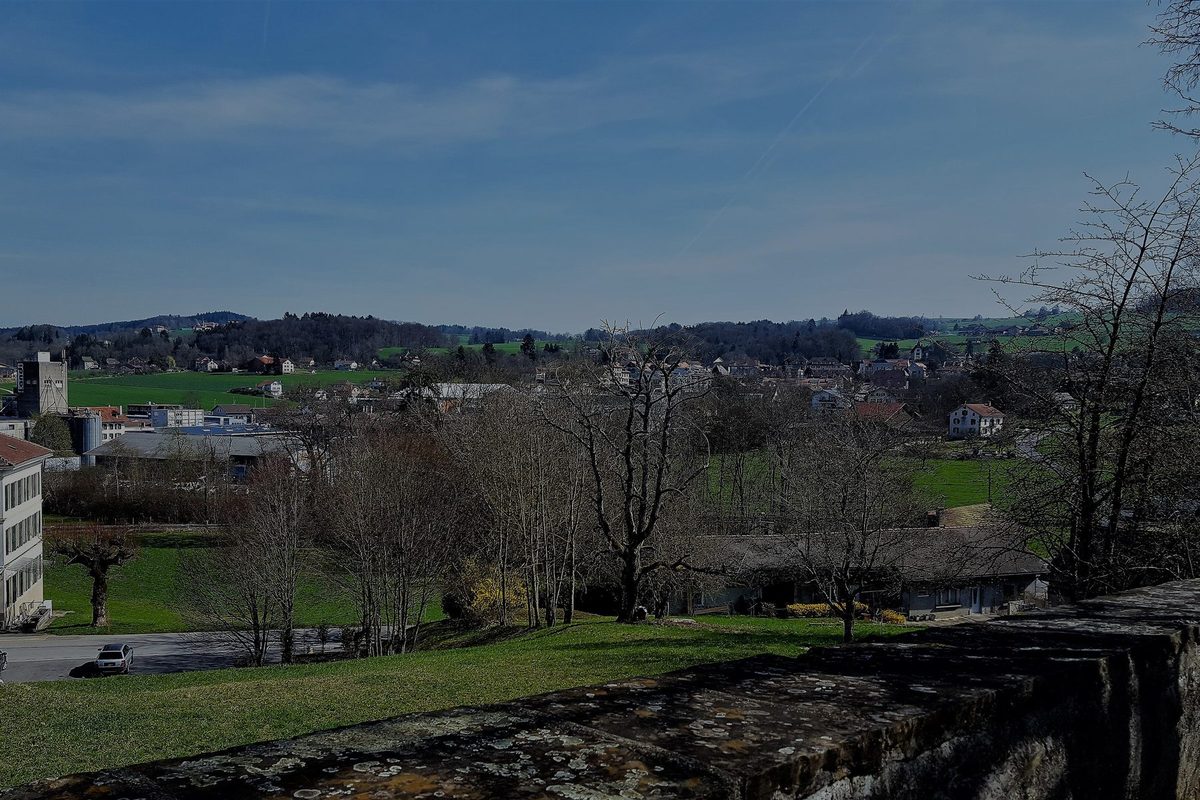
Origin of the name Châtillens
Châtillens is first mentioned around 1141. The origin of its name has not yet been explained.[1]
Founding of Châtillens
Nobody knows who founded Châtillens. It took shape as a farming hamlet around the barns of the abbey of Haut-Crêt. Around 1137 the abbey of Saint-Maurice ceded one third of the territory to Haut-Crêt, which obtained the other two thirds around the middle of the 12th century and became lord of the place. Châtillens stayed with the abbey until its secularization, then came under Bernese administration. An independent municipality from 1814, it has been part of Oron since 2012.[1][2]
History of Châtillens
around 1137. The abbey of Saint-Maurice cedes one third of Châtillens to the abbey of Haut-Crêt, which obtains the other two thirds around the middle of the 12th century.[1]
around 1141. First mention of the village.[1]
12th-15th century. The parish church, attested from the 12th century and rebuilt in Gothic style in the 15th century, becomes a place of pilgrimage centred on a venerated image of Saint Pancras.[1]
1361. A pig roaming the village attacks and devours a young child. The animal is tried in Lausanne, sentenced to death and hanged.[1]
1536. Secularization of the abbey of Haut-Crêt, which ends the ecclesiastical seigneury over Châtillens.[1]
1538. With the Reformation the Bernese have the image of Saint Pancras burned and the commune adopts the Reformed faith: the pilgrimage and the baptisms of infants who died unbaptised come to an end.[1]
1557. Châtillens comes under Bernese administration, incorporated into the bailiwick of Oron.[1]
1680. The village has 10 hearths.[1]
1764. The population stands at 87 inhabitants.[1]
1795. Construction of a manor house known as « Le Château », the home of Louis Jan, member of the Vaud government from 1804 to 1840.[1]
1814. Châtillens separates from Essertes and Les Tavernes and becomes an independent commune.[1]
18th century - 1946. Intermittent mining of lignite in the commune.[1]
30 November 1901. A meteorite reportedly falls in the Chervettaz wood.
1913. Installation in the church of stained-glass windows made by the painter Louis Rivier.[1]
1941-1946. The coal mine employs about 250 workers.[1]
1948. Discovery of a capital of Romanesque origin, now kept in the choir of the church.[1]
2000. The municipality has 365 inhabitants.[1]
1 January 2012. Châtillens merges with Bussigny-sur-Oron, Chesalles-sur-Oron, Écoteaux, Oron-la-Ville, Oron-le-Châtel, Palézieux, Les Tavernes, Les Thioleyres and Vuibroye to form the new municipality of Oron.[2]
Population of Châtillens
Sources and references: [1]
| 1680 | 10 hearths |
| 1764 | 87 |
| 1803 | 98 |
| 1850 | 248 |
| 1880 | 297 |
| 1900 | 289 |
| 1950 | 223 |
| 2000 | 365 |
Families of Châtillens
Citizen families before 1800. Clerc, Décosterd, Fontannaz, Gilliéron, Guignet, Jan, Manigley, Rogivue and Volet, as well as the Rossier family (from Rougemont VD), without a precise date.[5]
In the 19th century. The Détraz family (from Combremont-le-Petit VD) obtains citizenship in 1809 and the Piretti family (from Italy) in 1897.[5]
From 1901 to 1962. Several families come from abroad: from Italy (Passello in 1942 and Bardelloni in 1959 and 1961). From Switzerland comes the Gerber family from Röthenbach im Emmental BE (1956). They are joined by the Saugy family (1916), the Foursoff family (1926) and the Pache family (without a precise date). The last family registered, in 1961, is the Bardelloni family.[5]
Notable people of Châtillens
Louis-Etienne Jan (1771-1840). A notary in his native Châtillens, he sat in the provisional representative assembly of the Pays de Vaud in 1798. Elected to the Small Council in 1804, he remained in the Vaud government until his death, a record tenure in the cantonal executive. He initiated an intense legislative effort.[6]
Henri Jan (1817-1893). Born and died in Châtillens, this lawyer presided over the Vaud cantonal court several times. A Liberal Conservative, he was a national councillor, then a state councillor (1862-1874) and prefect of the Oron district. He introduced the first postal coach service in his area.[7]
Paul Demiéville (1855-1947). A physician born in Châtillens, he settled in Rolle and then in Lausanne, where in 1888 he founded the central dispensary that became the university outpatient clinic. A professor at the Lausanne medical faculty (1892-1927), he was a pioneer of the fight against tuberculosis in the canton of Vaud.[8]
Economy of Châtillens, past and present
Barns and farms. The village grew up around the barns of Haut-Crêt Abbey. Isolated farms are scattered across the territory, especially on the western slope of the Grenet. Forests cover 50 hectares.[1]
Lignite. Mined intermittently until 1946, lignite left its mark on the landscape: the old spoil heap can still be seen on the road from Châtillens to Les Tavernes.[1]
The cattle market. From 1939 to 1984 Châtillens held a monthly cattle market. It then moved to Oron-la-Ville.[1]
Historic sites in Châtillens
Parish church of Châtillens. Gothic 15th-century building of Romanesque origin, succeeding a church attested from the 12th century. A cultural property of regional importance. Until the Reformation a place of pilgrimage centred on a venerated image of Saint Pancras. The bells of 1502-1506 bear the dedications to Saint Maurice, the Holy Innocents and Saint Pancras. Ceiling of 1606, marquetry pulpit of 1621, stained glass by Louis Rivier (1913) and a capital discovered in 1948, kept in the choir.[1][3]
Le Château (1795). Manor house built in 1795, home of Louis Jan, member of the Vaud government from 1804 to 1840.[1]
Former mine. Former mine where lignite was worked intermittently from the 18th century to 1946. Between 1941 and 1946 the coal mine employed about 250 workers.[1]
Remains in Châtillens
Romanesque capital of the church. Capital discovered in 1948 and kept in the choir of the church, which is of Romanesque origin.[1]
Spoil heap of the former mine. The old spoil heap of the mine, worked intermittently from the 18th century to 1946, is still visible on the road to Les Tavernes.[1]
Chervettaz wood meteorite. A meteorite is said to have fallen on 30 November 1901 in the Chervettaz wood, seen by four witnesses. A fragment is said to be kept at the cantonal geology museum in Lausanne.
Protected heritage in Châtillens
Cultural property of regional significance (B objects)[4]
- Eglise réformée Saint-Maurice et Saint-Pancrace
Legends of Châtillens
Saint Pancras and children who died unbaptized. A tradition held that the image of Saint Pancras, venerated in the parish church and the object of a pilgrimage, could revive children who had died unbaptised long enough for them to be baptised. The practice ended with the Reformation: in 1538 the Bernese had the image burned.[1]
Sources
- Commune d'Oron, « Châtillens » (histoire du village)
- Commune d'Oron, « Villages »
- Office fédéral de la protection de la population, Inventaire PBC, liste cantonale VD (état au 1.1.2026)
- Federal Office for Civil Protection (FOCP), Swiss Inventory of Cultural Property (PCP), list for the canton of Vaud (as of 1.1.2026)
- Register of Swiss Surnames, 3rd edition (1989), search Commune "Châtillens", Canton VD
- Dictionnaire historique de la Suisse, « Jan, Louis-Etienne », version du 05.02.2007
- Dictionnaire historique de la Suisse, « Jan, Henri », version du 15.11.2005
- Dictionnaire historique de la Suisse, « Demiéville, Paul », version du 24.03.2004
Published by Sébastien Jörg ·
Other villages near Châtillens
Missing information, or do you have a source? Suggest a correction or addition. Every submission is checked before it's published.
Suggest a change