Palézieux
In 1344 Humbert de Billens founded a market town here ringed by walls and ditches. The fortified village has become one of the most important railway hubs in the canton of Vaud.
Entry based on 8 sources · Our method · Reusable text (CC BY-SA)
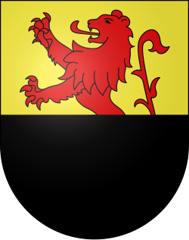
Coat of arms: CC BY 3.0, Own work, Wikimedia Commons
Origin of the name Palézieux
The name Palézieux is attested as early as 1134, in old forms such as Pallexiu, de Palaisol, Palatiolum (1141), Palaisol (1154), Palesuez (1218) and Palexieu (1545). It derives from the Latin diminutive palatiolum, meaning a small palace or a small lordly residence.[2]
Founding of Palézieux
The site reportedly already held a Roman villa, on the old road from Vevey to Moudon, but this is not established. In the 12th century a local noble family, the Palézieux, had a château built to control the bridge over the Broye, at the confluence of the Broye and the Mionnaz. Ruined around 1300, the family ceded château and lordship to Nicolas de Billens. It was his successor Humbert de Billens who created the market town: a settlement surrounded by walls and ditches, with broad liberties and important market rights. Today's fortified village grew out of it.[2]
History of Palézieux
Antiquity. A Roman villa reportedly stood on the road linking Vevey to Moudon.
1134. The place first appears in writing, in an old form of the name: Pallexiu or de Palaisol.[2]
1141. The place is mentioned in the form Palatiolum.
1154. Mention of the Palézieux family and of the name form Palaisol.[2]
1196. The parish church, already mentioned as early as the 12th century, is ceded to the abbey of Hautcrêt.
1218. The name of the place appears in the form Palesuez.[2]
1263. Hugues de Palézieux reportedly becomes the first bailiff of Vaud, in the service of Count Peter II of Savoy.
1276-1302. The Palézieux family goes through serious financial difficulties and goes bankrupt in 1302.
1302. Nicolas de Billens acquires the château and the lordship of Palézieux.
9 May 1344. Humbert de Billens founds a market town surrounded by walls and ditches, with broad liberties and important market rights.[2]
1381. By inheritance, the territory passes to François de Gruyère.
16th century. After the bankruptcy of the counts of Gruyère, the lordship comes under Bernese rule.
1519. The church bell is cast. Decorated with a coat of arms bearing three stars and a crane, given by Marguerite de Vergy, it carries a Latin Marian inscription and is today displayed at the school centre.[2]
1545. The name appears in the form Palexieu.
1557-1798. Palézieux is part of the Bernese bailiwick of Oron.
1700. The bridge over the Broye is swept away by floodwater.
1707. Construction of the presbytery.[2]
1750. Reconstruction of the bridge over the Broye, after several petitions from the inhabitants.
1798. End of Bernese rule with the creation of the canton of Vaud.
1828-1829. The church is entirely rebuilt in the neoclassical style by the Vevey architect Philippe Franel.
1862. Opening of the Lausanne-Berne railway line, which bypasses the historic village and gives rise to the hamlet of Palézieux-Gare, then limited to about ten houses.
1863. Founding of an agricultural institute at Serix, on the municipal territory.
1875. A stop opens at Palézieux-Village on the Broye line linking Palézieux to Lyss. Date uncertain.
1901-1903. Opening of the narrow-gauge line linking Palézieux to Châtel-Saint-Denis, later extended to Montbovon (Palézieux-Bulle-Montbovon), making Palézieux-Gare a junction of three railway lines.
1962-1992. The Siemens-Albis SA company establishes itself on the municipal territory.
1977. The group le Beau Lac de Bâle reportedly dedicates a humorous song to Palézieux.
1994. The agricultural institute of Serix becomes the Institut romand d'éducation de Serix.
1 January 2012. Palézieux merges with Bussigny-sur-Oron, Châtillens, Chesalles-sur-Oron, Écoteaux, Oron-la-Ville, Oron-le-Châtel, Les Tavernes, Les Thioleyres and Vuibroye to form the new municipality of Oron.[3]
Population of Palézieux
| 1416 | 50 hearths (households) |
| 1764 | 261 |
| 1850 | 426 |
| 1900 | 587 |
| 1950 | 635 |
| 2000 | 1'091 |
Families of Palézieux
De Palézieux. This noble family of the Pays de Vaud is recorded from the 12th century. In the middle of the 13th century it splits into several branches. First vassals of the bishops of Lausanne, its members enter the service of the House of Savoy as soon as it arrives in the Pays de Vaud. Ruined at the end of the 13th century, they sell their rights and property, including the lordship of Palézieux.[7]
Citizen families before 1800. Cardinaux, Demiéville, Dufey, Favez, Graz, Perroud and Rubattel are listed with no precise date, as are the Duffey, from Plan-les-Ouates GE. The Brunet, from France, are admitted in 1708.[8]
In the 19th century. The Félix, from La Rogivue VD, with no precise date.[8]
Show more families (1)
1901 to 1962. Eight families. The Toutain in 1925 and the Schmied in 1934 come before two Italian families, the Valle in 1953 and the Prigione in 1955. The others come from German-speaking Switzerland: the Sutter of Bätterkinden BE in 1956, the Gerzner of Einsiedeln SZ and the Schöni of Sumiswald BE in 1958. The Ramseyer of Schlosswil BE are registered in 1958, 1960 and 1961.[8]
Economy of Palézieux, past and present
Farms and business zones. Palézieux has remained agricultural, with fifteen farms in 2000. The village also has craft and industrial zones, where the company Siemens-Albis operated from 1962 to 1992.[1]
The station and the fair. The Official Gazette of the Canton of Vaud describes Palézieux as a strategic rail hub, served from Lausanne, Bern, Vevey, Bulle and Moudon. At Palézieux-Gare, the Clé des Champs district is planned for about 1'100 residents and jobs. Palézieux-Village hosts the monthly fair.[6]
Historic sites in Palézieux
Palézieux Castle. Built in the 12th century by the lords of Palézieux to control the bridge over the Broye, it passed in 1302 into the hands of the lords of Billens. Today only ruins remain, but the site remains an emblematic place in the village.
Palézieux Church. The parish has existed since the 12th century, and the church was ceded in 1196 to the abbey of Hautcrêt. The present neoclassical building was entirely rebuilt in 1828-1829 by the Vevey architect Philippe Franel. Its bell, cast in 1519 and given by Marguerite de Vergy, is today kept at the school centre.[2]
The presbytery. The village's presbytery was built in 1707.[2]
Palézieux railway station. A major railway hub of the canton of Vaud, Palézieux-Gare station sees three lines cross: the Lausanne-Berne axis (and beyond towards Zurich or Lucerne), the Broye line towards Moudon and Payerne, and the narrow-gauge line towards Châtel-Saint-Denis and Montbovon. A second stop, Palézieux-Village, serves the historic market town on the Broye line.
Serix Institute. Founded as an agricultural institute in 1863, it became in 1994 the Institut romand d'éducation de Serix.
Bridge over the Broye. A strategic crossing point since the Middle Ages, the bridge was swept away by a flood in 1700 and then rebuilt in 1750 after several efforts by the inhabitants.
Remains in Palézieux
Ruins of the medieval château. The remains of the fortified château built in the 12th century by the Palézieux family, later occupied by the lords of Billens, remain visible on the village site.
1519 bell. Old church bell, cast in 1519, decorated with a coat of arms bearing three stars and a crane, given by Marguerite de Vergy and bearing a Latin Marian inscription. It is today displayed at the village school centre.[2]
Roman villa. A Roman villa reportedly stood on the old road linking Vevey to Moudon, a sign of ancient occupation of the site. Its location is not confirmed.
Protected heritage in Palézieux
Cultural property of regional significance (B objects)[5]
- Cure
- Palézieux, ruines du château - Moyen Age
- Temple
Sources
- Emmanuel Abetel, « Palézieux », Dictionnaire historique de la Suisse
- Site officiel de la commune d'Oron, page village Palézieux
- Conseil d'État du canton de Vaud, exposé des motifs et projet de décret sur la fusion des communes d'Essertes et d'Oron (21_LEG_4)
- Statistique Vaud, « Population résidante permanente au 31 décembre 2025 »
- Federal Office for Civil Protection (FOCP), Swiss Inventory of Cultural Property (PCP), list for the canton of Vaud (as of 1.1.2026)
- Official Gazette of the Canton of Vaud (FAO), "Alphabet des communes vaudoises: Oron"
- Historical Dictionary of Switzerland (HDS), Bernard Andenmatten, "Palézieux, de", version of 09.11.2011
- Register of Swiss Surnames, 3rd edition (1989), search Commune "Palézieux", Canton VD
Published by Sébastien Jörg ·
Other villages near Palézieux
Missing information, or do you have a source? Suggest a correction or addition. Every submission is checked before it's published.
Suggest a change