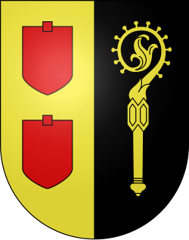
Les Thioleyres
In 1266 or 1267 the bishop of Lausanne granted the monks of Hautcrêt rights over this land on condition that a village be built there: Les Thioleyres grew up around their tile works.
Entry based on 5 sources · Our method · Reusable text (CC BY-SA)
Coat of arms: CC BY 3.0, Own work, Wikimedia Commons
Origin of the name Les Thioleyres
Les Thioleyres takes its name from a tile works that the monks of the abbey of Hautcrêt set up near the place called Les Adoux, for the needs of the monastery. The locality first appears in writing in 1266 or 1267, as «la Thiolere».[1][2]
Founding of Les Thioleyres
The land was among the first donations received by the abbey of Hautcrêt, founded in 1134 by Guy de Merlen, bishop of Lausanne. In 1266 or 1267 the bishop of Lausanne granted the monks rights of use and pasture over it, on condition that a village be built there. The hamlet thus arose as a rural and industrial dependency of the monastery, around a tile works operated by the abbey, rather than as a classic seigneurial foundation.[1][2][3]
History of Les Thioleyres
1134. The bishop of Lausanne Guy de Merlen founds the abbey of Hautcrêt, to which the territory of the future Les Thioleyres is given among its very first possessions.[1][2][3]
1266/1267. First written mention of the place under the name «la Thiolere». The bishop of Lausanne grants the monks of Hautcrêt rights of use and pasture over the territory, on condition that a village be built there.[1][2]
1557. Following the Bernese conquest of the Pays de Vaud, Les Thioleyres is incorporated into the Bernese bailiwick of Oron.[1]
1700. On 3 February, under bailiff Gabriel de Watteville, the tile works is re-leased to Pierre Davet, with the obligation to restore it and to supply the State of Berne each year with a thousand and a half tiles (1'500 tiles).[2]
1736. Construction of a first school in the village.[1]
1798. During the Helvetic Republic, Les Thioleyres is attached to the Canton of Léman, then incorporated into the district of Oron.[1]
around 1860. The tile works, neglected by the Bernese and revived around 1700, is abandoned. This marks the end of the activity that had given the village its name.[1][2]
1874. Reconstruction of the village's school building.[1]
1947. Further reconstruction of the communal school.[1]
1957. Establishment of an agricultural mechanics workshop in the village.[1]
2008. On 1 January the district of Oron disappears with the new Vaud district map. Les Thioleyres joins the district of Lavaux-Oron.[4]
2012. On 1 January, Les Thioleyres merges with Bussigny-sur-Oron, Châtillens, Chesalles-sur-Oron, Écoteaux, Oron-la-Ville, Oron-le-Châtel, Palézieux, Les Tavernes and Vuibroye to form the new municipality of Oron.[1]
Population of Les Thioleyres
Sources and references: [1]
| 1803 | 95 |
| 1850 | 166 |
| 1900 | 157 |
| 1950 | 130 |
| 2000 | 172 |
| 2010 | 213 |
| 2011 | 204 |
Families of Les Thioleyres
Citizen families before 1800. Chappuis, Décosterd, Mounoud, Rubattel, Ruchonnet, Volet and Wulliamoz, with no precise date. In 1716 three families from Château-d'Oex VD were registered under similar spellings: Rithener, Rithner and Rittener.[5]
In the 19th century. A single registration: the Hoffmann, from Hungary, in 1883.[5]
From 1901 to 1962. Twenty-five registrations. The Gerzner, from Einsiedeln SZ, open the series in 1914, followed in 1916 by the Erbeia (from Italy) and the Passard (from France). The year 1918 alone accounts for eleven families, eight from Italy (Bovo, Dardi, Mira, Piantanida, Poggia, Rusticoni, Tamborini and Zuretti) and three from Germany (Brion, Liewald and Wintz). Then come the Antonietti (from Italy), the Deleury (from France) and the Mau (from Germany) in 1919, the Florio (from Italy) in 1920, the Bichovsky (from Russia) in 1921, the Mariaux in 1923, the Grandvoinnet (from France) in 1936, the Conne in 1938, the Kistler in 1939 and the Landry (from Italy) in 1955. The last family registered, in 1956, is the Berovalis, from Greece.[5]
Economy of Les Thioleyres, past and present
The monks' tile works. The tile works that gave the village its name belonged to the monks of Hautcrêt. They had set it up near the place called Les Adoux, for the needs of their monastery. Revived in 1700, it was abandoned around 1860.[1][2]
Mixed farming. At the start of the 21st century, Les Thioleyres was still a village of mixed farming. New homes have been spreading there since the 1990s.[1]
Historic sites in Les Thioleyres
The historic street-village. Les Thioleyres consists of a characteristic small street-village, surrounded by scattered rural settlement. This structure reflects the old agricultural and craft organization of the place, which developed from the hamlet born around the monastic tile works.[1]
Site of the former Adoux tile works. The site of the former tile works, established by the monks of the abbey of Hautcrêt near the Adoux watercourse, is at the origin of the village's name and settlement. It was worked in stages from the Middle Ages until around 1860.[1][2]
The school building. The village school, built in 1736 and then rebuilt in 1874 and 1947, shows the communal life of Les Thioleyres before the 2012 merger.[1]
Remains in Les Thioleyres
Remains of the tile works. The former tile works that gave the village its name was abandoned around 1860. Whether any remains are still visible on the site today is not known.[1][2]
Sources
- Dictionnaire historique de la Suisse, Olivier Frédéric Dubuis, « Thioleyres, Les », version du 21.04.2022
- Commune d'Oron, page « Les Thioleyres »
- Commune d'Oron, page « Les Tavernes » (abbaye de Haut-Crêt, fondée en 1134 par Guy de Merlen)
- État de Vaud, communiqué du 12.07.2007, « Organisation des préfectures et adaptation au nouveau découpage territorial »
- Register of Swiss Surnames, 3rd edition (1989), search Commune "Les Thioleyres", Canton VD
Published by Sébastien Jörg ·
Other villages near Les Thioleyres
Missing information, or do you have a source? Suggest a correction or addition. Every submission is checked before it's published.
Suggest a change