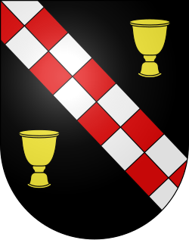
Les Tavernes
First called Froideville, the village took the name Les Tavernes from an inn authorised in 1342 on the road to the Dézaley, below the abbey of Haut-Crêt.
Entry based on 7 sources · Our method · Reusable text (CC BY-SA)
Origin of the name Les Tavernes
The oldest mentions are «frigida villa ante altam crestam» in 1343 and «in taberna ante altam crestam» in 1382. The village was first called Froideville, after the tenant farmers of the abbey of Haut-Crêt, then Les Tavernes, after an inn authorised in 1342 on the road to the Dézaley. Both names were used until about 1670. Latin «taberna» means an inn.[1]
Founding of Les Tavernes
Les Tavernes grew up as a farming village on the left bank of the Broye, below the Cistercian abbey of Haut-Crêt. The abbey had been founded by Guy de Merlen, bishop of Lausanne, who also granted it the territory. The village owes its name to an inn on the road to the Dézaley, the vineyard cleared by the monks. In 1814 it became a municipality, separating from Châtillens and Essertes.[1][2][4]
History of Les Tavernes
1542. Bern confirms the tavern right of the inn authorised in 1342 on the road to the Dézaley. The right is abolished in 1757.[1]
1557. Les Tavernes is attached to the Bernese bailiwick of Oron, which lasts until 1798.[1]
1798-1803. During the Helvetic period the region belongs to the canton of Léman and Les Tavernes to the district of Oron, before the founding of the canton of Vaud and its entry into the Swiss Confederation in 1803.[1]
19th-20th century. In 1814 Les Tavernes separates from Châtillens and Essertes to form a municipality. In this farming village a sandstone and lignite quarry is worked around the turn of the 20th century.[1]
2006. The remains of the church, the cloister and a burial vault of the Cistercian abbey of Haut-Crêt are uncovered on the bank of the Broye near the old mill. The site is a Swiss cultural property of national importance.[1][2]
2010. On 28 November 2010 the merger of the ten municipalities of the Oron area, including Les Tavernes, is accepted with 77.9 % voting yes.[4]
2012. On 1 January 2012, Les Tavernes merges with Bussigny-sur-Oron, Châtillens, Chesalles-sur-Oron, Écoteaux, Oron-la-Ville, Oron-le-Châtel, Palézieux, Les Thioleyres and Vuibroye to form the new municipality of Oron, ending its existence as an independent municipality.[1][3][4]
Population of Les Tavernes
Sources and references: [1]
| 1900 | 137 |
| 2000 | 122 |
| 2010 | 130 |
Families of Les Tavernes
Joffrey. A citizen family of Les Tavernes, since extinct. After the Reformation and the Bernese conquest, the castle of La Dausaz and its estate, given to Haut-Crêt Abbey in 1154 by one Joret de Lutry, became a lordship in its favour. The family kept the castle until 1815.[2]
Citizen families before 1800. Manigley and Mounoud, with no precise date.[7]
In the 19th century. Three families were registered in 1809: the Gilliéron, from Servion VD, the Jan and the Rossier. The Schneeberg were also registered in the 19th century, with no precise date.[7]
Show more families (1)
From 1901 to 1962. Two registrations: the Laengle, from Germany, in 1915, and the Gaillet, from Vully-le-Haut FR, in 1957.[7]
Economy of Les Tavernes, past and present
The inn on the Dézaley road. The village owes its name to the inn that Hautcrêt Abbey authorised in 1342 on the road to the Dézaley. The bridge over the Broye collapsed in 1700 and was not rebuilt. The inn later closed, around the middle of the 18th century.[1][2]
Historic sites in Les Tavernes
Site of the former abbey of Haut-Crêt. Cistercian abbey founded in 1134 by Guy de Merlen, bishop of Lausanne. Its exact site was found in 2006 on the bank of the Broye, near the old mill. The site is listed as a Swiss cultural property of national importance.[2][5]
Village core of Les Tavernes. Farming village on the left bank of the Broye. The cadastral plan of 1835-1838 shows it at a road junction near a stone bridge over the Grenet. The municipality included the hamlets of Les Carboles, La Dausaz, Haut-Crêt, Les Rafforts and Le Saley.[1]
Remains in Les Tavernes
Remains of the abbey of Haut-Crêt. The remains of the church, the cloister and a burial vault of the Cistercian abbey of Haut-Crêt were discovered in 2006 on the historical territory of Les Tavernes.[1][2]
Protected heritage in Les Tavernes
Cultural property of national significance (A objects in the PCP inventory)[6]
- Haut Crêt, ancienne abbaye cistercienne
Cultural property of regional significance (B objects)[6]
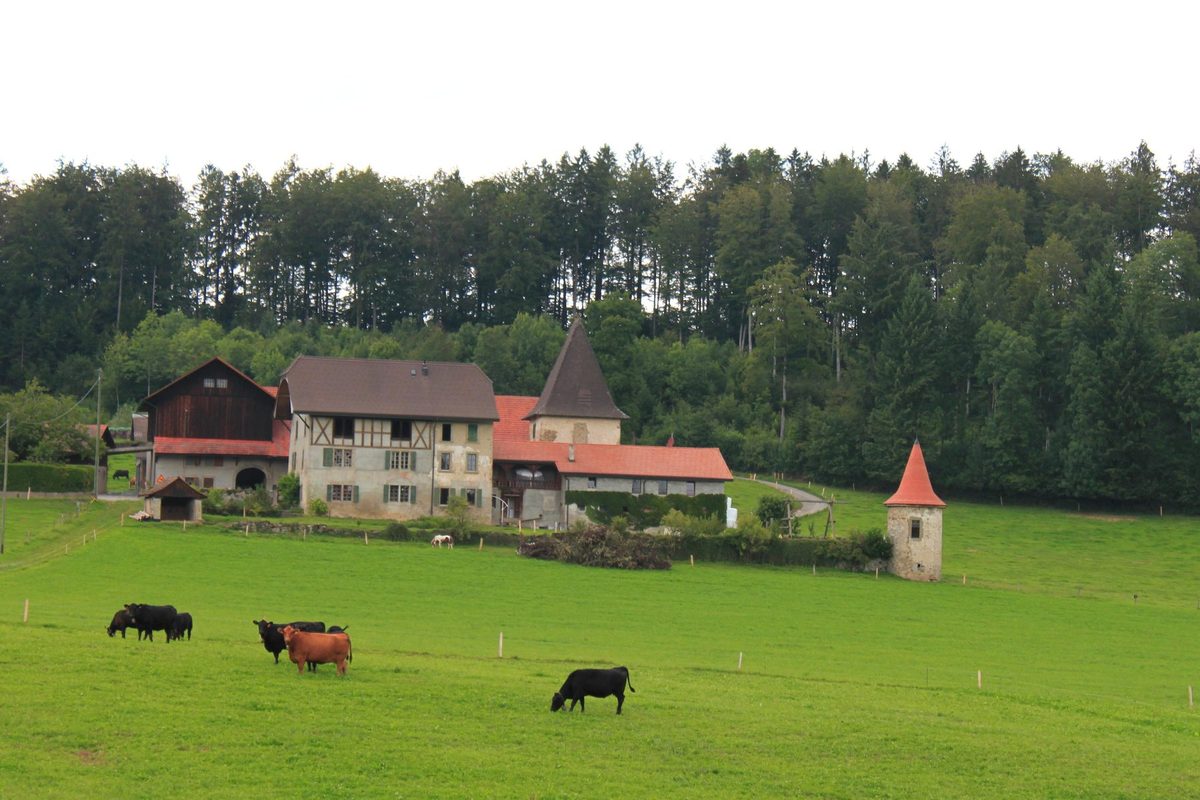
- La Dausaz, ferme avec rural, tour et grenier, remise, galerie au sud, tourelle et mur d'enceinte
Sources
- Dictionnaire historique de la Suisse, Olivier Frédéric Dubuis, « Tavernes, Les », version du 03.05.2022
- Commune d'Oron, page « Les Tavernes »
- Dictionnaire historique de la Suisse, Emmanuel Abetel, « Palézieux », version du 21.04.2022
- État de Vaud, communiqué du 28.11.2010, « 17 communes plébiscitent leur fusion »
- Office fédéral de la protection de la population, Inventaire suisse des biens culturels d'importance nationale et régionale, liste du canton de Vaud (état au 1.1.2026)
- Federal Office for Civil Protection (FOCP), Swiss Inventory of Cultural Property (PCP), list for the canton of Vaud (as of 1.1.2026)
- Register of Swiss Surnames, 3rd edition (1989), search Commune "Les Tavernes", Canton VD
Published by Sébastien Jörg ·
Other villages near Les Tavernes
Missing information, or do you have a source? Suggest a correction or addition. Every submission is checked before it's published.
Suggest a change