Sévery
Recorded from 1228, the Sévery mill still runs, now as a walnut oil press. The village, mentioned in 979, has been part of Hautemorges since 2021.
Entry based on 8 sources · Our method · Reusable text (CC BY-SA)
Origin of the name Sévery
The oldest written forms of the name are Siuiriaco in 979 and Syuiriez in 1453. Its precise origin has not been explained. Common in Vaud place names, the ending in -y is often linked to an old Gallo-Roman suffix attached to a personal name, which may also apply to Sévery.
Coat of arms of Sévery
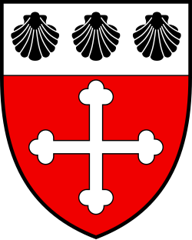
Gules, a cross botonny argent, on a chief of the second three scallops sable. A white cross with trefoil-shaped ends stands out on a red field. The horizontal band at the top is white and bears three black scallop shells. These are the arms of the former municipality of Sévery, adopted in 1921 when armorial stained-glass windows were installed in the restored church. The cross, known as the cross of Saint Maurice, recalls the patron of the old church and the ties with the Abbey of Saint-Maurice d'Agaune. The scallops come from the arms of the nobles of Sévery.[7]
Founding of Sévery
Neither a founder nor a date of creation is known for Sévery: like most villages in the region, it took shape gradually in the early Middle Ages around an older rural settlement. The site has been occupied since Antiquity. At Le Châtelard, remains of a 1st-century Roman villa and an early medieval necropolis have been uncovered. The village appears in the records in 979, as Siuiriaco. In the Middle Ages it fell under the barony and then the castellany of Cossonay, and the abbey of Saint-Maurice held important estates there.
History of Sévery
1st century. Roman occupation attested by the remains of a villa discovered at the place called Le Châtelard.
Early Middle Ages. A necropolis occupies the site of Le Châtelard after the Roman villa is abandoned.
979. First written mention of the village, in the Latinized form Siuiriaco.
1007. A first château, a few hundred metres north-east of the village, is reportedly mentioned this year.[2]
1228. A mill is mentioned for the first time within the village's territory. It still operates today as an oil press.
13th century. Construction of a second château on the bank of the Simpremont, square in plan, of the Savoyard type, with four round towers.[2]
1453. The village's name is attested in the form Syuiriez.
1495. The lord of Sévery is reportedly Jean de Mont.[2]
1536. The conquest of the Pays de Vaud by Berne places Sévery under the administration of the bailiwick of Morges.
1768. The present château (manor house) is rebuilt by Salomon de Charrière, reusing the stones of the old 13th-century Gothic château.[2]
1784. The present church, dedicated to Saint Maurice, is built on an earlier building.
1802. The « Bourla-Papey » reportedly destroy the château's archives.[2]
1798-2007. After the fall of Bernese rule, the village belongs to the district of Cossonay until it joins the district of Morges on 1 January 2008.[4][5]
1885. The communal authorities have the remains of the first château (in the north-east) demolished, in order to increase the income from communal property.[2]
1911. The village church is restored.
1 July 2021. Sévery merges with Apples, Bussy-Chardonney, Cottens, Pampigny and Reverolle to form the new commune of Hautemorges. The least populous of the six former communes (225 inhabitants at the end of 2018), Sévery reportedly obtains only 4 seats on the communal council.[3]
Population of Sévery
Sources and references: [3]
| 1764 | 160 |
| 1850 | 198 |
| 1900 | 162 |
| 1950 | 137 |
| 2000 | 193 |
| 2018 | 225 |
Families of Sévery
Nobles of Sévery. A family of old knighthood going back to Wantelme de Cossonay, who bore the name Sévery or Siviriez. Pierre de Siviriez succeeded him, and his descendants kept the lordship until the end of the 15th century. The nobles of Sévery owned a fortified house in the village.[7]
Burgher families before 1800. Cart, Crinsoz, Gaudin, Joly, Seillon, Tappy and Tapy, with no precise date.[8]
In the 19th century. Girard, Sallaz and Vidoudez, as well as the Robert from Le Locle NE, with no precise date. The Naegele, from Germany, were received in 1892, and the de Charrière de Sévery, from Lausanne VD, in 1897.[8]
Show more families (1)
From 1901 to 1962. Ten entries, almost all from abroad. The Rodriguez, from Spain, opened the list in 1901. They were followed by the Martinelli from Italy (1908), the Schätzle from Germany (1910), the Chiavazza and the Redondi from Italy (1917), then the Leya from Latvia (1934) and the Löffler from Germany (1950). In 1956 two families from Guggisberg BE were registered, the Henneberger and the Hostettler. The last to arrive were the Rozmuski, from Poland, in 1959.[8]
Economy of Sévery, past and present
Fields and forest. Sévery has remained essentially agricultural. According to the FAO, about 82% of the land is farmland and 12% forest. In 2003 the municipality buys the Bois de Sévery, a wood of about 11 hectares.[1][7]
The oil mill. First mentioned in 1228, the mill still works as an oil mill, no longer driven by the waters of the Morges. The Bovey oil mill makes seven kinds of oil by traditional methods and has obtained the PDO Huile de noix vaudoise.[1][7]
Meat and workshops. Boucherie de Sévery SA runs an approved slaughterhouse. The Partenariat de Sévery sells Hérens breed beef under the name "Lo Bâo". The village also has a metal construction workshop, a forestry firm specialising in difficult felling, a masonry business and a riding centre.[7]
Historic sites in Sévery
Saint-Maurice church. Built in 1784 on an earlier building and restored in 1911, the church is dedicated to Saint Maurice. It became an annex of the parish of Pampigny as early as the 15th century.
Sévery Château. In 1768, two years after his marriage to Catherine de Chandieu (1766), Salomon de Charrière rebuilt the manor with the stones of the 13th-century Gothic château that preceded it. In the early 20th century W. de Charrière reportedly had it repaired.[2]
Le Châtelard. Archaeological site that has yielded remains of a Roman villa from the 1st century, later occupied by an early medieval necropolis.
Former oil mill. The mill is mentioned as early as 1228 within the village's territory and still operates today as an oil press. The present building of the walnut oil mill reportedly dates from 1598. The date is uncertain and may relate to a rebuilding.
Remains in Sévery
Tower of the 13th-century Gothic château. The second château, built in the 13th century on the Simpremont, followed a square Savoyard-type plan with four round towers. Only one complete tower survives. A drawing by Wagner of 1839 reportedly shows a second tower lowered to half its height.[2]
Remains of the Roman villa of Le Châtelard. Remains of a Roman villa from the 1st century and of an early medieval necropolis have been uncovered at the place called Le Châtelard.
Protected heritage in Sévery
Cultural property of regional significance (B objects)[6]
- Château avec dépendance et tour
Sources
- François Béboux, « Sévery », Dictionnaire historique de la Suisse (DHS), version du 01.11.2021
- swisscastles.ch, « Château de Sévery »
- Conseil d'État du canton de Vaud, exposé des motifs et projet de décret sur la fusion des communes d'Apples, Bussy-Chardonney, Cottens, Pampigny, Reverolle et Sévery (Hautemorges), novembre 2019
- État de Vaud, Loi du 30 mai 2006 sur le découpage territorial (LDecTer)
- État de Vaud, communiqué « Organisation des préfectures et adaptation au nouveau découpage territorial », 12 juillet 2007
- Federal Office for Civil Protection (FOCP), Swiss Inventory of Cultural Property (PCP), list for the canton of Vaud (as of 1.1.2026)
- Official Gazette of the Canton of Vaud (FAO), "Alphabet des communes vaudoises: Sévery"
- Register of Swiss Surnames, 3rd edition (1989), search Commune "Sévery", Canton VD
Published by Sébastien Jörg ·
Other villages near Sévery
Missing information, or do you have a source? Suggest a correction or addition. Every submission is checked before it's published.
Suggest a change