Treytorrens
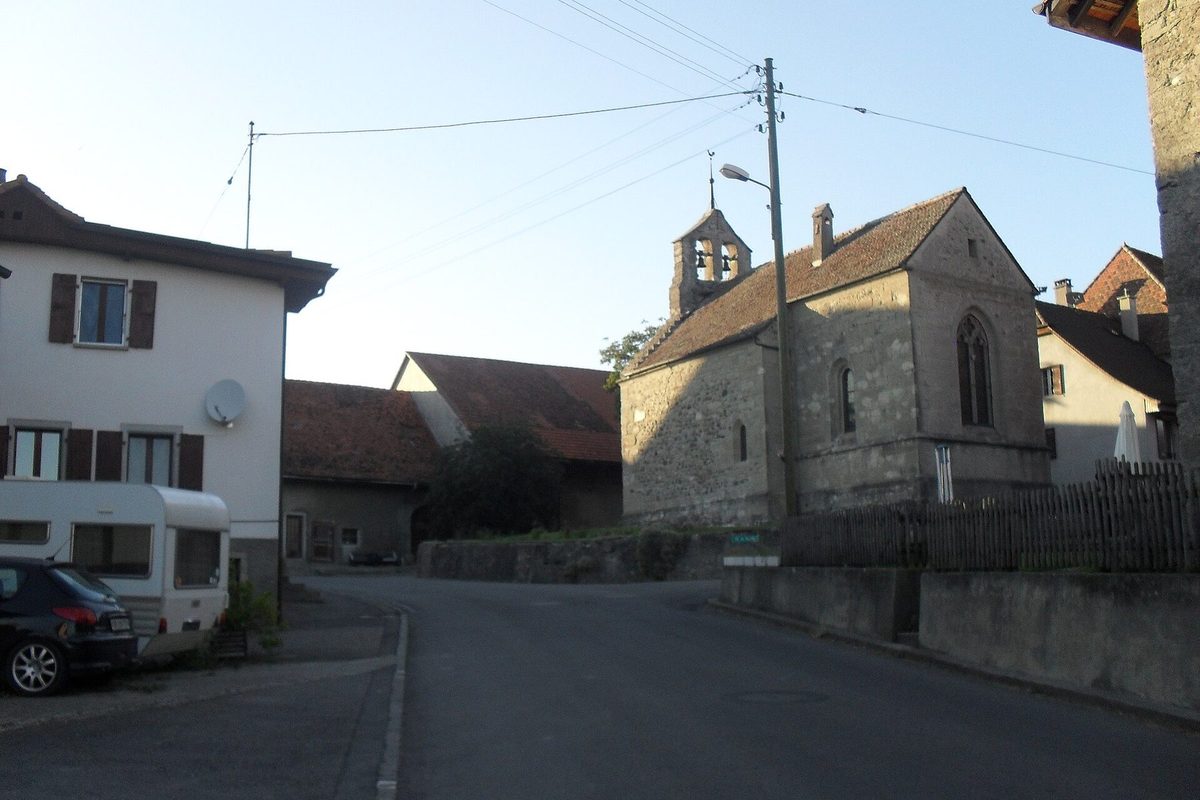
Treytorrens is thought to have grown around a 13th-century fortified house that still stands. Its church of Saint-Jean-l'Évangéliste, rebuilt in the 15th century, is of national importance.
Entry based on 11 sources · Our method · Reusable text (CC BY-SA)
Origin of the name Treytorrens
The first written mention, in 1194, gives the form «Troterens». The name is said to come from a Germanic personal name such as Trudhari followed by the suffix -ingos, meaning «among the people of» that person.[3]
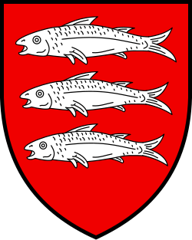
Coat of arms of Treytorrens
Gules, three fish argent, fesswise in pale. On a red field, three white fish lie horizontally one above the other. These are the arms of the nobles of Treytorrens, who had no male heir after 1848. The municipality took them over in full in 1907.[9][8]
Founding of Treytorrens
Remains of a Roman settlement show early occupation of the site. Neither the founding date of the village nor its founder is known. It is thought to have formed around the fortified house known as the «château», dating back to the 13th century and still visible. In the 12th century, the lords of Treytorrens were vassals of the Bishop of Lausanne. The municipality comprises the clustered village of Treytorrens and the hamlet of Les Molliettes.[3]
History of Treytorrens
Roman period. Roman settlement, of which remains survive.[3]
12th century. The lords of Treytorrens are vassals of the Bishop of Lausanne.
1194. First written mention, in the form «Troterens».[3]
13th century. Construction of the fortified house around which the village is thought to have formed. In the middle of the century, the lords of Treytorrens recognise the overlordship of Peter II of Savoy.[3]
1433. The village has 13 hearths (this count is also dated to 1443).
15th century. Rebuilding of the church of Saint-Jean-l'Évangéliste.[3][4]
1536. Start of Bernese rule; Treytorrens belongs to the bailiwick of Moudon until 1798.[3]
1543. The seigneury is sold to Pierre Morel, of Fribourg, then passes the same year to the Molin family of Estavayer; the «château» is mentioned.[3]
1685. The seigneury passes to the DuGué family, Huguenot refugees, who keep it until 1798.[3]
1798. The municipality is assigned to the district of Payerne, until the new districts came into force on 1 January 2008.[6]
1882. Construction of the school, today the municipal hall.[3]
1907. Restoration of the church.[3][4]
1941-1943. Land consolidation.[3]
1985. Further restoration of the church (or in 1987).[3][4]
2005. The municipality has eleven farms.
2008. The district of Broye-Vully, created by the new territorial division of Vaud, begins operating on 1 January.[6]
Population of Treytorrens
Sources and references: [2]
| 1433 | 13 hearths (households) |
| 1558 | 16 hearths (households) |
| 1764 | 80 inhabitants |
| 1850 | 195 inhabitants |
| 1900 | 164 inhabitants |
| 1950 | 157 inhabitants |
| 2000 | 102 inhabitants |
| 2025 | 108 inhabitants |
Families of Treytorrens
De Treytorrens. From the 12th century the family held various lordships in the Pays de Vaud, including the village of Treytorrens. Its earliest known members, the knights Uldriod and Renaud, are mentioned from 1160. Several members played a political role at the court of the House of Savoy. It held the mayoralty of Cudrefin, was among the burghers of Payerne, Estavayer, Cudrefin, Avenches and Moudon, and died out in the male line with Henri de Treytorrens, the last of the Treytorrens of Cudrefin.[10][8]
Burgher families before 1800. Besson, Charbon and Piot, with no precise date.[11]
In the 19th century. Correvon, Frider and Lador, with no precise date. The Assal, from Germany, were registered in 1868.[11]
Show more families (1)
From 1901 to 1962. Seven entries: the Walter, from Germany, in 1916, the Rossi, from Italy, in 1918, then two more Italian families, the Bacuzzi in 1951 and the Boninsegni in 1957. In 1961 came the Ivanescu, from Romania, and the Bütikofer of Mühleberg BE. The Goetschi of Galmiz FR, in 1962, were the last to be registered.[11]
Economy of Treytorrens, past and present
Cereals and milk. The inhabitants have long drawn most of their income from farming. The village lives from crops, mainly cereals, and from milk production. The milk was processed on site, in the building the cheese dairy society had built around 1829. In the 19th century the Petite-Glâne drove a mill at the place called Les Molliettes. In the 20th century the economic situation changed little. The milk goes to the cheese dairy of Combremont-le-Petit. 6 farms share 240 ha of farmland, where wheat, potatoes, fodder crops and pasture alternate. The 60 ha of forest, 23 of them owned by the municipality, are mostly conifers.[3][8]
Sawmill and workshops. The ISOS inventory lists a few businesses: a sawmill with a carpentry workshop, another workshop used for joinery, a telecine studio and a painting workshop.[3]
Disasters and major events in Treytorrens
The fire of 1839. During the night of 24 to 25 October 1839, fire destroyed part of the castle next to the church, including its barns.[8]
Historic sites in Treytorrens
Church of Saint-Jean-l'Évangéliste. Church with a bell-gable, which belonged to the parishes of Murist and Combremont-le-Grand. Rebuilt in the 15th century, restored in 1907 and 1985 (or 1987). It is listed as a cultural property of national importance.[3][4][5]
The «château». Fortified house dating back to the 13th century, mentioned as a «château» in 1543 and still visible. The village is thought to have formed around it.[3]
Former school. School built in 1882, today the municipal hall.[3]
Remains in Treytorrens
Roman settlement. Remains of a Roman-period settlement on the territory of the municipality.[3]
Fortified house. Fortified house dating back to the 13th century, still standing, called a «château» in the 1543 mention.[3]
Protected heritage in Treytorrens
Cultural property of national significance (A objects in the PCP inventory)[7]
- Eglise réformée Saint-Jean-l'Evangéliste
Cultural property of regional significance (B objects)[7]
- Bâtiment dit «le Couvent»
- Château
Traditions and festivals in Treytorrens
1 August with Champtauroz. Treytorrens celebrates 1 August every other year, taking turns with Champtauroz. The village also has its Christmas party, and a Christmas meal brings the seniors together.[8]
Sources
- Dictionnaire historique de la Suisse, « Treytorrens (Payerne) »
- Statistique Vaud, « Population résidante permanente au 31 décembre 2025 »
- Office fédéral de la culture, ISOS, « Treytorrens », fiche n° 4697, 2e version, novembre 2011
- Inventaire fédéral des biens culturels (PBC), fiche 6505 « Église réformée, ancienne Saint-Jean-l'Évangéliste », texte de la Société d'histoire de l'art en Suisse
- Office fédéral de la protection de la population, géodonnées de l'inventaire PBC, objet 6505 (catégorie A), Treytorrens (Payerne)
- État de Vaud, communiqué du 12.07.2007, « Les préfètes et les préfets sont attribués aux nouveaux districts »
- Federal Office for Civil Protection (FOCP), Swiss Inventory of Cultural Property (PCP), list for the canton of Vaud (as of 1.1.2026)
- Official Gazette of the Canton of Vaud (FAO), "Alphabet des communes vaudoises: Treytorrens"
- IPI, Swissreg, emblems database: coat of arms of Treytorrens (Payerne) (no. 101946)
- Historical Dictionary of Switzerland (HDS), article "Treytorrens" (Olivier Pavillon, version of 22.08.2024)
- Register of Swiss Surnames, 3rd edition (1989), search Commune "Treytorrens (Payerne)", Canton VD
Published by Sébastien Jörg ·
Other villages near Treytorrens
Missing information, or do you have a source? Suggest a correction or addition. Every submission is checked before it's published.
Suggest a change