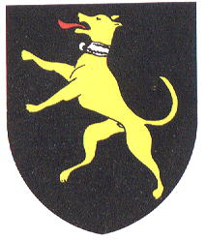
Combremont-le-Grand
At Le Cerisier, near early medieval graves, three well-shaped pits arranged in a triangle remain a mystery. The castle, built around 1330-1340, bears the arms of the Mestral family dated 1537.
Entry based on 12 sources · Our method · Reusable text (CC BY-SA)
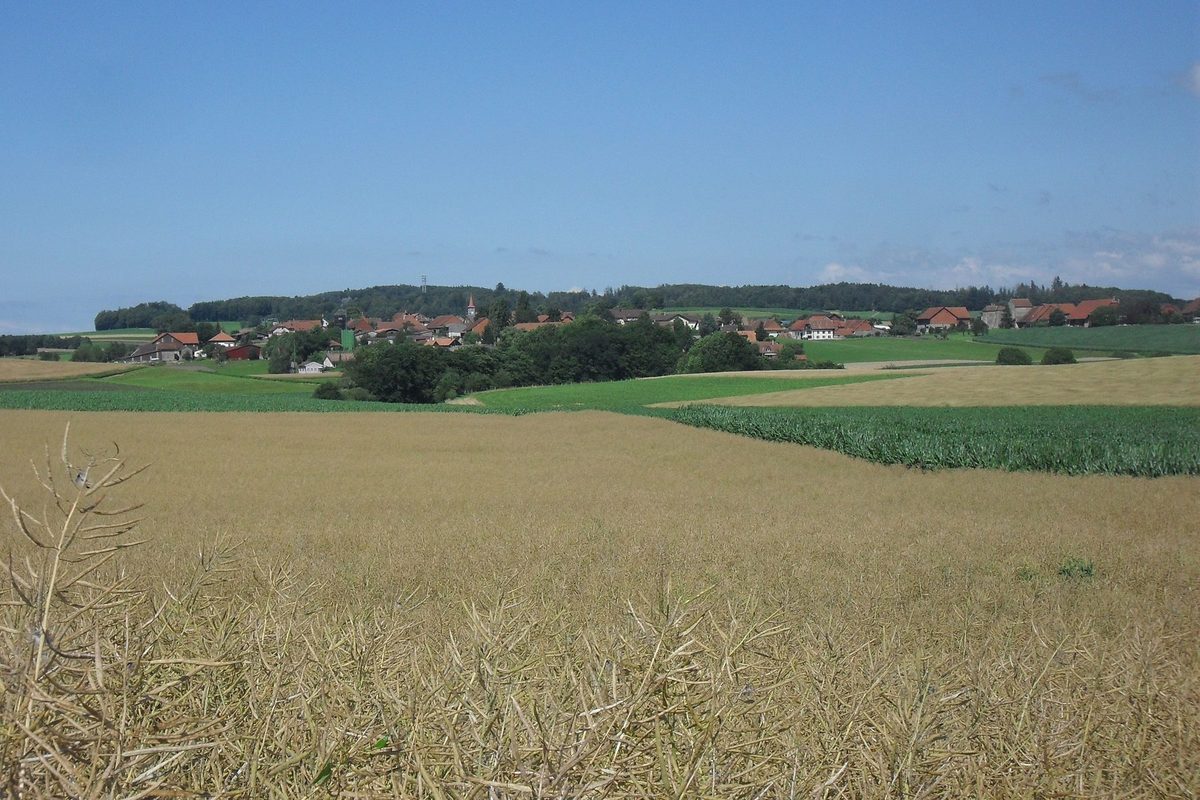
Origin of the name Combremont-le-Grand
The name appears in 911 in the form «Cumbromo», then in 1142 in the form «Combremont», which has remained stable since. The neighbouring village of Combremont-le-Petit shares this root and these dates, which indicates a common origin for the two localities before their administrative and parish separation. The name is probably made up of «combe» (small valley, hollow) and «mont» (hill), but no detailed etymological study confirms this. The qualifier «le Grand» appeared later, to distinguish the village from its smaller neighbour.[1]
Founding of Combremont-le-Grand
No single person or act marks the birth of the village. The site has been occupied since the early Middle Ages, and a chapel is mentioned there in 911. Combremont-le-Grand took its seigneurial form in the late Middle Ages under the de Combremont family, who had a castle built on the site of an older building. The community then organised itself around this seigneury, with a communal assembly and two governors. The seigneury passed to other noble families, then under Bernese rule.[1]
History of Combremont-le-Grand
911. First attested mention of the place, in the form "Cumbromo", on the occasion of the mention of a chapel. This attestation is shared with that of the future Combremont-le-Petit.[1][5]
1142. The place is mentioned in the form "Combremont", a form close to the present-day name.[1]
14th century. Mention of the parish church of Combremont-le-Grand, which at the time also served the surrounding hamlets.[1][5]
around 1330-1340. The de Combremont family has a castle built on the site of an earlier building. The building is remodelled in the second half of the 16th century.[1]
1432. The village has 21 hearths (households), according to the surveys of the time.[1]
1536. After the conquest of the Pays de Vaud by Berne, Berne and Fribourg share the seigneury. The larger part goes to Berne and is attached to the bailiwick of Moudon.[1]
1537. After buying the castle, the de Mestral family places its coat of arms, dated 1537, above the entrance door.[4]
1798-1803. With the independence of the canton of Vaud, Combremont-le-Grand is attached to the district of Moudon.[1]
1803-2007. The municipality is part of the district of Payerne.
1824-1825. The parish church is entirely rebuilt.[1]
1951. Construction of a new school building.
1980s. Development of a villa zone, while retaining the village's predominantly agricultural character.[1]
1 January 2008. The new territorial division comes into force: the district of Payerne disappears and the municipality joins the new district of Broye-Vully.
1 July 2011. Combremont-le-Grand merges with Cerniaz, Combremont-le-Petit, Granges-près-Marnand, Marnand, Sassel, Seigneux and Villars-Bramard to form the new municipality of Valbroye. Combremont-le-Grand becomes a locality within this municipality.[6][9]
Population of Combremont-le-Grand
Sources and references: [1]
| 1432 | 21 hearths (households) |
| 1764 | 194 |
| 1798 | 257 |
| 1850 | 444 |
| 1900 | 441 |
| 1920 | 458 |
| 1950 | 362 |
| 1980 | 278 |
| 2000 | 308 |
Families of Combremont-le-Grand
De Combremont. Lords of the place until the 14th century, they built the castle around 1330-1340. After the family died out, the lordship passed to the d'Avenches, the d'Estavayer, the Mestral and the Mayor.[1]
Mestral. A Payerne family, also called Mestral de Rue after the métralie (mayoralty) of Rue that it held. It gave the town several avoyers (chief magistrates), among them Girard, lord of Brit, in office from 1536 to 1557. He bought the lordship of Combremont-le-Grand in 1537. The Combremont-le-Grand branch died out with Marguerite in 1760.[11]
Citizen families before 1800. Ballif, Bercher, Décrevel, Favre, Gatabin, Gilliand, Monnerat, Rey and Viquerat, without a precise date. The Du Mont family (from France) obtains citizenship in 1770.[12]
Show more families (1)
From 1901 to 1962. 11 registrations. Several families come from abroad: from Italy (Catellani in 1935, Delpedro in 1950 and 1952, Calderara in 1953, Viglino in 1954 and Rastoldo in 1960), from Germany (Fackler in 1933 and Sinning in 1953) and from France (Dumont in 1906). From Switzerland come the Zaugg family from Trub BE (1956) and the Burgy family from Monterschu FR (1957). They are joined by the Bourquin family (1950). The last family registered, in 1960, is the Rastoldo family.[12]
Economy of Combremont-le-Grand, past and present
A farming village. In the 20th century Combremont-le-Grand remained a farming village, also home to several small businesses.[1]
Historic sites in Combremont-le-Grand
Combremont-le-Grand Castle. Built around 1330-1340 by the de Combremont family on the site of an older building, the castle originally had an imposing keep and a crenellated curtain wall ending in a corbelled turret, elements later demolished. The gate tower has retained arrow-slit openings adapted for arquebuses, a Gothic pointed-arch entrance door and carved coats of arms, including those of the de Mestral family and the von Erlach family. The inner courtyard is lined with Gothic pointed arcades and Renaissance basket-arch arcades, topped by a former wooden gallery now closed off. The Mestral family placed its arms there with the date 1537, after buying the castle.[1][4]
Parish church. A chapel is mentioned on the site as early as 911, and a parish church is attested as early as the 14th century. The present building results from a complete reconstruction carried out in 1824-1825.[1][5]
Remains in Combremont-le-Grand
Necropolis and enigmatic structures of Le Cerisier. At the place called Le Cerisier, early medieval graves have been uncovered. Nearby, three well-shaped hollows, arranged in a triangle, have also been recorded, but their function and dating have not been established to date.[1]
Protected heritage in Combremont-le-Grand
Cultural property of regional significance (B objects)[10]
- Château et ancien donjon
Sources
- Dictionnaire historique de la Suisse, article "Combremont-le-Grand"
- Dictionnaire historique de la Suisse, article "Combremont-le-Grand" (ancienne URL)
- Dictionnaire historique de la Suisse, article "Combremont-le-Petit"
- Swisscastles.ch, "Le château de Combremont le Grand"
- notreHistoire.ch, "Eglise de Combremont-le-Grand"
- Feuille des Avis Officiels du canton de Vaud, alphabet des communes, "Valbroye"
- Dictionnaire historique de la Suisse, article "Valbroye"
- État de Vaud, communiqué du 12.07.2007, « Organisation des préfectures et adaptation au nouveau découpage territorial »
- Canton de Vaud, Loi sur le découpage territorial (LDecTer, RSV 132.15) du 30 mai 2006
- Federal Office for Civil Protection (FOCP), Swiss Inventory of Cultural Property (PCP), list for the canton of Vaud (as of 1.1.2026)
- Historical Dictionary of Switzerland, "Mestral, de (VD, Combremont)" (version of 05.11.2008)
- Register of Swiss Surnames, 3rd edition (1989), search Commune "Combremont-le-Grand", Canton VD
Published by Sébastien Jörg ·
Other villages near Combremont-le-Grand
Missing information, or do you have a source? Suggest a correction or addition. Every submission is checked before it's published.
Suggest a change