Troistorrents
Origin of the name Troistorrents
The form « Trestorrens » is attested in 1248, followed by « Trestorrentibus » (1283), « Trestorrent » (1352) and « Troistorrens » (1505). The name is said to come from the Latin « Trans Torrentium », « beyond the torrent ». Reread as « of the three torrents », it would have led people to believe there were three streams.[1][3]
Founding of Troistorrents
Nobody knows who founded Troistorrents. A few Roman coins have been found here. The village lies in the Val d'Illiez, the valley of the Vièze, on the left bank of the Rhône, and the municipality also includes Morgins, Chemex, Chenarlier, Croix-du-Nant and Vers-Ensier. In the Middle Ages Troistorrents belonged to the Savoyard castellany of Monthey but kept its own metral, even after Monthey came under the Upper Valais dizains. The Abbey of Saint-Maurice also held the lordships of Cries and of Chièzes, a village that has since vanished, on its territory. After repeated conflicts with Monthey and Collombey, Troistorrents became a castellany in its own right.[1]
History of Troistorrents
1248. Mention « Trestorrens » and first mention of a chapel, dependent on Collombey. Troistorrents becomes a parish before 1278.[1]
1258. The Abbey of Saint-Maurice holds the lordships of Chièzes and Cries, which it keeps until 1798.[1]
1401. Date of the Tine mills, now listed.[1]
1480. The office of metral is held by the Nicolerat family, who sell it in 1619 to the du Fay. They later cede it to the municipality.[1]
1505. The Abbey of Saint-Maurice sets up a high court of justice at Chièzes, despite protests from the castellan of Monthey.[1]
1536. The castellany of Monthey comes under the rule of the Upper Valais dizains.[1]
1702. Construction of the church of Sainte-Marie-Madeleine, restored in 1959.[1]
1787. The Valais Diet separates Troistorrents, Monthey and Collombey. Troistorrents forms a new castellany.[1]
1790. Troistorrents joins the revolt of the people of the Val d'Illiez led by Pierre-Maurice Rey-Bellet.[1]
1839. Troistorrents and Illiez recognise the government of Sierre and are then occupied by the troops of the government of Sion.[1]
1844. The Troistorrents militia fights at the battle of the Trient in the ranks of the Old Switzerland. In 1847 the municipality is occupied by federal troops.[1]
1851. Some sixty inhabitants emigrate to Algeria.[1]
1866. The burghers' community has a hotel built to benefit from the nascent tourism.[1]
1908. Opening of the station of the Monthey-Champéry railway. The carriage road follows in 1911.[1]
1940. In the 1940s winter tourism begins to develop, above all in Morgins.[1]
Population of Troistorrents
Sources and references: [1][6]
| 1850 | 1'191 |
| 1900 | 1'556 |
| 1950 | 1'836 |
| 2000 | 3'567 |
| 2025 | 5'067 |
Historic sites in Troistorrents
Church of Sainte-Marie-Madeleine. Parish church of 1702, restored in 1959. Each village of the municipality also has its own chapel.[1][4][5]
Morgins. Village of the municipality at 1'342 m above sea level, where winter tourism develops from the 1940s. The resort belongs to the Portes du Soleil ski area.[1][2]
Chapel of Chemex. Chapel of the Three Kings, cultural property of regional importance (federal PCP inventory).[4][5]
Bread ovens. Propéraz communal bread oven, built in 1663, cultural property of regional importance (federal PCP inventory). The Collaire oven reportedly dates from 1610.[4][5]
Remains in Troistorrents
Tine mills. Mills dated 1401, protected as historic monuments. Cultural property of regional importance (federal PCP inventory).[1][4]
Chièzes. Vanished village, seat of a lordship of the Abbey of Saint-Maurice where a high court of justice was set up in 1505.[1]
Roman coins. A few Roman coins were discovered in 1947.[1]
Legends of Troistorrents
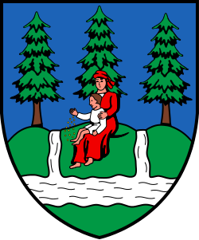
Ashes against the Saracens. According to a tradition recalled by the woman and child on the coat of arms, the women and children of the village are said to have blinded Saracen invaders by throwing ashes at them.
The child who survived the plague. Another tradition, linked to the same coat of arms, tells that the village, emptied by the plague, is said to have been repopulated from a single surviving child.
Sources
- Dictionnaire historique de la Suisse, « Troistorrents » (David Rey, version du 26.11.2012)
- Dictionnaire historique de la Suisse, « Morgins » (Pascal Dubey, version du 13.01.2009)
- Henry Suter, « Noms de lieux de Suisse romande, Savoie et environs », glossaire, article « Troistorrents »
- Office fédéral de la protection de la population (OFPP), Inventaire PBC, liste cantonale du Valais (objets A et B, état au 1.1.2026)
- Région Dents du Midi, « Orange Cultural Trail: Troistorrents, Croix du Nant, Chemex, Propéraz, Troistorrents »
- Office fédéral de la statistique (OFS), STATPOP, chiffres provisoires au 31.12.2025, via citypopulation.de
- geo.admin.ch, recherche de lieux (coordonnées)
Localities of the municipality with a page
Other villages near Troistorrents
Missing information, or do you have a source? Suggest a correction or addition. Every submission is checked before it's published.
Suggest a change