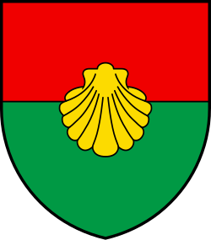
Vandœuvres
Coat of arms: Public domain, Wikimedia Commons
Origin of the name Vandœuvres
The form « Vandovre » appears in 1225, and the parish is attested in 1280. The origin of the name has not yet been explained.[1]
Founding of Vandœuvres
The territory was occupied from the end of the Early Iron Age and in the Late La Tène period. A Gallo-Roman villa was inhabited here from the 1st to the 4th century. In the 5th century a funerary chapel dedicated to Saint James was built against it, the oldest known Christian place of worship in the Genevan countryside. Nobody knows who founded the village. In the 13th century Vandœuvres was a parish: the chapter of Genève and the priory of Saint-Victor owned most of the territory and shared sovereignty with the Count of Geneva, whose rights later passed to the House of Savoy. After the Reformation Genève shared sovereignty with Bern, then with Catholic Savoy, until the Treaty of Turin restored it in full. Vandœuvres became a municipality when Genève was annexed by France.[1]
History of Vandœuvres
650-450 BC. Remains from the end of the Early Iron Age.[1]
120-100/50 BC. Remains from the Late La Tène period.[1]
1st-4th century. A Gallo-Roman villa is inhabited on the territory.[1]
5th century. Construction of a funerary chapel dedicated to Saint James, built against the villa: the oldest known Christian place of worship in the Genevan countryside.[1]
1225. Old form of the name « Vandovre ».[1]
1280. The parish is attested.[1]
1295. The chapter of Genève and the priory of Saint-Victor, the main landowners, share sovereignty with the Count of Geneva Amadeus II.[1]
1406. The parish of Cologny is united with that of Vandœuvres.[2]
Early 15th century. The rights of the Count of Geneva pass to the House of Savoy.[1]
1536. After occupation by Genevan troops, the Reformation is adopted.[1]
1538-1564. Genève shares sovereignty with Bern, then with Catholic Savoy.[1]
17th-18th century. Wealthy Genevan families (Butini, Mallet, Revilliod) build country houses here.[1]
1754. The Treaty of Turin ends the disputes over jurisdiction and restores full sovereignty to Genève.[1]
1798. Vandœuvres becomes a municipality when Genève is annexed by France.[1]
1952. The municipality, entirely agricultural until then, sees a third of its area rezoned for villas.[1]
Today. Strongly residential municipality that keeps farming on 65 % of its territory.[1]
Population of Vandœuvres
Sources and references: [1][3]
| 1850 | 526 |
| 1900 | 542 |
| 1950 | 1'073 |
| 2000 | 2'333 |
| 2025 | 3'129 |
Historic sites in Vandœuvres
Village and localities. The municipality comprises the village of Vandœuvres and the localities of Chougny, Crête, Miolan and Pressy.[1]
Country houses. In the 17th and 18th centuries wealthy Genevan families, including the Butini, Mallet and Revilliod, built country houses here.[1]
Remains in Vandœuvres
Gallo-Roman villa. Villa inhabited from the 1st to the 4th century AD.[1]
Funerary chapel of Saint-Jacques. 5th-century chapel built against the villa, the oldest known Christian place of worship in the Genevan countryside.[1]
Iron Age remains. Remains from the end of the Early Iron Age (650-450 BC) and from the Late La Tène period (120-100/50 BC).[1]
Sources
- Dictionnaire historique de la Suisse, « Vandœuvres » (Hansjörg Roth)
- Dictionnaire historique de la Suisse, « Cologny » (Jacques Barrelet)
- Office cantonal de la statistique (OCSTAT), Mémento statistique du canton de Genève 2026, tableau Population résidante par commune, en 2025
- Office fédéral de topographie swisstopo, service de recherche geo.admin.ch (coordonnées)
Localities of the municipality with a page
Other villages near Vandœuvres
Missing information, or do you have a source? Suggest a correction or addition. Every submission is checked before it's published.
Suggest a change