Vernier
Origin of the name Vernier
The name appears in 1209 as « Verneyer », and the fief of « Verny » is mentioned in 1308. Its etymology has not yet been explained.[1]
Founding of Vernier
Who founded Vernier is not known. The site was nonetheless occupied early: Bronze Age axes and rings have been found at Aïre, remains line the Roman road from Genève to Lyon, and some graves date from after the 5th century. In the Middle Ages the village belonged to the parish centred on Poussy. It then counted some twenty fiefs, the most important being Verny. Part of the Pays de Gex, it later passed to the Bernese, then to France, before being ceded to Genève. Until the mid-19th century Vernier lived from farming, vineyards and forest. It then industrialised and urbanised massively from the early 1960s.[1]
History of Vernier
Bronze Age. Axes and rings found at Aïre.[1]
1153. Poussy (« Possiniaco ») is the centre of the parish of Vernier.[1]
1209. Old form « Verneyer ».[1]
1308. Mention of the fief of « Verny », the most important of the fiefs at Vernier and Poussy.[1]
1410. The Bourgeois family, vassals of the lord of Gex, become lords of Verny and build a castle at Poussy.[1]
1481. At the pastoral visitation the parish depends on the abbey of Saint-Claude.[1]
1536-1567. Bernese rule over the Pays de Gex. Adoption of Protestantism in 1538.[1]
1590. Demolition of the castle of Poussy, rebuilt in 1680.[1]
1601. Vernier becomes French; the Catholics are attached to Le Grand-Saconnex.[1]
1687. The Catholic parish is restored.[1]
1792-1813. Vernier belongs to the department of Ain (1792-1798), then to the department of Léman (1798-1813).[1]
1815. Vernier is ceded by France to Switzerland and joined to the canton of Genève.[1]
1837. A Protestant temple is built. Protestant worship had been restored in 1819.[1]
1844. Construction of the new church of Saints-Jacques-et-Philippe.[1]
1858. Opening of the Lyon-Genève railway line.[1]
1896. The Chèvres hydroelectric plant goes into service, the first run-of-river plant in Europe.[1]
1914. Construction of a gasworks, with its own railway siding.[1]
1961-1963. Start of massive urbanisation: the Avanchet (1961) and Le Lignon (1963) estates.[1]
1979. Experimental solar energy station (Solarcad project).[1]
Population of Vernier
Sources and references: [1][2]
| 1816 | 566 |
| 1850 | 767 |
| 1900 | 1'280 |
| 1950 | 3'906 |
| 1960 | 8'045 |
| 1970 | 22'230 |
| 2000 | 29'559 |
| 2025 | 38'823 |
Historic sites in Vernier
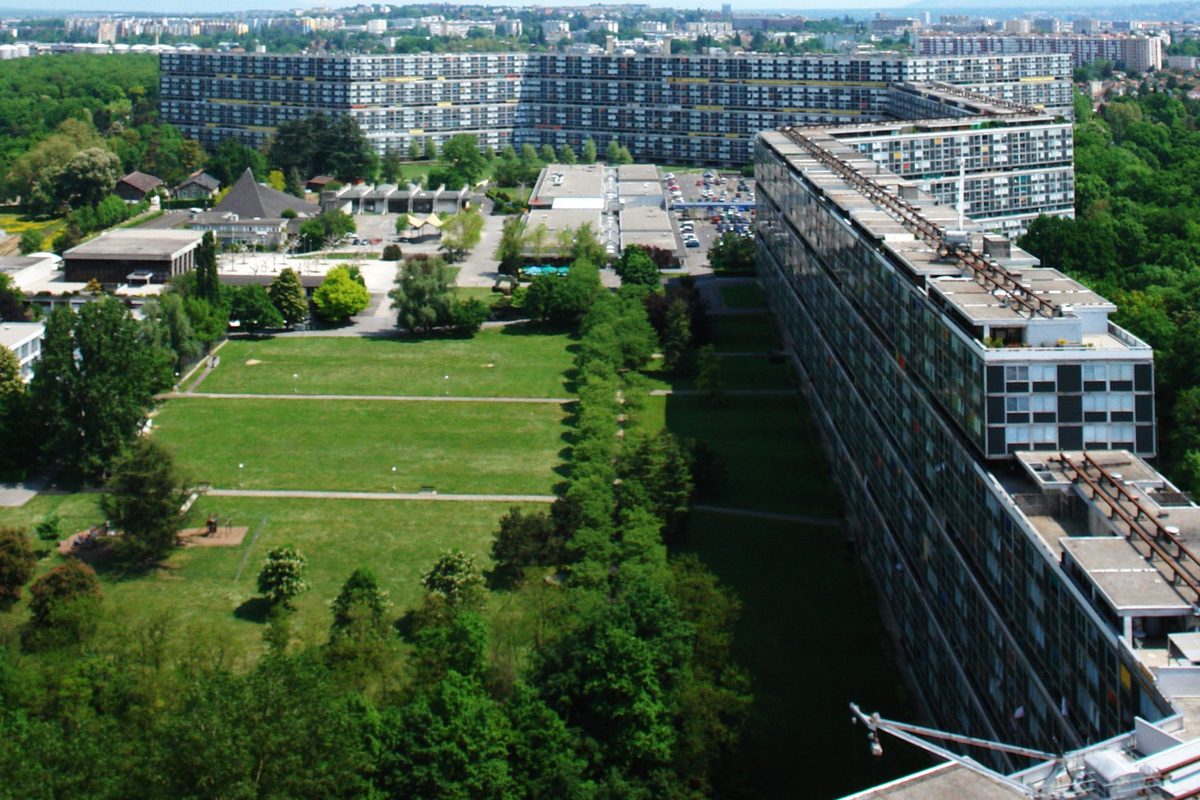
Le Lignon. Large housing estate built from 1963, partly subsidised.[1]
Chèvres power plant. Hydroelectric plant on the Rhône put into service in 1896, the first run-of-river plant in Europe.[1]
Church of Saints-Jacques-et-Philippe. Catholic church built in 1844.[1]
Temple of Vernier. Protestant church built in 1837, after Protestant worship was restored in 1819.[1]
Aïre and Châtelaine. Localities of the municipality; in the Middle Ages the cemetery of the Jews of Genève was at Châtelaine, and the raising of the level of the Rhône submerged the mills and islands of Aïre.[1]
Remains in Vernier
Bronze Age finds at Aïre. Bronze Age axes and rings.[1]
Roman road and burials. Remains along the Roman road from Genève to Lyon. Slab graves and earth burials later than the 5th century.[1]
Sources
- Dictionnaire historique de la Suisse, « Vernier » (Pierre Pittard)
- Office cantonal de la statistique (OCSTAT), Mémento statistique du canton de Genève 2026, tableau Population résidante par commune, en 2025
Localities of the municipality with a page
Other villages near Vernier
Missing information, or do you have a source? Suggest a correction or addition. Every submission is checked before it's published.
Suggest a change