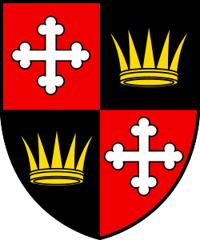
Vérossaz
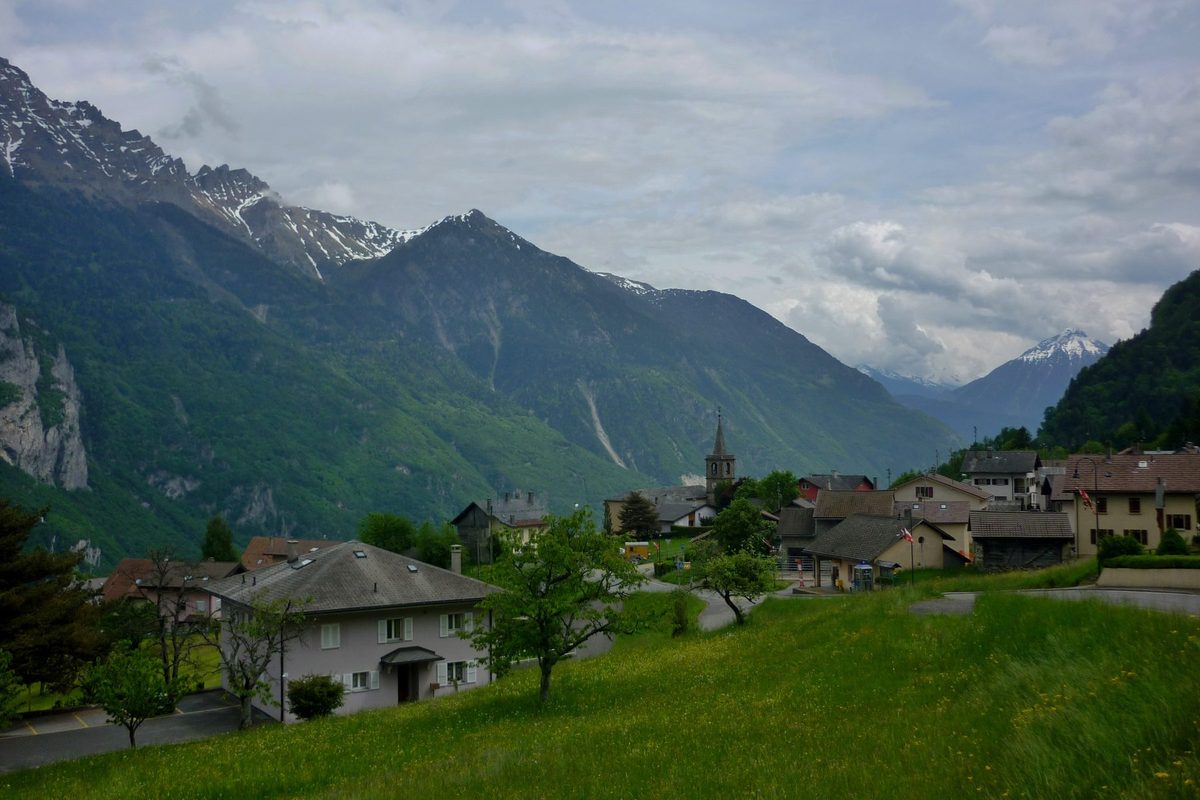
Origin of the name Vérossaz
The name appears in 1046 as « Verolsa ». It reportedly comes from the Franco-Provençal verossa, meaning the mountain alder, a word probably of Gaulish origin.[1]
Founding of Vérossaz
A Bronze Age axe has been found on the plateau above Saint-Maurice, but the plateau does not seem to have been permanently settled before the 11th century. After the death of Rudolph III, the last king of Burgundy, the territory passed to the House of Savoy and belonged to the castellany of Saint-Maurice: the mayoralty of Les Haussex and Les Bassex belonged to the abbey of Saint-Maurice, La Doey to Savoy. Vérossaz was later part of the governorship, then the district of Saint-Maurice. Long part of the large municipality of Saint-Maurice, it separated from it to become independent. It joins the hamlets of Les Haussex, its main core, Les Bassex, La Doey, Chavanne and Vésenaud. Who founded Vérossaz is not known.[1]
History of Vérossaz
523. According to tradition, Sigismund, king of the Burgundians, is said to have withdrawn to Vérossaz.[1]
1032. Death of Rudolph III, the last king of Burgundy. Vérossaz then comes under the sovereignty of the House of Savoy, in the castellany of Saint-Maurice.[1]
1046. First attestation of the name, in the form « Verolsa ».[1]
1296. A rural community with syndics elected every year reportedly appears for the first time.
1349. The Black Death reportedly causes high mortality and a contraction of settlement.
1465. Construction of a first chapel, dependent on Saint-Maurice, rebuilt in 1742.[1]
1475-1798. Vérossaz is part of the governorship of Saint-Maurice.[1]
1531. The bell tower is built. It was reportedly kept and raised in 1875. Dates uncertain.
1822. Separation from Saint-Maurice and creation of the municipality.[1]
1831. As part of the fortification of the Saint-Maurice gorge, a redoubt for 200 soldiers and two artillery pieces is reportedly built.
1836-1838. Vérossaz is raised to a rectorate.[1]
1838. Construction of the church of Sainte-Marguerite, replacing the chapel.[1]
1847. Vérossaz becomes a parish, served by the canons of the abbey of Saint-Maurice.[1]
1996. An astronomical observatory is put into service.[1]
2000. Three quarters of the working population work outside the municipality, mainly in Saint-Maurice and Monthey.[1]
Population of Vérossaz
Sources and references: [1][2]
| 1313 | 72 hearths (households) (unconfirmed) |
| 1350 | 22 hearths (households) |
| 1417 | 32 hearths (households) (unconfirmed) |
| 1798 | 358 |
| 1850 | 607 |
| 1900 | 518 |
| 1950 | 371 |
| 2000 | 439 |
| 2025 | 944 |
Historic sites in Vérossaz
Church of Sainte-Marguerite. Built in 1838 on the site of the chapel of 1465, rebuilt in 1742, it has stained glass windows by Albert Chavaz.[1]
Hamlets of the plateau. Les Haussex, the main core, Les Bassex, La Doey, Chavanne and Vésenaud make up the municipality. In the Middle Ages the mayoralty of Les Haussex and Les Bassex belonged to the abbey of Saint-Maurice and La Doey to Savoy.[1]
Astronomical observatory. Observatory put into service in 1996.[1]
Remains in Vérossaz
Bronze Age axe. A Bronze Age axe has been found on the municipal territory.[1]
Fortifications. The Saint-Maurice gorge was reportedly fortified from the 1820s. A redoubt was reportedly built at Vérossaz in 1831, with further works added in the 20th century. They are now abandoned or converted, notably into an observatory.
Legends of Vérossaz
The refuge of Saint Sigismund. According to tradition, Sigismund, king of the Burgundians and founder of the abbey of Saint-Maurice, withdrew to Vérossaz in 523 after his defeat. A « grotte à saint Sigismond » in the Mauvoisin gorges keeps this memory alive in oral tradition. Nothing confirms the story.[1]
The druid stone of Combrevoux. North of the plateau, a so-called « druid » stone is said by tradition to have been used for sacrifices. Nothing confirms it.
Sources
- Dictionnaire historique de la Suisse, « Vérossaz » (David Rey, version du 10.12.2012)
- Office fédéral de la statistique (OFS), STATPOP, chiffres provisoires au 31.12.2025, via citypopulation.de
- geo.admin.ch, recherche de lieux (coordonnées)
Other villages near Vérossaz
Missing information, or do you have a source? Suggest a correction or addition. Every submission is checked before it's published.
Suggest a change