Abbaye de Moutier-Grandval
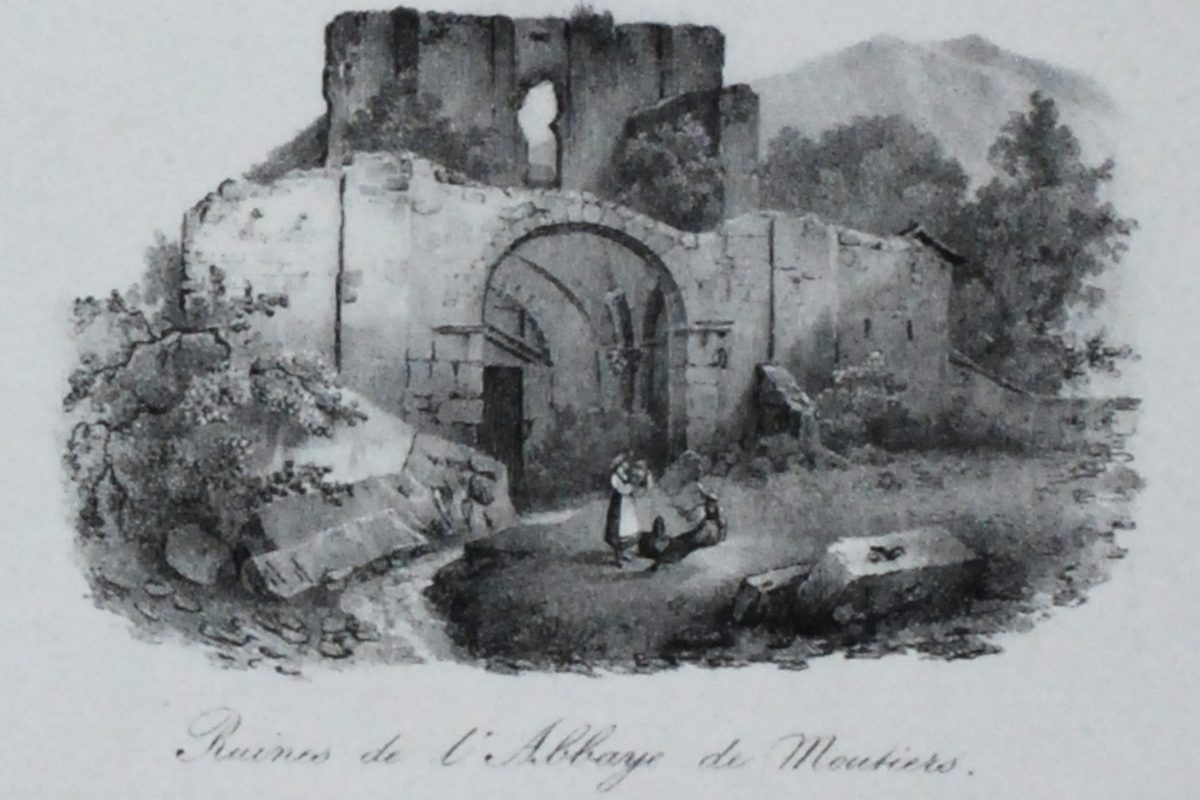
Origin of the name Abbaye de Moutier-Grandval
The abbey bears two names. Moutier is the town that grew up around the monastery and owes its name to it. Grandval comes from « Grandisvallis », the upper part of the Birse valley where the lands given to the monastery lay. The donation of Rudolph III speaks of « l'abbaye de Sainte Marie et de Saint Germain que l'on nomme Granval ». The old German name is « Münster-Granfelden ». The origin of the word « Grandisvallis » has not been explained.[1][5]
Founding of Abbaye de Moutier-Grandval
Around 640 (or in the third quarter of the 7th century) Gundoin, Duke of Alsace, gave lands in the upper Birse valley to Walbert, abbot of Luxeuil. At a date not precisely known, Walbert had an abbey founded there and entrusted it to its first abbot, the monk Germanus, a native of Trier. The location of the original monastery long remained unknown: in 2008 structures discovered in the Rue Centrale in Moutier were attributed to it. The abbey later became a chapter of canons, whose collegiate church was rebuilt on a new site in Moutier at the end of the 11th or the beginning of the 12th century. Its lands formed the provostship of Moutier-Grandval. The chapter left the town at the Reformation and was abolished in 1797-1801. The site lies today in the municipality of Moutier.[1][2]
History of Abbaye de Moutier-Grandval
around 640. Gundoin, Duke of Alsace, gives lands in the upper Birse valley to Walbert, abbot of Luxeuil. The abbey founded on these lands is entrusted to the monk Germanus, its first abbot.[1][2][6]
around 675. Around 21 February, Germanus and Randoald, provost of the monastery, are murdered in the Delémont valley, on their way back from a meeting with Eticho, Duke of Alsace, whom Germanus had reproached for his violence against the population.
around 740. The abbey probably comes under the diocese of Basel. After the end of the duchy of Alsace, it becomes a royal abbey.
9th century. Given to Liutfrid, Count of Alsace, around the middle of the century, the abbey enjoys a cultural flowering to which the Moutier-Grandval Bible bears witness.[1]
around 830. The Moutier-Grandval Bible is made in the scriptorium of the abbey of Saint-Martin in Tours.[4]
967. Emperor Otto I grants the abbey to King Conrad of Burgundy.[1]
999. King Rudolph III of Burgundy gives the abbey to the bishop of Basel. This donation is the origin of the later Prince-Bishopric of Basel.[1]
1049-1150. The monastery is turned into a chapter of canons. The collegiate church, also dedicated to Saint Randoald, is rebuilt on a new site in Moutier at the end of the 11th or the beginning of the 12th century.[1]
1120. First mention of a provost of the chapter, Siginand, who founds Bellelay Abbey around 1140. The chapter has at most 12 canons.[1]
1160-1178. The chapter probably runs a hospital from 1160 and a school from 1178.[1]
1461. The rights and customs of the provostship are recorded in a roll, renewed in 1652.[1]
1486. Bern briefly occupies the provostship. A treaty of co-citizenship is concluded and Johannes Meyer of Büren is appointed provost, until 1492.[1]
1531. With the Reformation the collegiate church is closed and destroyed. The chapter takes refuge in Delémont in 1534 and settles there for good in 1571, the year a fire leaves the collegiate church in ruins.[1][2]
1588-1591. The chapter cedes its seigneurial rights to the prince-bishop of Basel.[1]
1711. The Treaty of Aarberg completely separates the confessions in the provostship.[1]
1797. The French invasion in December abolishes the chapter in fact, and the concordat of 1801 abolishes it in law. The provostship is attached to the department of Mont-Terrible, then to Haut-Rhin in 1800.[1]
1858-1863. Rebuilding of the collegiate church of Moutier, in this year or perhaps in 1860-1863, slightly offset from the medieval foundations.[1][2]
1957-1961. The collegiate church is restored in its Romanesque style, with stained glass by Coghuf and Yves Voirol.[2]
2008. Major structures discovered in the Rue Centrale in Moutier are attributed to the early medieval monastery.[1][2]
2025. From 8 March to 8 June, the Moutier-Grandval Bible, lent by the British Library, is exhibited at the Musée jurassien d'art et d'histoire in Delémont, as it already was in 1981.[4]
2026. On 1 January the municipality of Moutier, former chief town of the provostship, moves from the canton of Bern to the canton of Jura.
Historic sites in Abbaye de Moutier-Grandval
Collegiate church of Saints-Germain-et-Randoald. Successor to the chapter's church built at the end of the 11th or the beginning of the 12th century, destroyed at the Reformation and then ruined by the fire of 1571, the collegiate church of Moutier was rebuilt in the 19th century and restored in 1957-1961 in its Romanesque style, with stained glass by Coghuf and Yves Voirol.[1][2]
Rue Centrale. It was under the Rue Centrale in Moutier that the structures attributed to the original monastery were uncovered in 2008.[1][2]
Musée jurassien d'art et d'histoire (Delémont). The abbey's treasury is kept here, including a 7th-century crosier presented as the oldest known decorated crosier.[4]
Remains in Abbaye de Moutier-Grandval
Remains of the monastery. The structures discovered in 2008 in the Rue Centrale are the main material remains of the original abbey, whose exact location had been unknown until then.[1][2]
Moutier-Grandval Bible. Manuscript of 449 folios (898 pages), measuring 50 by 37.5 cm, made around 830 at Saint-Martin in Tours and kept at the abbey. It is now in the British Library in London (Add. MS 10546).[1][4]
Church of Saint-Pierre (vanished). Probably early medieval church of Moutier, where Germanus may have been buried. Enlarged after the Reformation, it was demolished in 1873 (or 1859).[2][7]
Legends of Abbaye de Moutier-Grandval
The crosier of Saint Germanus. Tradition attributes to Saint Germanus, the first abbot, the richly decorated 7th-century crosier now kept in Delémont.[4]
Sources
- Dictionnaire historique de la Suisse, « Moutier-Grandval » (Kathrin Utz Tremp, Stéphanie Lachat), version remaniée du 20.01.2026
- Dictionnaire historique de la Suisse, « Moutier » (François Wisard), version remaniée du 18.12.2025
- Dictionnaire historique de la Suisse, « Germain (saint) » (Romain Jurot)
- Musée jurassien d'art et d'histoire, dossier de presse de l'exposition de la Bible de Moutier-Grandval (2025)
- Ville de Moutier, « Historique »
- Dictionnaire du Jura, « Moutier-Grandval (premiers monastères) » (Ludwig Poget, 2008)
- Dictionnaire du Jura, « Église Saint-Pierre (site archéologique, Moutier) » (Claude Juillerat, François Schifferdecker, Ludwig Poget)
Other villages near Abbaye de Moutier-Grandval
Missing information, or do you have a source? Suggest a correction or addition. Every submission is checked before it's published.
Suggest a change