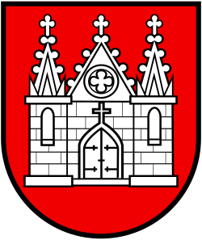
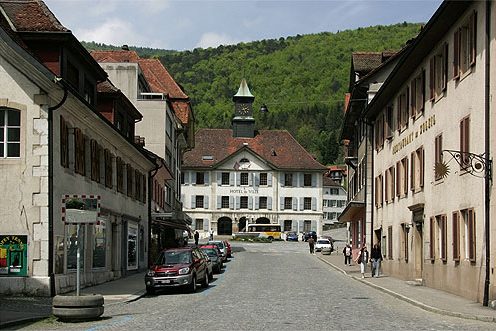
Moutier
Origin of the name Moutier
The name comes from the monastery around which the settlement formed: it is attested in the Latin forms « datum Monasterii » in 1154 and « apud Monasterium » in 1181. « Moutier » is the old form of the French word for « monastery ». The German name is « Münster ». The inhabitants are called Prévôtois, after the provostship of Moutier-Grandval.[1][8]
Founding of Moutier
Around 640, Gundoin, Duke of Alsace, who wished to reopen the road over the Pierre-Pertuis pass already used in Roman times, gave land in the upper Birse valley (the future « Grandisvallis ») to Walbert, abbot of Luxeuil, to be cleared. Walbert had an abbey founded there and entrusted it to the monk Germanus, a native of Trier, who became its first abbot. A few settlements probably already existed on the site. The town developed around the monastery, which was turned into a chapter of canons between 1049 and 1150. A small fortified town existed by the 12th century at the latest.[1][2][8]
History of Moutier
around 640. Foundation of the abbey of Moutier-Grandval on land given by Gundoin, Duke of Alsace, to Walbert, abbot of Luxeuil. The monk Germanus is its first abbot. Remains discovered in Moutier in 2008 are attributed to this monastery.[1][2][8]
around 675. Abbot Germanus and Randoald, provost of the monastery, are murdered in the Delémont valley after Germanus had reproached Eticho, Duke of Alsace, for his violence against the population.[3]
9th century. Under Count Liutfrid the abbey enjoys a cultural flowering, witnessed by the Moutier-Grandval Bible, now kept at the British Library in London.[2]
999. King Rudolph III of Burgundy gives the abbey to the Bishop of Basel. This donation is the origin of the future prince-bishopric.[2]
1049-1150. The monastery becomes a chapter of canons. The first recorded provost, Siginand (1120), founds the abbey of Bellelay around 1140.[1][2]
1148. First mention of a hospital in Moutier.[1]
1269. The small town, formed by the 12th century at the latest, is burned.[1]
1486. During a dispute over the provostship, Bern occupies the lordship, which is returned to the bishop the same year. A co-citizenship treaty is then formed between Bern and the provostship.[2]
1531. With the Reformation, adopted by four fifths of the inhabitants, the collegiate church is closed. The chapter takes refuge in Delémont in 1534 and settles there permanently in 1571, the year a fire ruins the collegiate church.[1][2]
1793. In January the provostship becomes independent under the protection of Bern, with the bishop's consent. A constitution is voted in Moutier, chosen as chief town.[2]
1797. The French invasion ends the provostship. Moutier belongs to the department of Mont-Terrible, then Haut-Rhin, until 1813.[1][2]
1815. Attached to the canton of Bern. Moutier becomes chief town of the bailiwick, then of the district of Moutier (1831-2025). In 1817 Bern acquires the castle to house the prefecture.[1]
1842. Start of operations at the glassworks founded by Célestin Châtelain, which becomes the largest window glass factory in Switzerland.[1]
1876-1877. Rail links to Basel (1876) and to Biel through the Tavannes valley (1877).[1]
1883. Nicolas Junker establishes the automatic lathe industry, which became Tornos-Bechler in 1974 and Tornos SA in 2001.[1]
1915. Opening of the Moutier-Grenchen tunnel (8.6 km), completing the rail link to Solothurn opened in 1908.[1]
1950. Moutier is regarded as a town.[1][8]
1974-1975. Plebiscites of the Jura question: in 1974 a lead of 70 votes for the pro-Bernese side. The votes of 16 March and 7 September 1975 are accompanied by violence.[1]
2017. On 18 June, Moutier voters accept the transfer to the canton of Jura by 2'067 votes to 1'930 (51.72 %). The vote is annulled by the prefect of the Bernese Jura on 2 November 2018, an annulment confirmed by the Bernese administrative court on 23 August 2019.[1][4][6]
2021. On 28 March, a new vote: the transfer is accepted by 2'114 votes to 1'740 (54.9 %).[1][4][6]
2023-2025. The concordat between Bern and Jura is signed in Moutier on 24 November 2023, approved by popular vote in both cantons on 22 September 2024, then approved by the Council of States (5 March 2025) and the National Council (10 March 2025).[6]
2026. On 1 January, Moutier joins the canton of Jura, which now has 51 municipalities, and forms the district of Moutier on its own.[1][4][6][13]
Population of Moutier
Sources and references: [1]
| 16th century | 342 inhabitants |
| 1850 | 917 |
| 1880 | 2'111 |
| 1900 | 3'088 |
| 1910 | 4'164 |
| 1950 | 5'916 |
| 1970 | 8'794 |
| 2000 | 7'701 |
| 2010 | 7'379 |
| 2020 | 7'228 |
| 2025 | 7'053 |
Historic sites in Moutier
Collegiate church of Saint-Germain. The collegiate church of Saints Germanus and Randoald, built in the 12th century, was closed at the Reformation in 1531 and ruined by fire in 1571. Rebuilt in 1860-1863 and restored in 1957-1961, it serves as the French-speaking Reformed church. It has stained glass windows by Coghuf and Yves Voirol.[1]
Chalière chapel. Small Romanesque chapel, probably from the 11th century, on a former Carolingian site: a hall ending in an apse, a small bell turret and eight tall round-arched windows. A renovation in 1934-1936 uncovered wall paintings: Christ in glory in the apse, the twelve apostles seated in pairs and, below, Cain and Abel presenting their offerings. It is now the cemetery chapel.[7]
Moutier castle. Provost's castle built at the end of the 16th century, acquired by the State of Bern in 1817 to house the prefecture and renovated in 1932.[1]
Church of Notre-Dame de la Prévôté. Catholic church completed in 1967, with stained glass windows by Alfred Manessier.[1][8]
Cité Sainte-Marie. Workers' housing estate built in 1918, a witness to the housing built by companies for their workers during the industrial boom.[1]
Musée du tour automatique et d'histoire. Museum devoted to the history of the automatic lathe and of Moutier's industry, rue Industrielle 121. The town also has a historical trail of 23 explanatory panels.[1][9][15]
Remains in Moutier
Remains of the early medieval monastery. Remains discovered in Moutier in 2008 are attributed to the monastery founded around 640 by the monks of Luxeuil.[1][2]
Chalière wall paintings. The Romanesque frescoes of the Chalière chapel, discovered during the 1934-1936 renovation, are dated to the 11th century. Specialists compare their style to the Reichenau school, while others see Burgundian influence. Their restoration is considered questionable.[7][11]
Moutier-Grandval Bible. Illuminated manuscript produced during the abbey's cultural flowering in the 9th century, now kept at the British Library in London.[2]
Church of Saint-Pierre (vanished). Church probably of early medieval origin, enlarged after the Reformation and demolished in 1873. Saint Germanus may have been buried there. Its demolition began as early as the mid-19th century.[1][3][14]
Legends of Moutier
The consecration of Chalière by the emperor. A tradition repeated by many authors holds that the Chalière chapel was consecrated in 1019 in the presence of Emperor Henry II, who is said to have paid for its paintings. No document confirms this: that year Henry II attended the consecration of Basel cathedral.[7]
The crozier of Saint Germanus. A richly decorated 7th-century crozier, now kept in Delémont, is attributed by tradition to Saint Germanus, first abbot of Moutier-Grandval, murdered with Randoald around 675.[3]
Sources
- Dictionnaire historique de la Suisse, « Moutier (commune) » (François Wisard), version du 18.12.2025
- Dictionnaire historique de la Suisse, « Moutier-Grandval » (Kathrin Utz Tremp, Stéphanie Lachat), version du 20.01.2026
- Dictionnaire historique de la Suisse, « Germain (saint) »
- Office fédéral de la justice, « Résolution de la Question jurassienne » (page publiée le 1.1.2026)
- Conseil fédéral, message concernant l'arrêté fédéral sur le changement d'appartenance cantonale de la commune de Moutier
- République et Canton du Jura, « Moutier dans la Question jurassienne » (contexte historique)
- Ville de Moutier, « La Chapelle de Chalière »
- Ville de Moutier, « Historique »
- Jura & Trois-Lacs, « The Enriching History of Moutier »
- Statistique Jura, tableau JU-T.01.01.03, population résidante permanente au 31 décembre 2025
- Dictionnaire historique de la Suisse, « Chalières »
- République et Canton du Jura, Gouvernement, message au Parlement relatif à la modification de la Constitution cantonale portant sur la création du district de Moutier (26 mars 2024)
- République et Canton du Jura, Délégué aux affaires communales, « Les communes jurassiennes » (état au 1.1.2026)
- Dictionnaire du Jura, « Église Saint-Pierre (site archéologique, Moutier) » (Claude Juillerat, François Schifferdecker, Ludwig Poget)
- Office fédéral de la protection de la population (OFPP), Inventaire PBC, liste cantonale du canton du Jura (état au 1.1.2026)
Localities of the municipality with a page
Other villages near Moutier
Missing information, or do you have a source? Suggest a correction or addition. Every submission is checked before it's published.
Suggest a change