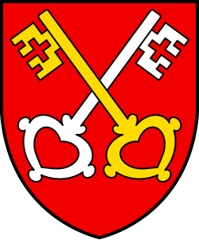
Ardon
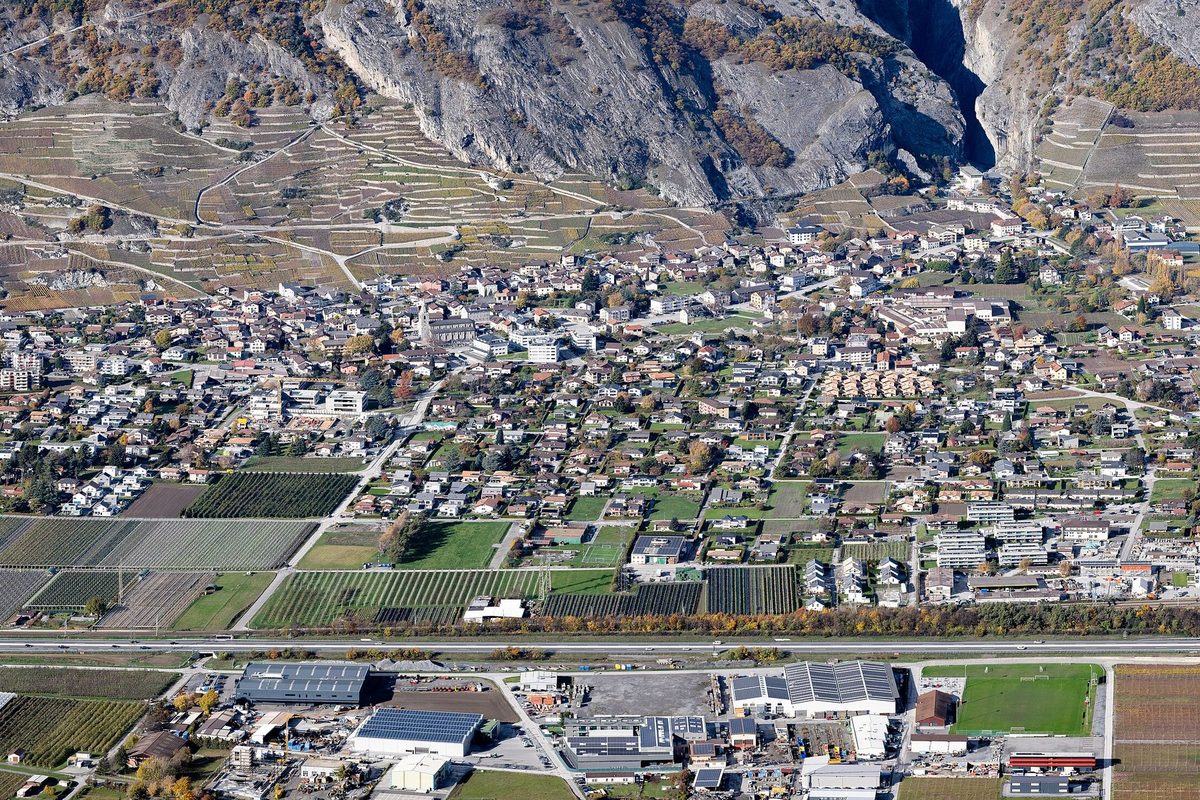
Origin of the name Ardon
The name appears as « Ardunum » at the end of the 11th century, then « Ardun » in 1179. The former German name is Arden. It is said to combine Celtic elements meaning roughly « near the castle » or « near the fortified height ».[1]
Founding of Ardon
The area has been occupied since the La Tène period, and remains of a Roman villa are attested. From the 5th century a Christian sanctuary stood on the site of the present church. The village reportedly first settled at the foot of the slope, safe from the Rhône floods, and spread into the plain only after the river was corrected in the 19th century. From the 11th century Ardon belonged to the lordship of Ardon-Chamoson, which came under the episcopal mensa of Sion and also included Chamoson, Saint-Pierre-de-Clages and Grugnay. Ardon and Chamoson formed two separate communities early on, but Ardon became an autonomous municipality only in the 19th century, when its foundries made it a major industrial centre of Valais.[1][2]
History of Ardon
La Tène period. Remains from this period have been found in the area. Remains of a Roman villa are also attested.[1]
5th century. A Christian sanctuary is attested on the site of the present church.[1]
10th century. The church of Saint-Jean-Baptiste becomes a parish church, between the Carolingian period and the end of the 10th century.[1]
11th century. Ardon is part of the lordship of Ardon-Chamoson, which belongs to the episcopal mensa of Sion. At the end of the century the name appears as « Ardunum ».[1][2]
1179. Mentioned as « Ardun ».[1]
13th century. In the second half of the century the castle of Crest is attested at Ardon.[2]
1315. Ardon and Chamoson already form separate communities.[2]
1334-1832. Chamoson is a daughter church of the parish of Ardon.[1]
1384-1475. The lordship is held by the counts and later dukes of Savoy.[2]
1475. The castle of Crest is razed. The lordship returns to the episcopal mensa.[2]
1525. Construction of the church's Gothic porch tower, attributed to Ulrich Ruffiner.
1780. The bishop grants Ardon the right to hold an annual fair.[1]
1798. The lordship of Ardon disappears. Ardon belongs to the district of Martigny until 1815.[1][2]
1810. The foundries begin operating; until then limestone quarries coexisted with a saltpetre works.[1]
1819. Ardon becomes an independent municipality, separate from Chamoson.[1]
Around 1850. The foundries employ nearly 600 workers, then the largest company in Valais. The first mechanical threshing machine appears in 1850.[1]
1870. Founding of a type and printing-plate factory, which employs about a hundred workers in 1910, switches to aluminium processing around 1932 and closes in 1939. The foundries close temporarily from 1870 to 1875.[1]
1892. The old church, restored in the 17th century, is replaced by a neo-Gothic building.[1]
1900. Inauguration of a power station on the Lizerne.[1]
1934. The Sion-Riddes canal allows 130 hectares to be drained, later used for fruit growing.[1]
Population of Ardon
Sources and references: [1][3]
| 1798 | 466 |
| 1829 | 714 |
| 1850 | 816 |
| 1900 | 1'227 |
| 1950 | 1'354 |
| 2000 | 2'295 |
| 2025 | 3'938 |
Historic sites in Ardon
Church of Saint-Jean-Baptiste. Neo-Gothic church of 1892, built on a Christian site attested from the 5th century. It has kept a Gothic porch tower of 1525, perhaps by Ulrich Ruffiner.[1]
Ardon foundries. Put into operation in 1810 and still active at the end of the 20th century, they employed nearly 600 workers around 1850, about 130 around 1960 and 40 to 45 in 1993.[1]
La Pontaise. The second-oldest surviving building in Ardon. Its large volume and high rooms suggest a seigneurial function, though this is not established.
Remains in Ardon
Remains beneath the parish church. Excavations during the church renovation in 1959-1960 revealed a succession of pre-Christian and Christian buildings, the oldest sanctuary dating back to the 5th or 6th century. Since 1996, remains from the 3rd to the 11th century have reportedly been on display beneath the church.[5]
Roman villa. Remains of a Roman villa are attested in the municipal territory.[1]
Sources
- Dictionnaire historique de la Suisse, « Ardon » (Danielle Allet-Zwissig), version italienne du 11.08.2009
- Dictionnaire historique de la Suisse, « Ardon-Chamoson » (Danielle Allet-Zwissig), version du 10.04.2014
- Office fédéral de la statistique (OFS), STATPOP, chiffres provisoires au 31.12.2025, via citypopulation.de
- geo.admin.ch, service de recherche de swisstopo (Ardon)
- Dictionnaire historique de la Suisse, « Dubuis, François-Olivier » (Antoine Lugon), version du 19.04.2004 (fouilles dans les églises d'Ardon en 1959)
Other villages near Ardon
Missing information, or do you have a source? Suggest a correction or addition. Every submission is checked before it's published.
Suggest a change