Belmont-sur-Lausanne
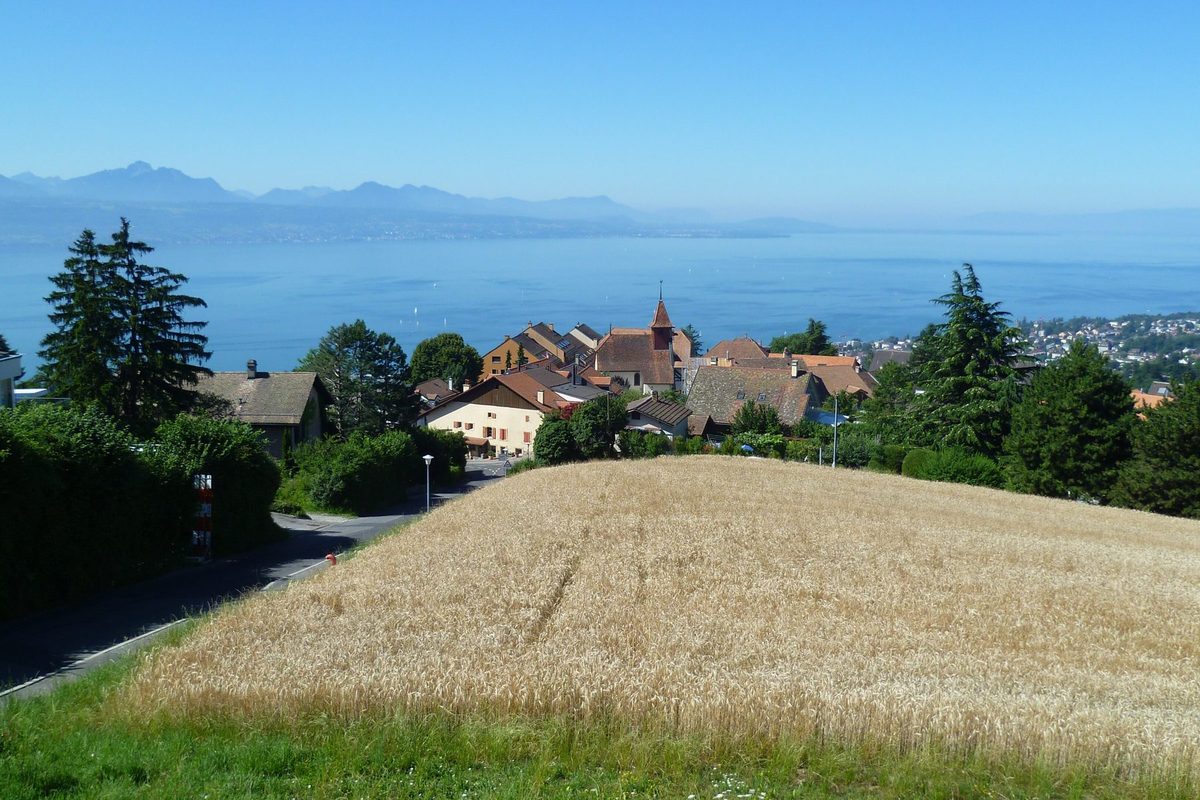
Below this promontory overlooking Lake Geneva, coal was mined in the Paudèze valley from 1771, and lignite again during both world wars.
Entry based on 12 sources · Our method · Reusable text (CC BY-SA)
Origin of the name Belmont-sur-Lausanne
The village is first mentioned in 1228 in the forms « Belmunt » and « apud bellum Montem ». The name reportedly means « fair mount », which matches its position on a promontory overlooking Lake Geneva. In Vaud patois the municipality is said to be called « Bîman ». The inhabitants are the Belmontais or « Bimands », reportedly nicknamed « les Hannetons » and « les Cancoires ».[1]
Coat of arms of Belmont-sur-Lausanne
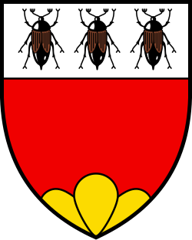
Gules, a mount of three hillocks or, on a chief argent three cockchafers proper. On a red field rises a yellow hill with three rounded tops. The white band across the top of the shield bears three brown cockchafers in their natural colours.[5]
Founding of Belmont-sur-Lausanne
Who founded Belmont-sur-Lausanne, or when, remains unknown. Belmont occupies a promontory above Lake Geneva, on the eastern side of the Paudèze valley, with the hamlet of Rochettaz and the former hamlet of Les Chaffaises (mill and sawmill), now vanished. In the 13th century the village depended on the Lausanne chapter, which drew revenues there jointly with the Benedictine priory of Lutry, and its Saint-Martin church was already a parish church. People lived from farming and vines, on ground prone to many landslides, until Lausanne's population growth turned it into a residential municipality.[1]
History of Belmont-sur-Lausanne
1228. First written mention (« Belmunt », « apud bellum Montem »). The Saint-Martin church is then a parish church.[1]
13th century. Belmont depends on the Lausanne chapter, which draws revenues there jointly with the Benedictine priory of Lutry.[1]
1419. A confraternity of the Holy Spirit is recorded.[1]
1536-1798. Under Bernese rule the village, attached to the bailiwick of Lausanne, is run by a governor assisted by the assembly of commune members. Bern and the town of Lausanne share the tithes, ground rents and jurisdiction.
After the Reformation. The Saint-Martin church becomes a chapel of ease sometimes of the parish of Pully, sometimes of that of Lutry.[1]
1595. Restoration of the church, which was reportedly rebuilt to the original plan from 1589.[1]
1681. Further restoration of the church.[1]
1771-1796. Gottlieb Wagner works the coal of the Paudèze valley and a lime kiln.[1]
1798. Belmont becomes a municipality of the district of Lausanne.[1]
1851-1892. The Radical government grants some forty coal-mining concessions, ruined in the 20th century by foreign coal.[1]
1858-1862. Construction of the railway viaduct of the Lausanne-Bern line, which towers over the hamlet of Rochettaz.[1]
1911. Belmont becomes a parish again.[1]
1914-1918. Lignite mining resumes, and again during the Second World War (1939-1945).[1]
1958. On 18 January an air accident reportedly costs the life of the Belgian knight Philippe de Selliers de Moranville. A memorial stone in the woods commemorates him.
1960. Start of the transformation into a residential municipality (villas). There were 14 farmers in 1950 and 4 in 1994.[1]
1964. Creation of the Fondation pour l'art de Hans et Joram Deutsch.[1]
1989. Inauguration of the community centre.[1]
2008. The new territorial division comes into force (law of 30 May 2006): Belmont-sur-Lausanne joins the district of Lavaux-Oron.[3][4]
Population of Belmont-sur-Lausanne
Sources and references: [1][2]
| 1709 | 130 |
| 1764 | 181 |
| 1850 | 455 |
| 1860 | 514 |
| 1900 | 491 |
| 1941 | 347 |
| 1950 | 405 |
| 1980 | 1'415 |
| 2000 | 2'358 |
| 2025 | 3'891 |
Families of Belmont-sur-Lausanne
Bugnion. A family from Belmont, recorded there in 1295. Settling in Lausanne in the 16th century, the Bugnion became burghers there in 1601 and held public office in every generation. Their house, L'Hermitage, built in 1852, has housed the Fondation de l'Hermitage since 1984.[6]
Burgher families before 1800. Abetel, Béboux, Blanc, Bolomey, Bugnion, Corbaz, Forney, Gay, Liardet and Reybaz, with no precise date. The commune dates several of them: the Bugnion since 1312, the Abetel since 1321, the Liardet since 1352, the Corbaz since 1457 and the Blanc since 1553.[12][11]
In the 19th century. Twenty-six entries. Ten appear with no precise date: Cochet, Guex, Langendorf and Rudolph, as well as the Dépassel of Hermenches VD, the Ménétrey of Poliez-le-Grand VD, the Kuhn of Illnau ZH, the Steiner of Mühlethurnen BE, the Faraudo, from Romania, and the Zaborowski, from Russia. The Maleszewski, from Poland, were registered as early as 1848. The others arrived towards the end of the century, almost all from France or Germany: Garcin (1874), Wambold (1879), Engler (1881), Koch (1882), Pauroux (1885), Sambuc (1888), Niering and Rempp (1889), Grumbach (1890), Picard and Riede (1891), Bailly (1896), Peyrot (1897) and Wertheimer (1898). The Gowthorpe, from Great Britain, were registered in 1884.[12]
Show more families (1)
From 1901 to 1962. Twenty-one entries. Italian families are the most numerous: Rossi (1911), Sapho (1914), Picconi (1918), Bianchi (1919), Giobellina (1927), Gabella (1952), Lozzia (1953) and Monti (1954). Others came from Austria (Vitek, 1902), Germany (Dischler, 1912), Turkey (Adout, 1927), France (Raynal, 1929), Romania (Wachsmann, 1932) and Bulgaria (Cohenoff, 1953). The Gruninger (1934) and the Strudel (1936) appear with no origin. Then came the Zufferey of Saint-Luc VS (1956), the Dafflon of Vaulruz FR (1957 and 1958), the Vesin of Grossgurmels FR (1958) and the Gysler of Langnau im Emmental BE (1960). The last entry, in 1961, was the Fischer family, from France.[12]
Notable people of Belmont-sur-Lausanne
François-Louis Bugnion (Belmont-sur-Lausanne 1822 - off Naples 1880). The son of a schoolmaster. A pastor at Chabag, the Vaud colony in Bessarabia, then in Mauritius and Réunion, he proclaimed himself "honorary bishop of the Church of the Lord". He then travelled through India, the United States and Australia, where he wanted to bring in Russian and Swiss settlers.[7]
Charles Liardet (Cuarnens 1830 - Lausanne 1873). Engineer and citizen of Belmont-sur-Lausanne. He worked for the Ouest-Suisse railway, then became chief engineer of the Jura-Bern-Lucerne line in 1871.[8]
Charles Soldan (Lausanne 1855 - Lausanne 1900). The son of a refugee from Hesse, he became a citizen of Belmont-sur-Lausanne in 1867. A jurist and Radical member of the cantonal government from 1888 to 1890, he joined the Federal Supreme Court, which he presided over in 1897 and 1898.[9]
Eric Tappy (Lausanne 1931 - Belmont-sur-Lausanne 2024). A lyric tenor, he sang in Geneva, Hamburg, London, San Francisco and Zurich and became known for Bach, Monteverdi and Mozart. A filmed interview with him was recorded in Belmont in 1985, and he died in the commune.[10]
Economy of Belmont-sur-Lausanne, past and present
Fields and vines. For a long time Belmont lived from its crops and vines, on land often carried away by landslides. The village still had 14 farms in 1950. Only 4 remained in 1994.[1]
Coal from the Paudèze. The eastern slope of the Paudèze valley belongs to the local coal basin. In the late 18th century Gottlieb Wagner mined coal there and ran a lime kiln. In the 19th century some forty mining concessions followed one another. Lignite was mined again during both world wars.[1]
Villas. Since the 1960s, the growth of Lausanne and the view over Lake Geneva have drawn new residents. Belmont thus became a residential municipality, covered with villas.[1]
Historic sites in Belmont-sur-Lausanne
Saint-Martin church (Reformed church). Parish church recorded from 1228 at least, later a Reformed church, an annex of Pully or Lutry and a parish again in 1911. Restored in 1595 and 1681. It is said to have been rebuilt from 1589 to 1595 to the original plan, with the porch and façade bell tower modernised in 1781. The pulpit reportedly dates from 1681 and the stained glass from Edouard Diekmann (1902) and René Martin (1927).[1]
Paudèze valley. On the eastern side of this valley lay the coalfield worked from 1771 to 1796 by Gottlieb Wagner, then by many concession holders in the 19th century, and for lignite during the two world wars.[1]
Hamlet of Rochettaz and railway viaduct. Hamlet overlooked by the viaduct of the Lausanne-Bern line, built from 1858 to 1862.[1]
1958 memorial stone. Stone in the woods recalling the air accident of 18 January 1958 in which the Belgian knight Philippe de Selliers de Moranville reportedly died.
Traditions and festivals in Belmont-sur-Lausanne
The communal wine of honour. The commune's 1'851 square metres of vines produce Belmont's wine of honour, which carries the Terravin label. Each year the communal treasury sells some 700 bottles to residents and local societies.[11]
Sources
- Dictionnaire historique de la Suisse, « Belmont-sur-Lausanne »
- Statistique Vaud, « Population résidante permanente au 31 décembre 2025 »
- Canton de Vaud, Loi sur le découpage territorial (LDecTer, RSV 132.15) du 30 mai 2006
- État de Vaud, communiqué du 12.07.2007, « Les préfètes et les préfets sont attribués aux nouveaux districts »
- IPI, Swissreg, emblems database: coat of arms of Belmont-sur-Lausanne (no. 101465)
- Historical Dictionary of Switzerland (HDS), article "Bugnion"
- Historical Dictionary of Switzerland (HDS), article "Bugnion, François-Louis"
- Historical Dictionary of Switzerland (HDS), article "Liardet, Charles"
- Historical Dictionary of Switzerland (HDS), article "Soldan, Charles"
- Historical Dictionary of Switzerland (HDS), article "Tappy, Eric"
- Official Gazette of the Canton of Vaud (FAO), "Alphabet des communes vaudoises: Belmont-sur-Lausanne"
- Register of Swiss Surnames, 3rd edition (1989), search Commune "Belmont-sur-Lausanne", Canton VD
Published by Sébastien Jörg ·
Other villages near Belmont-sur-Lausanne
Missing information, or do you have a source? Suggest a correction or addition. Every submission is checked before it's published.
Suggest a change