Paudex
On its 49 hectares on Lake Geneva, between Pully and Lutry, Paudex grew vines until the 20th century and worked the Paudèze coal mines.
Entry based on 7 sources · Our method · Reusable text (CC BY-SA)
Origin of the name Paudex
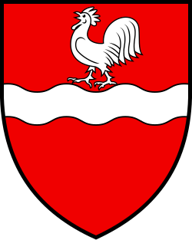
The forms « Paudais », « Poudaix » and « Poudays » are found for the 13th century. The municipality explains the name by a patois word meaning « marsh », though this is not established. It is also said to be linked to the name of the Paudèze, the stream marking the boundary with Pully. « Pau » means « cockerel » in patois, the inhabitants' nickname: the canting arms of Paudex show a golden cockerel and the Paudèze. The inhabitants are reportedly also nicknamed « Peaux-d'âne » and « Rats Blancs ».[2]
Coat of arms of Paudex
Gules, a fess wavy argent, in chief a cock of the same. On a red field, a white wavy band crosses the shield horizontally, beneath a white cock. These are canting arms: "pau" means cock in the local patois and is also the nickname of the inhabitants. The wavy band stands for the Paudèze.[6][2]
Founding of Paudex
Nobody knows who founded Paudex. The Bochat estate is mentioned from 1233. Made a community in 1385, Paudex depended judicially and militarily on the bishop of Lausanne and administratively on Lutry, whose priory held several rights there. Initially linked to Pully, the place only obtained its own municipal authorities in 1721. A wine-growing village until the 20th century, it also lived from its coal mines and a glassworks before becoming a residential locality.[1]
History of Paudex
Roman period. Date of the milestone from the reign of the emperor Antoninus Pius, found at Paudex in 1768.[1]
13th century. Early forms of the name: « Paudais », « Poudaix », « Poudays ».[2]
1233. The Bochat estate is mentioned.[1]
1385. Paudex is made a community. It depends judicially and militarily on the bishop of Lausanne, administratively on Lutry.[1]
1536-1798. Under Bernese rule Paudex is attached to the lordship of Lausanne. After the Reformation it is part of the parish of Pully.[1]
1570. The Paudeysse quarry is worked for repairs to the church of Lutry and several buildings in Lavaux.[2]
1709. The Greek prospector Eirini d'Eirinis reportedly obtains a concession for the Paudex coal, shared with Isaac de Loys, who founds the Houillière de Paudex and runs it until his death in 1733.
1721. On 10 June Lausanne authorises Paudex to separate from Pully: the municipality obtains its own authorities.[1][2]
1768. Discovery of the Roman milestone.[1][2]
1771. Bern grants Captain Wagner, at La Verrière, the right to mine the coal. The Paudèze mines are worked from 1771 to 1870.[1][2]
1798. On 30 January the municipality plants the liberty tree to mark the departure of the Bernese. It then belongs to the district of Lausanne until 31 December 2007.[2]
1799. First municipal executive, with Jean-Jacques Crousaz as syndic.[2]
1858. Construction of the railway.[2]
1894. Coal mining resumes, continuing until the Second World War.[1]
1896. Arrival of the tramway; a school is built in 1903.[2]
1966. A municipal council (Conseil communal) replaces the general council (Conseil général). The executive has five members.[1][2]
1968. Inauguration of the municipal complex bringing together a school, an ecumenical chapel and a performance hall.[1][2]
2008. Paudex joins the new district of Lavaux-Oron.[4]
2014-2015. Redevelopment of the harbour.[2]
Population of Paudex
Sources and references: [1][3]
| 1764 | 76 |
| 1798 | 149 |
| 1870 | 216 |
| 1950 | 453 |
| 2000 | 1'403 |
| 2025 | 1'483 |
Families of Paudex
Citizen families before 1800. Crousaz, Dépassel, Diserens, Dizerens, Ravessoud and Verboux are listed with no precise date, along with the Séchaud, from Sullens VD. In the 18th century Paudex admits the Chabaud, from France (1732), the de Cérenville, from France (1766), the Diemer, from Germany (1767), the Bippert, from France (1769), and the Borgeaud, from Pully VD (1771).[7]
In the 19th century. Fourteen families. The Marcel, from Lausanne VD, join with no precise date, the Wullschleger of Vordemwald AG in 1861. All the others come from abroad, most often from Germany: Krauel (1861), Hochstuhl (1862), Hartmann (1877), Bilharz (1879), Michahelles and Schneider (1880), Ammann (1885). They are joined by the Spiro, from the Netherlands (1877), the de Reÿher, from Russia (1882), the Leroy, from France (1883), the Nozyinski, from Poland (1885), and the Serra, from Italy (1893).[7]
1901 to 1962. Fourteen registrations. The first six concern foreign families: Ramoni from Italy (1902), Krending from Germany (1918), Anderson from Sweden (1921), Gatti from Italy (1932), Diez from Germany (1934) and Tazzolio from Italy (1944). Then come the Livio of Vacallo TI (1951), the Guinard, from France (1953), the Schärli of Ufhusen LU (1956), the Dewarrat of Bossonnens FR and the Stamm of Geneva (1957), the Desoche of Geneva (1959) and the Brügger of Belpberg BE (1960). The Guisolan of Noréaz FR, admitted in 1962, close the list.[7]
Notable people of Paudex
Henri Delamuraz. Syndic (mayor) of Paudex for twenty years, he is made an honorary citizen of the commune in 1969.[2]
Jean-Pascal Delamuraz. A Federal Councillor, he becomes an honorary citizen of Paudex in 1984. Since 1999 a space in the village has borne the dedication «Henri et Jean-Pascal Delamuraz».[2]
Denise Voïta. An altarpiece by the artist has adorned the ecumenical chapel since 1988.[2]
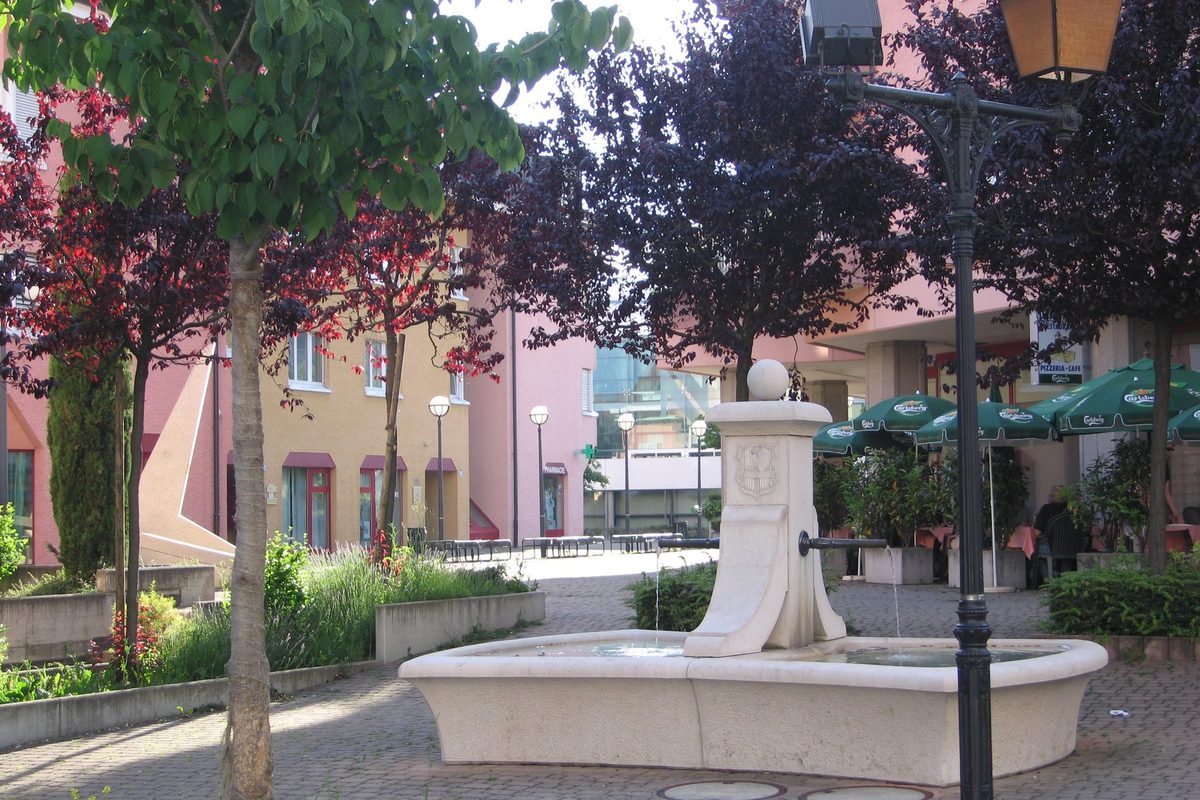
Luc Chappuis. He made the Fontaine du 700e, the fountain unveiled in 1991 in the village centre.[2]
Economy of Paudex, past and present
Vineyards and mills. In 1354 the mill of Rive is mentioned, along with several vineyards belonging to the monastery. In 1498 the bishop of Lausanne and the priory of Payerne also owned vineyards in Paudex, and in 1539 the priory of Lutry held mills there. In 1982 the municipality bought the vineyard "Aux Côtes Saint-Maire".[2]
Stone and coal. In 1570 the Paudeysse quarry supplied stone for repairs to the church of Lutry and several buildings in Lavaux. In 1771 Bern granted Captain Wagner, at La Verrière, the right to mine coal.[2]
Company headquarters. The Centre patronal vaudois opened its new headquarters in Paudex in 2000. The following year Nestlé Nespresso opened its global headquarters there, whose foundation stone had been laid in 1999.[2]
Historic sites in Paudex
Bochat estate. Estate mentioned from 1233, one of the oldest named places in the municipality.[1]
Municipal complex. Inaugurated in 1968, it brings together a school, an ecumenical chapel and a performance hall.[1][2]
Saint-Maire municipal vineyards. The only remaining vines of this village, which was a wine-growing place until the 20th century (0.6 ha).[1]
Paudex harbour. Harbour on Lake Geneva, redeveloped in 2014-2015.[2]
Paudèze viaduct. Railway viaduct over the Paudèze between Paudex and Pully: the metal bridge of 1859 was replaced by a nine-arch masonry bridge, 179.50 m long.[5]
Remains in Paudex
Roman milestone. Roman road marker found in 1768, reportedly displayed at the municipal hall. It is said to date from the reign of Antoninus Pius. The municipality attributes it to the emperor Caesar Augustus. Neither attribution is established.[1][2]
Paudèze coal mines. Worked from 1771 to 1870, then from 1894 to the Second World War. The place also had a glassworks in the 18th century.[1]
Sources
- Dictionnaire historique de la Suisse, « Paudex »
- Commune de Paudex, « Historique »
- Statistique Vaud, « Population résidante permanente au 31 décembre 2025 »
- État de Vaud, communiqué du 12.07.2007, « Organisation des préfectures et adaptation au nouveau découpage territorial »
- Structurae, « Viaduc de la Paudèze (1923) »
- IPI, Swissreg, emblems database: coat of arms of Paudex (no. 102124)
- Register of Swiss Surnames, 3rd edition (1989), search Commune "Paudex", Canton VD
Published by Sébastien Jörg ·
Other villages near Paudex
Missing information, or do you have a source? Suggest a correction or addition. Every submission is checked before it's published.
Suggest a change