Lutry
Twenty-four aligned menhirs, found in 1984, and a town walled in the 13th century around a Benedictine priory: Lutry opens the Lavaux vineyards on their western side.
Entry based on 7 sources · Our method · Reusable text (CC BY-SA)
Origin of the name Lutry
The place is mentioned in 908 in the phrase "in Lustraco villam", then in the forms "Lustriacus" (1124) and "Lustriey" (1147). The suffix "-acum" denotes an old Gallo-Roman estate. It reportedly contains a personal name that has not yet been identified.[1]
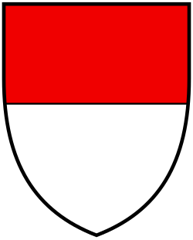
Coat of arms of Lutry
Per fess gules and argent. The shield is divided horizontally, red above and white below. This division in the colours of the bishop of Lausanne dates from the 16th century. In the 15th century, the arms of Lutry showed five roses set around the edge.[4][5]
Founding of Lutry
Stone-cist graves at Le Châtelard and Montagny and an alignment of menhirs show that the site was occupied from the Neolithic. It still was in Roman times. The medieval town, for its part, formed around a Benedictine priory founded between 1025 and 1124 and dependent on the abbey of Savigny-en-Lyonnais. The priory held lordship over the surrounding area, while the bishop of Lausanne held temporal authority. In the early 13th century Lutry surrounded itself with walls, including the so-called Bishop's Tower.[1]
History of Lutry
Neolithic. Stone-cist graves at Le Châtelard and Montagny; alignment of twenty-four menhirs.[1]
Roman period. Roman tiles, walls and architectural elements found at several sites.[1]
908. First mention, in the phrase "in Lustraco villam".[1]
1025-1124. Founding of a Benedictine priory dependent on the abbey of Savigny-en-Lyonnais.[1]
early 13th century. Construction of the town walls and the so-called Bishop's Tower.[1]
1416. The town has 200 hearths (households).[1]
1536. Bernese conquest; the following year, in 1537, the priory is suppressed and the bishop's lands secularised.[1]
1550. The town has 902 inhabitants (191 hearths).[1]
1764. The commune has 1'780 inhabitants.[1]
1798. The commune has 2'433 inhabitants.[1]
1836-1838. A harbour is built.[1]
1861. The station opens.[1]
1896. A tramway to Lausanne goes into service.[1]
1950. The commune has 2'916 inhabitants.[1]
1984. An alignment of twenty-four menhirs is found during the construction of a car park.[1]
2000. The commune has 8'270 inhabitants.[1]
2007. The terraced vineyards of Lavaux, which begin at Lutry, are inscribed on the UNESCO World Heritage List.
Population of Lutry
Sources and references: [1][2]
| 1416 | 200 hearths (households) |
| 1550 | 902 |
| 1764 | 1'780 |
| 1798 | 2'433 |
| 1850 | 2'011 |
| 1900 | 2'243 |
| 1950 | 2'916 |
| 1980 | 5'884 |
| 2000 | 8'270 |
| 2025 | 10'843 |
Families of Lutry
Mayor de Lutry. A noble family of Lutry in which the office of mayor becomes hereditary, and which takes its name from it. After Claude Mayor de Lutry, who died in 1598, a castellan replaces the mayor. The Crousaz of Corsier hold this office until 1798.[1]
Citizen families before 1800. The register lists 99, of which 70 have no precise date. The oldest dated registrations are those of the Bron, the Brun and the Ruffy in 1535, then the Destraz in 1536, all from Savoy. Other Savoyard families follow until 1640: Mellioret (1543), Baatard (1571), Amaudruz (1589), Pinget (1600), Michoud (1635) and Dentan (1640). The last admitted before 1800 are the Ecoffey, of Vulliens VD, in 1797.[6]
In the 19th century. Ten families. The Buche (1824), the Koch (1829), the Kachler (1836), the Mansfeld (1852) and the Hipp (1860) come from Germany, the Rosenbusch (1843) from Austria. Three Bernese families are admitted around the middle of the century: the Wenger of Forst (1845), the Zahler of St. Stephan (1847) and the Steiner of Saanen (1848). The Bobillier close the list in 1885.[6]
Show more families (1)
From 1901 to 1962. Eighty-nine registrations, 37 of them in 1956 alone, almost all of families from other Swiss cantons. The Hutchinson, from Great Britain, open the list in 1908. Several families come from France or Italy, others from Hungary (Benig in 1922, Zöldhegyi in 1957), Turkey (Congos in 1926) or Greece (Keramidas in 1958). The Müller, from Germany, registered in 1954 and in 1962, close the list.[6]
Notable people of Lutry
Anselme. The Benedictine priory of Lutry is founded following a donation by a man named Anselme.[1]
Bishop Berthold. In the early 13th century, Bishop Berthold (1212-1219) has the town wall built.[1]
Guillaume d'Ecublens. Guillaume d'Ecublens (1221-1229) has the square tower known as the Bishop's Tower built.[1]
Economy of Lutry, past and present
The vineyards. Under the Ancien Régime, half the vineyards belonged to patricians from Fribourg, Bern, Lausanne and Yverdon, the other half to people of Lutry. In the 19th and early 20th centuries, wine-growing remained the main activity and source of income. A winegrowers' association existed from 1906. The phylloxera crisis then caused an economic crisis without precedent. From 1950 the vineyards gave way to building. According to the FAO, nearly twenty winegrowers still work some 120 hectares, including the 3.7 hectares of the municipal estate, and Chasselas dominates.[1][5]
Small firms rather than factories. Lutry has always refused heavy industry on its land. The municipality relies on small and medium-sized businesses, of which there were nearly 400 in 2000. It has been part of the Lausanne conurbation since the 1960s. According to the FAO, it also owns 254 hectares of forest.[1][5]
Disasters and major events in Lutry
The fire of 1344. Fire struck the priory church, partly rebuilt around 1250-1260 on an 11th-century building. It was remodelled after the fire.[1]
The Bernese conquest of 1536. Lutry resisted the Bernese and Protestantism, without being able to stop them. The following year the priory was dissolved.[1]
Historic sites in Lutry
Medieval town. The fortified town of the early 13th century, with the so-called Bishop's Tower, keeps its character on the lakeshore.[1]
Former priory and church. The Benedictine priory founded between 1025 and 1124 is the origin of the town. Suppressed in 1537, its church became the Reformed church.[1]
Harbour. Built in 1836-1838, it recalls the role of the lake in Lutry's wine economy.[1]
Lavaux vineyards. Lutry lies at the western entrance to the terraced Lavaux vineyards, inscribed on the UNESCO World Heritage List in 2007.
Remains in Lutry
Lutry menhirs. An alignment of twenty-four Neolithic menhirs, including a small stele engraved with a figure, was uncovered in 1984 during the construction of a car park.[1]
Neolithic graves. Stone-cist graves have been found at Le Châtelard and Montagny.[1]
Protected heritage in Lutry
Cultural property of national significance (A objects in the PCP inventory)[3]
- Château avec dépendance et château des Rôdeurs
- Eglise catholique Saint-Martin
- Eglise réformée Saint-Martin
- Maison à façade gothique, dite «Le Cloître»
Cultural property of regional significance (B objects)[3]
- Cure
- La Possession, alignement de menhirs - Néolithique
- Maison d'Ernst
- Savuit, la balance (poid public)
- Tour Bertholod
Traditions and festivals in Lutry
The Fête des vendanges. It began in 1946, when young people from Lutry, coming back in costume from La Comballaz, where the Lutry holiday camp stands, improvised a procession in the town centre. That procession grew into the Fête des vendanges, run by volunteers over three days in early autumn. The profits go to the holiday camp, founded in 1922. Pupils from the schools of Lutry and Paudex march in the Sunday procession.[7][5]
The Singes. The people of Lutry are nicknamed the Singes (monkeys).[5]
Sources
- Dictionnaire historique de la Suisse, « Lutry »
- Statistique Vaud, « Population résidante permanente au 31 décembre 2025 »
- Federal Office for Civil Protection (FOCP), Swiss Inventory of Cultural Property (PCP), list for the canton of Vaud (as of 1.1.2026)
- IPI, Swissreg, emblems database: coat of arms of Lutry (no. 102045)
- Feuille des avis officiels du canton de Vaud (Official Gazette of the Canton of Vaud), « Alphabet des communes vaudoises : Lutry »
- Register of Swiss Surnames, 3rd edition (1989), search Commune "Lutry", Canton VD
- Canton of Vaud, Cantonal inventory of intangible heritage, "Fête des vendanges"
Published by Sébastien Jörg ·
Localities of the municipality with a page
Other villages near Lutry
Missing information, or do you have a source? Suggest a correction or addition. Every submission is checked before it's published.
Suggest a change