Bursinel
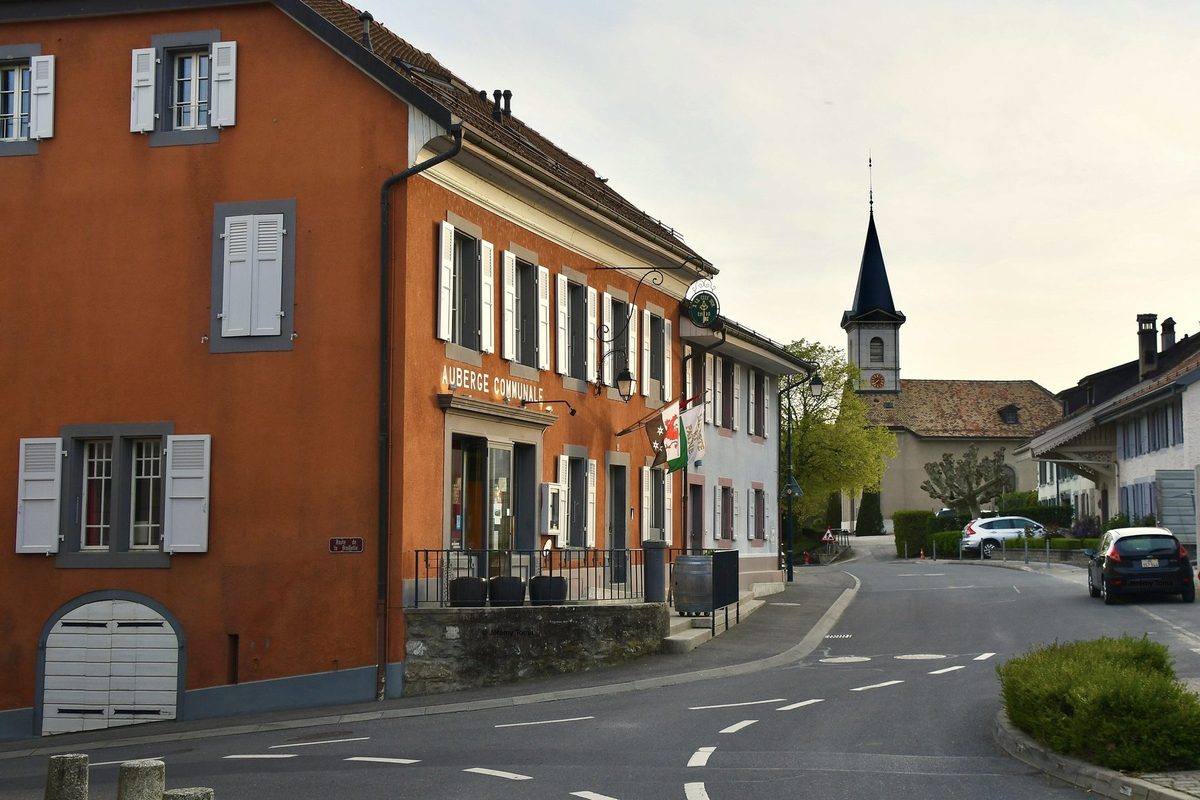
On La Côte, facing Lake Geneva, Bursinel has kept its castle, seat of the Sacconay and then the Watteville families, and its layout as a wine-growing street village.
Entry based on 8 sources · Our method · Reusable text (CC BY-SA)
Origin of the name Bursinel
The place appears in 1139 as «Brucines». The etymology of «Bursinel» has yet to be found.[1]
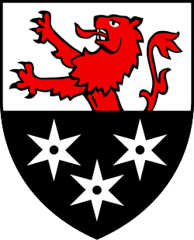
Coat of arms of Bursinel
Per fess, argent a lion issuant gules, and sable three mullets pierced argent. The upper half of the shield is white, with a red lion of which only the upper body emerges. The lower half is black with three white spur rowels, stars pierced in the centre.[5]
Founding of Bursinel
Who founded Bursinel, and why, is unknown. At its first mention, in 1139, the village already had a chapel, Saint-Hilaire, a daughter church of Bursins in the diocese of Geneva. In the Middle Ages it belonged to the lordship of Mont-le-Vieux. Its houses line a single street on a gentle rise facing Lake Geneva, among vineyards and fields.[1]
History of Bursinel
1139. First mention of the place as «Brucines». The chapel of Saint-Hilaire, a daughter church of Bursins (diocese of Geneva), is recorded.[1]
1143. Date given for the castle.[1]
early 13th century. The chapel becomes a parish church.[1]
1244. Pierre de Bursinel gives land to the Charterhouse of Oujon.[1]
1536. The parish adopts the Reformation.[1]
16th century. The lordship of Bursinel passes to the de Sacconay family. Major additions to the castle. Under Bernese rule the village belongs to the bailiwick of Morges.[1]
1745. The last descendant of the Sacconay buys the high, middle and low jurisdiction from the Baroness of Rolle.[1]
18th century. Further major additions to the castle.[1]
1791. The lordship passes by marriage to the de Watteville family.[1]
19th century. The parish is attached several times, successively, to those of Bursins and Rolle.[1]
1922. Major land improvement works carried out with the municipality of Dully. The water supply and hydrants encourage mechanised vine growing.[1]
20th century. Bursinel belongs to the parish of Rolle.[1]
2008. The new districts come into force (1 January): Bursinel moves from the district of Rolle to that of Nyon.
Population of Bursinel
Sources and references: [1][3]
| 1764 | 87 |
| 1798 | 143 |
| 1850 | 187 |
| 1860 | 166 |
| 1900 | 199 |
| 1950 | 219 |
| 1980 | 164 |
| 1990 | 271 |
| 2000 | 342 |
| 2025 | 535 |
Families of Bursinel
Sacconay. The family acquired the seigneurie of Bursinel in the 16th century and kept it until it died out in 1788. The communal arms taken up in 1923 derive from its coat of arms, with spur rowels in place of its stars.[7]
Burgher families before 1800. Badel, Bonnet, Caboussat and Debonneville, with no precise date. The Chanson from Mont-sur-Rolle VD were admitted in 1716. The Chinet from Rolle VD and the Keim from France followed in 1755.[6]
In the 19th century. Abrezol and Suardet, along with the Larpin of Féchy VD, with no precise date. The Rueg of Dürstelen ZH were registered in 1809, the de Lessert of Cossonay VD in 1830 and the Boimond, from France, in 1891.[6]
Show more families (1)
From 1901 to 1962. Seven entries. The Hutin, from France, were admitted in 1932 and the Mouravieff, from the Soviet Union, in 1933. The Santo followed in 1939, the Ignatieff in 1947 and the Tauss of Lenk BE in 1956. The Del Cul in 1960 and the Micotti, from Italy, in 1962 close the list.[6]
Notable people of Bursinel
Jean de Sacconay. A member of Bursinel's seigneurial family, he was commander-in-chief of the Bernese army at Villmergen in 1712. The spur rowels in the communal arms recall him.[7]
Winston Churchill. The former British prime minister stayed at Bursinel in 1946, on the Choisi estate. A plaque placed on the commune house in 1985 recalls the visit.[8]
Economy of Bursinel, past and present
Vines and fields. Bursinel lives from vines and farming. The land improvements of 1922, carried out with Dully, brought water and hydrants that made mechanised vine growing easier. The village keeps this wine-growing and farming structure but is becoming increasingly residential.[1]
Historic sites in Bursinel
Bursinel Castle. Castle dated to 1143, enlarged with major additions in the 16th and 18th centuries. It was the seat of the lordship held by the Sacconay from the 16th century, then by the Watteville from 1791.[1]
Former church of Saint-Hilaire. Chapel recorded in 1139 as a daughter church of Bursins, which became a parish church in the early 13th century and adopted the Reformation in 1536.[1]
Street village and vineyards. The street village, on a gentle rise facing Lake Geneva, keeps its wine-growing and farming layout while becoming increasingly residential.[1]
Protected heritage in Bursinel
Cultural property of national significance (A objects in the PCP inventory)[4]
- Villa Choisy avec hangar à bateaux, île, ancienne ferme et fontaine
Cultural property of regional significance (B objects)[4]
- Château et fontaine
Sources
- François Vodoz, « Bursinel », Dictionnaire historique de la Suisse, version du 14.03.2003
- État de Vaud, communiqué « Organisation des préfectures et adaptation au nouveau découpage territorial », 12.07.2007
- Statistique Vaud, « Population résidante permanente au 31 décembre 2025 »
- Federal Office for Civil Protection (FOCP), Swiss Inventory of Cultural Property (PCP), list for the canton of Vaud (as of 1.1.2026)
- IPI, Swissreg, emblems database: coat of arms of Bursinel (no. 102088)
- Register of Swiss Surnames, 3rd edition (1989), search Commune "Bursinel", Canton VD
- Commune of Bursinel, home page (presentation and coat of arms)
- Commune of Bursinel, "L'histoire de Bursinel"
Published by Sébastien Jörg ·
Other villages near Bursinel
Missing information, or do you have a source? Suggest a correction or addition. Every submission is checked before it's published.
Suggest a change