CERN
Origin of the name CERN
CERN is the acronym of the Conseil européen pour la recherche nucléaire, a provisional council set up in 1952. The European Organization for Nuclear Research kept the acronym.[1][4]
Founding of CERN
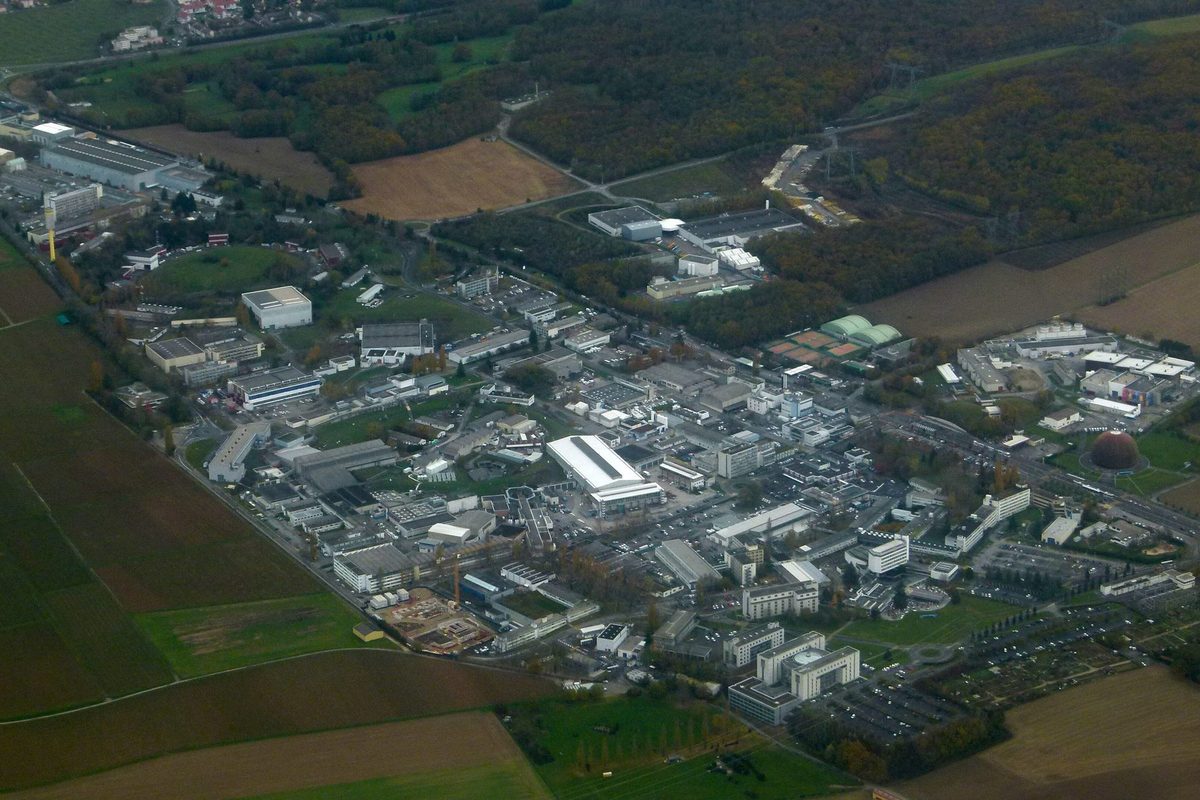
After 1945, European physicists watched with concern as their researchers left for the United States, and called for cooperation between states. The idea of a joint laboratory travelled from Lausanne to Paris, where it was adopted in December 1951. The Swiss delegates Paul Scherrer and Albert Picot then proposed setting up the laboratory in Switzerland, and the Council chose Genève in October 1952. After the vote of the Genevan people and the signing of the convention by twelve states in 1953, the laboratory moved in 1954 to the municipality of Meyrin. It later spread across the French-Swiss border.[1][5]
History of CERN
1949. In December the idea of European cooperation in physics is discussed at the European Cultural Conference in Lausanne.[1]
1950. In June a resolution of the UNESCO conference in Florence takes up the idea.[1]
1951. In December the Paris conference decides to create a European laboratory for nuclear research.[1][4]
1952. In February the Genève negotiations lead to the formation of a council of European states. In June the Federal Assembly grants one million francs to the project. In October, in Amsterdam, the Council chooses Genève as its seat.[1][4]
1953. On 29 June the Genevan people approve the establishment, despite opposition notably from William Emmanuel Rappard and the communists. On 1 July twelve states sign the convention creating CERN in Paris.[1][4]
1954. CERN settles on the territory of the municipality of Meyrin. The laboratory begins operating in October.[1][2]
1955. On 10 June Felix Bloch, Director-General of CERN, lays the foundation stone.[3][4]
1957. Commissioning of the first accelerator, the proton Synchro-Cyclotron.[3]
1965. On 13 September a convention between France and Switzerland extends the CERN site onto French territory.[5]
1984. Carlo Rubbia and Simon van der Meer receive the Nobel Prize in Physics for their decisive contributions to the project that led to the discovery of the W and Z particles.[6]
1989. In July commissioning of LEP, a 27 km underground circular accelerator, operated until 2000.[1][3]
1989-1990. Tim Berners-Lee, joined by Robert Cailliau, invents the web at CERN.[3]
2005. On 17 September opening of the Globe of Science and Innovation, formerly the Palais de l'équilibre of Expo.02.[3]
2008. In September commissioning of the LHC, 27 km in circumference, successor to LEP.[1][3][5]
2011. On 30 April inauguration of the tram line serving CERN.[3]
Historic sites in CERN
Globe of Science and Innovation. Formerly the Palais de l'équilibre of Expo.02, opened at CERN on 17 September 2005.[3]
Large Hadron Collider (LHC). Underground accelerator 27 km in circumference, completed in 2008 in the LEP tunnel (1989-2000).[1][3][5]
Sources
- Dictionnaire historique de la Suisse, « Organisation européenne pour la recherche nucléaire (CERN) » (Antoine Fleury), version du 24.02.2011
- Dictionnaire historique de la Suisse, « Meyrin » (Martine Piguet), version du 03.03.2011
- Commune de Meyrin, archives, « Chronologie meyrinoise (dès 1950) »
- CERN, « Notre histoire »
- Sénat (France), rapport n° 669 (2012-2013) de Xavier Pintat sur le protocole d'amendement de la convention franco-suisse du 13 septembre 1965 relative à l'extension du domaine du CERN en territoire français (18.06.2013)
- Fondation Nobel, « The Nobel Prize in Physics 1984 »
- geo.admin.ch, service de recherche de swisstopo (quartier CERN, Meyrin, coordonnées)
Other villages near CERN
Missing information, or do you have a source? Suggest a correction or addition. Every submission is checked before it's published.
Suggest a change