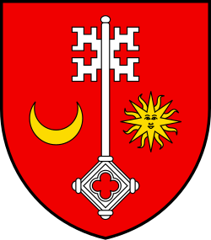
Satigny
Origin of the name Satigny
The name appears as « villam Satiniatis » in a deed dated 912, known from a forged 12th-century copy, then « de Satiniaco » around 1128 and « Satignie » in 1280. It reportedly derives from a Latin family name, Sattinius, the name of the owner of a rural estate, followed by the suffix -acum denoting a place.[1]
Founding of Satigny
The Choully hillside has been settled since the Late Neolithic, at the place called Crédery, and other finds point to at least two Roman villae. Excavations date the first religious buildings to the 8th century. At the beginning of the 10th century a priory dependent on the Benedictine abbey of Ainay, in Lyon, is said to have been founded at Satigny. It later became a community of Augustinian canons, then passed to the cathedral chapter of Genève. The area, called the terre de Mortier, was first under the influence of the lords of Gex, then under the growing influence of the bishop of Genève, which led to the mandement of Peney. The municipality would later take over the boundaries of the Protestant parish, which grouped Satigny, Bourdigny, Peissy and Peney.[1][2]
History of Satigny
Late Neolithic. Settlement on the Choully hillside, at the place called Crédery (hearth structures, pottery, flint).[1]
Roman period. At least two Roman villae occupy the territory.[1]
8th century. Excavations date the first religious buildings to this period.[1]
early 10th century. A priory dependent on the Benedictine abbey of Ainay, in Lyon, is said to have been founded at Satigny.[1]
912. Mention « villam Satiniatis » in a deed known from a forged 12th-century copy.[1]
around 1133. The priory becomes a community of Augustinian canons.[1]
13th century. In the first half of the century, Bishop Aymon de Grandson builds Peney castle, centre of the episcopal mandement.[2]
1328. Mention of the mill of the « Bougieres », with five wheels, called Moulin-Fabry since the 18th century.[1]
1381. The cathedral chapter of Genève incorporates the priory.[1]
1481. Satigny has 29 hearths, excluding Bourdigny, Peissy and Peney.[1]
1512. Official suppression of the priory, effective in 1536.[1]
1536. End of episcopal rule: Satigny depends on the Seigneurie of Genève. Peney castle, taken by the Protestants, is demolished.[1][2]
1538. After the adoption of the Reformation, creation of a Protestant parish grouping Satigny, Bourdigny, Peissy and Peney.[1]
1726-1728. Construction of the bell turret of the church of Saint-Pierre.[1]
1798. Creation of the municipality, which takes over the boundaries of the parish of 1538. Peney is attached to it.[1][2]
1858. Opening of the railway line to Lyon, which crosses the municipality.[1]
1903. Construction of the Catholic church of Saints-Pierre-et-Paul.[1]
1912-1935. Attempt at a collective cowshed, at the peak and then the decline of the municipality's dairy farming.[1]
1970s. Industrialisation begins with the Meyrin-Satigny and Bois-de-Bay zones.[1]
2005. These zones account for 55 % of secondary-sector jobs. The municipality is residential, agricultural and wine-growing, with the largest vineyard area in Switzerland and a cooperative winery.[1]
Population of Satigny
Sources and references: [1][4]
| 1481 | 29 hearths (households), excluding Bourdigny, Peissy and Peney |
| 1818 | 900 approximately |
| 1850 | 1'044 |
| 1900 | 1'343 |
| 1950 | 1'373 |
| 2000 | 2'785 |
| 2025 | 4'867 |
Historic sites in Satigny
Church of Saint-Pierre-aux-Liens (Satigny temple). Church that retains its Gothic plan of the late 13th century, which succeeded a three-aisled 12th-century building. The bell turret dates from 1726-1728 and the building was restored in 1830, 1895 and 1977.[1]
Peney. Hamlet divided into Peney-Dessus and Peney-Dessous, mentioned in 1258 (« Pineyum »). The castle built by Bishop Aymon de Grandson was the administrative and judicial centre of the mandement of Peney, which belonged to the Seigneurie of Genève until 1792. A refuge for supporters of the bishop and the Duke of Savoy in 1534, it was taken by the Protestants and demolished in 1536. A gravel pit has been worked there since the 19th century.[2]
Moulin-Fabry. Mill of the priory, known as the mill of the « Bougieres », with five wheels, recorded from 1328 and called Moulin-Fabry since the 18th century.[1]
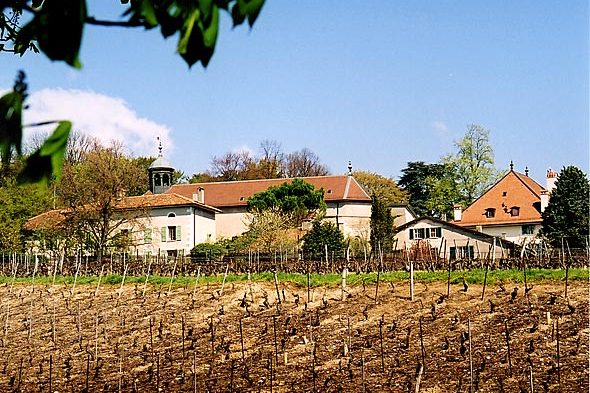
Choully castle. Residence built in 1720-1725 for Charles Lullin-de Châteauvieux-Humbert, at the centre of an estate assembled from 1667 by his father, the banker Jean-Antoine Lullin. It is one of the largest in Genève.
Satigny vineyards. In the early 21st century, the municipality has the largest vineyard area in Switzerland and a cooperative winery.[1]
Remains in Satigny
Neolithic site of Crédery. On the Choully hillside, at the place called Crédery, hearth structures, pottery and flints show Late Neolithic settlement.[1]
Roman villae. Finds point to at least two Roman villae in the municipal territory.[1]
Sources
- Dictionnaire historique de la Suisse, « Satigny » (Isabelle Brunier), version du 04.04.2013
- Dictionnaire historique de la Suisse, « Peney » (Martine Piguet), version du 27.11.2009
- Office fédéral de la protection de la population, Inventaire PBC, « Château de Choully », fiche KGS 02621 (texte de la Société d'histoire de l'art en Suisse)
- Office cantonal de la statistique (OCSTAT), Mémento statistique du canton de Genève 2026, tableau Population résidante par commune, en 2025
- geo.admin.ch, service de recherche de swisstopo (coordonnées)
Localities of the municipality with a page
Other villages near Satigny
Missing information, or do you have a source? Suggest a correction or addition. Every submission is checked before it's published.
Suggest a change