Peney
Origin of the name Peney
The place appears in 1258 in the form « Pineyum ». What the name means is not yet known.[1]
Founding of Peney
Who founded Peney, a hamlet of Satigny on the right bank of the Rhône divided into Peney-Dessus and Peney-Dessous, is not known. A coin hoard buried by the river shows that the site was occupied in the Burgundian period. Until the 12th century the area was under the counts of Genève and their vassals, the lords of Gex. In the early 12th century the bishop of Genève extended his overlordship over Peney and the other localities of the terre de Mortier. They formed the mandement of Peney, named after the castle, its administrative and judicial centre. Bishop Aymon de Grandson built the castle in the first half of the 13th century, and the fortification of the village soon caused conflicts with the lords of Gex.[1]
History of Peney
3rd century-420. A coin hoard buried on the bank of the Rhône shows the site was occupied in the Burgundian period.[1]
11th century. Vines are grown on the slopes of the mandement. Winegrowing remains the main activity of the area.[1]
Early 12th century. The bishop of Genève extends his overlordship over Peney and the terre de Mortier, which form the mandement of Peney.[1]
13th century. Bishop Aymon de Grandson builds the castle of Peney in the first half of the century.[1]
1258. First written mention, in the form « Pineyum ».[1]
1261. Simon de Joinville confirms the bishop's rights on the right bank of the Rhône, ending the conflicts with the lords of Gex.[1]
1275. First mention of the parish church of Peney, dedicated to the Virgin.[1]
1305. A community of inhabitants is attested at Peney.[1]
14th century. The mandement is the scene of wars between the counts of Genève and of Savoy.[1]
1469. The bishop grants franchises to the men of Peney, as to those of the mandements of Jussy and Thiez.[1]
1518. Peney has 12 hearths.[1]
1534. During the troubles of the Reformation the castle serves as a refuge for supporters of the bishop and the Duke of Savoy, henceforth called Peneysans.[1]
1536. Taken by the Protestants, the castle is demolished. The mandement is placed under the seigneury of Genève, which installs a castellan there.[1]
1538. Creation of the Protestant parish of Satigny, uniting the parishes of Satigny, Bourdigny, Peissy and Peney.[2]
1749. A temple is built on the ruins of the parish church.[1]
1792. End of the subjection of the inhabitants of the mandements to the seigneury of Genève.[1]
1798. Creation of the municipality of Satigny, to which Peney is attached.[1][2]
1852-1858. A suspension bridge built in 1852 collapses during a test in 1853. It is replaced by an iron bridge in 1858.[1]
2008. Peney has 179 inhabitants.[1]
Population of Peney
Sources and references: [1]
| 1518 | 12 hearths (households) |
| 2008 | 179 |
Historic sites in Peney
Peney-Dessus and Peney-Dessous. The two parts of the hamlet on the right bank of the Rhône. A ferry once linked Peney-Dessous with Aire-la-Ville.[1]
Peney bridge. The suspension bridge of 1852 collapsed during a test in 1853 and was replaced by an iron bridge in 1858.[1]
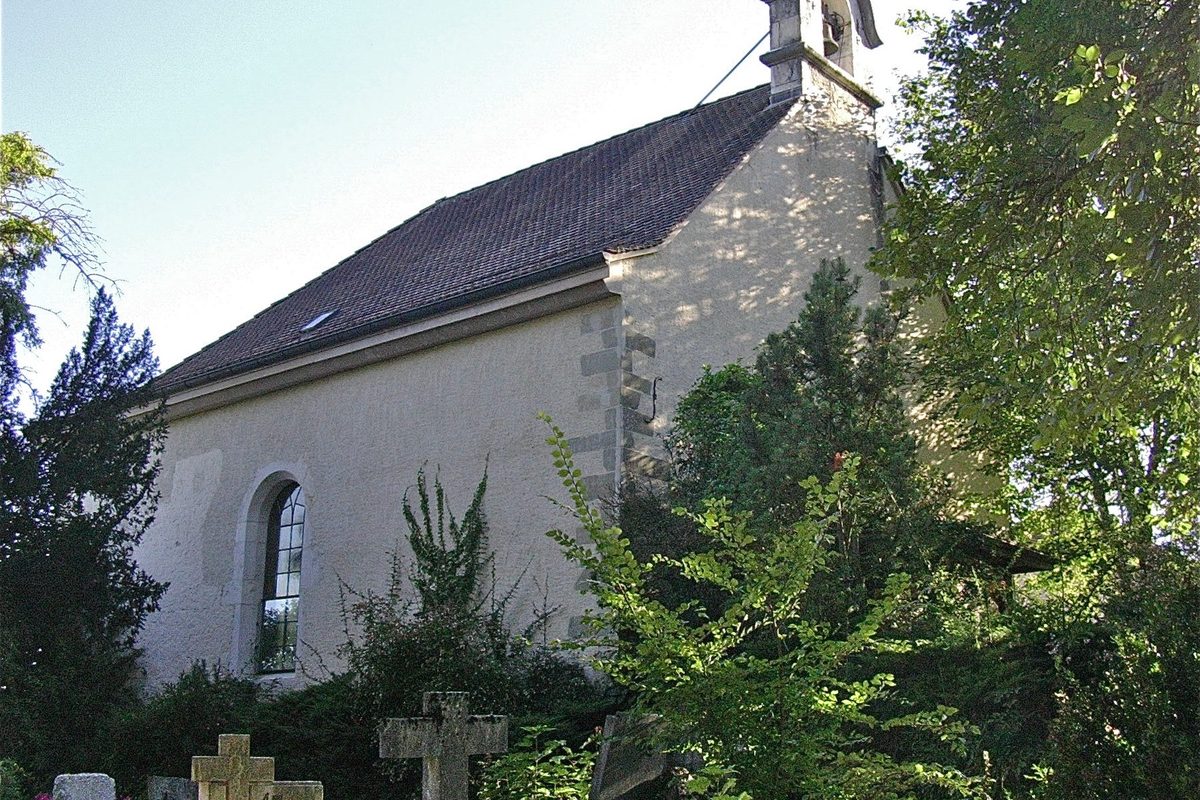
Temple. Built in 1749 on the ruins of the former parish church dedicated to the Virgin.[1]
Remains in Peney
Episcopal castle. Built by Bishop Aymon de Grandson in the first half of the 13th century, centre of the mandement of Peney. Taken by the Protestants, it was demolished in 1536.[1]
Sources
- Dictionnaire historique de la Suisse, « Peney » (Martine Piguet), version du 27.11.2009
- Dictionnaire historique de la Suisse, « Satigny » (Isabelle Brunier), version du 04.04.2013
- geo.admin.ch, service de recherche de swisstopo (Peney, Satigny, coordonnées)
Other villages near Peney
Missing information, or do you have a source? Suggest a correction or addition. Every submission is checked before it's published.
Suggest a change