Chavannes-sur-Moudon
On the right bank of the Broye, on the Fribourg border, a burial mound of the early Iron Age, from the Hallstatt period, is the oldest known trace of human presence.
Entry based on 6 sources · Our method · Reusable text (CC BY-SA)
Origin of the name Chavannes-sur-Moudon
Chavannes appears in 1453 as «Chavanes». The name «Chavannes-sur-Moudon» still awaits an explanation.[1]
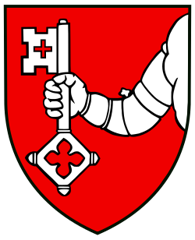
Coat of arms of Chavannes-sur-Moudon
Gules, a dexter arm armoured issuing from a cloud and holding a key, all Argent. On a red field, an armoured arm comes out of a cloud on the left and holds a key. Arm, cloud and key are white. The municipality adopted these arms in 1929. They are a variant of those of the Glane family, lords of Villardin, seen on a stained-glass panel of 1613, quartered with the arms of the Loys.[4][5]
Founding of Chavannes-sur-Moudon
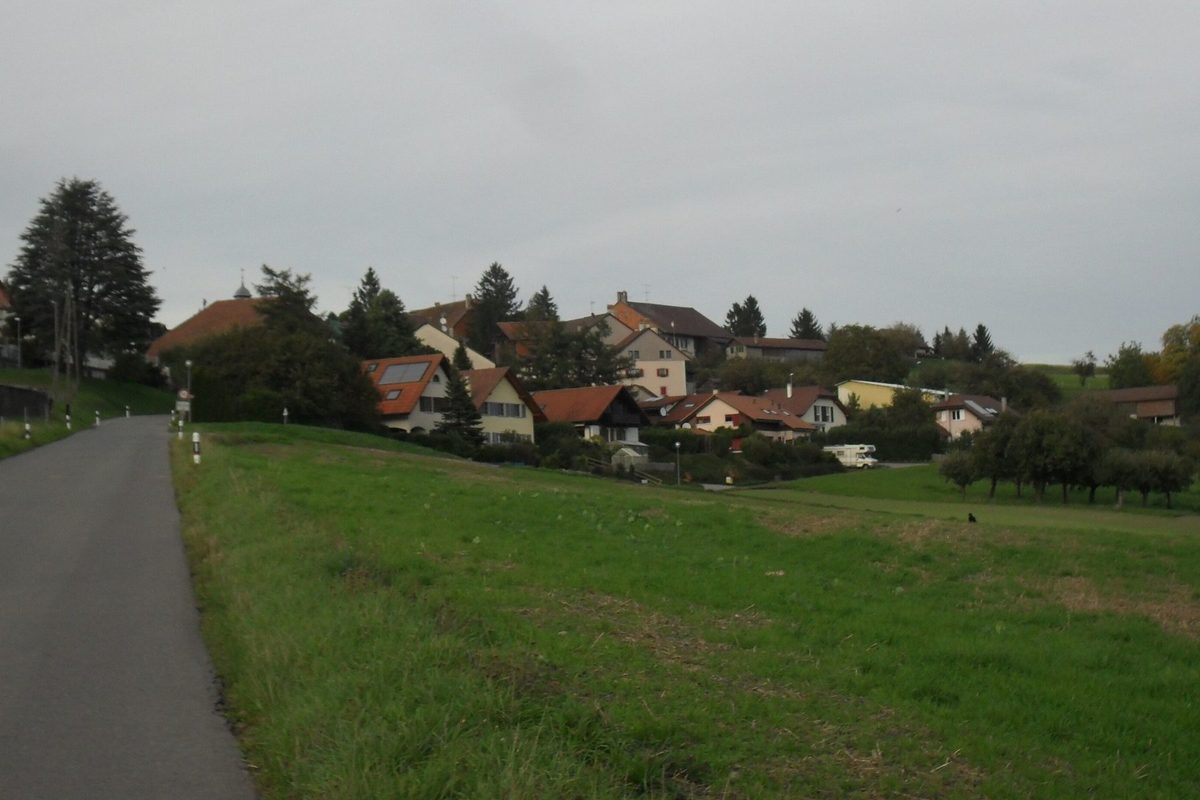
There is no known founder or founding act for Chavannes-sur-Moudon. Yet the area was occupied very early, as a Hallstatt-period burial mound shows. In the Middle Ages several noble families shared the lordship. With its chapel of Notre-Dame, the village then belonged to the parish of Morlens (Fribourg). It was attached to Moudon only after the Bernese conquest.[1]
History of Chavannes-sur-Moudon
Iron Age. A Hallstatt-period burial mound is raised in the area.[1]
13th century. The chapel of Notre-Dame is served by the priest of the church of Morlens (FR).[1]
1310. The lordship reportedly belongs to Jean de Prez.
14th-16th century. The lordship is shared among several families: the vidames of Moudon, the nobles of Villardens, and the d'Illens, de Prez and de Glâne families.[1]
1406/1436. The village has 23 hearths (households).[1]
1453. First mention, in the form «Chavanes».
1484. Chavannes is part of the castellany of Rue.[1]
1536. Bernese conquest: the village is attached to the bailiwick and castellany of Moudon until 1798. The commune is run by the assembly of burghers. At the Reformation the chapel is attached to the parish of Moudon.[1]
1663. Bern, which was also a lord at Chavannes, sells all its rights to the de Loys family.[1]
1764. A fire reportedly destroys a large part of the village.
1797. Construction of the municipal building.[1]
1942. Last of the successive alterations to the chapel of Notre-Dame.[1]
1980. The general council votes to build the public water network.[1]
2008. On 1 January, with the entry into force of the new territorial division of Vaud, the commune moves from the district of Moudon to the new Broye-Vully district.
Population of Chavannes-sur-Moudon
Sources and references: [1][3]
| 1406/1436 | 23 hearths (households) |
| 1764 | 169 |
| 1850 | 342 |
| 1900 | 335 |
| 1910 | 369 |
| 1950 | 268 |
| 1980 | 180 |
| 2000 | 197 |
| 2025 | 232 |
Families of Chavannes-sur-Moudon
Glane. At the beginning of the 14th century Chavannes belonged to the nobles of Villardin. Their property later passed to the de Glane family through a marriage alliance.[5]
Loys. In the 16th century a marriage brought Chavannes to the Loys family. In 1663 the family made it a lordship with high justice.[5]
Citizen families before 1800. Burnand, Crausaz, Duc, Dutoit and Veyre, without a precise date. The Nicati family (from Moudon VD) obtains citizenship in 1646.[6]
Show more families (2)
In the 19th century. The Augsburger family (from Worb BE) obtains citizenship in 1819.[6]
From 1901 to 1962. The Matalon family comes from Greece (1952). From Switzerland comes the Eyer family from Riggisberg BE (1958). They are joined by the Engel family (1937). The last family registered, in 1958, is the Eyer family.[6]
Economy of Chavannes-sur-Moudon, past and present
Milk, meat and grain. Of its 515 hectares, the municipality has 388 hectares of farmland and about a hundred hectares of forest. Some fifteen farms and outlying houses surround the village. Ten farms are still in operation. They live from milk, livestock breeding and fattening, broiler chickens, cereals and rapeseed.[5]
Historic sites in Chavannes-sur-Moudon
The chapel of Notre-Dame. Served in the 13th century by the priest of Morlens (FR) and attached to the parish of Moudon at the Reformation, it has undergone several alterations, the last in 1942. Its choir reportedly dates from the second half of the 15th century.[1]
The municipal building. Built in 1797, it reportedly also served as a school.[1]
The village, an ISOS site. The whole village is reportedly listed in the Federal Inventory of Swiss Heritage Sites of national importance (ISOS).
Remains in Chavannes-sur-Moudon
Hallstatt burial mound. A burial mound (tumulus) from the Early Iron Age, the Hallstatt period, lies in the municipal area. It is the oldest known evidence of human presence at Chavannes.[1]
Traditions and festivals in Chavannes-sur-Moudon
L'Écho du Mont. Founded in 1945, the male choir l'Écho du Mont has some twenty singers. It gives its evening concert every year.[5]
The youth society. The youth society takes part in the major events of the FVJC. In the village it holds a card tournament with its bar and organises the elders' Christmas and the National Day. The tour de jeunesse comes with a communal meal.[5]
Sources
- Dictionnaire historique de la Suisse, « Chavannes-sur-Moudon »
- État de Vaud, communiqué du 12.07.2007, « Organisation des préfectures et adaptation au nouveau découpage territorial »
- Statistique Vaud, « Population résidante permanente au 31 décembre 2025 »
- IPI, Swissreg, emblems database: coat of arms of Chavannes-sur-Moudon (no. 101773)
- Feuille des avis officiels du canton de Vaud, "Alphabet des communes vaudoises: Chavannes-sur-Moudon"
- Register of Swiss Surnames, 3rd edition (1989), search Commune "Chavannes-sur-Moudon", Canton VD
Published by Sébastien Jörg ·
Other villages near Chavannes-sur-Moudon
Missing information, or do you have a source? Suggest a correction or addition. Every submission is checked before it's published.
Suggest a change