Moudon
Heir to the Roman vicus of Minnodunum, Moudon was the capital of Savoyard Vaud, and its liberties of 1285 served as a model for the other towns of Vaud.
Entry based on 10 sources · Our method · Reusable text (CC BY-SA)
Origin of the name Moudon
The Roman name is "Minnodunum" or "Minnidunum". The Celtic suffix "-dunum" denotes a fortified place. In the Middle Ages the forms "Meldun" (around 1000, 1154, 1180), "Moudon" (1161, popular form) and "Meldunum" or "Mildunum" (1167) appear. The old German name is "Milden".[1]
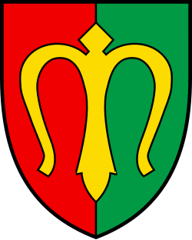
Coat of arms of Moudon
Per pale gules and vert, a Gothic capital letter M Or overall. The shield is divided vertically, red on the left and green on the right. A large yellow Gothic M spreads across both halves. The arms are known from the 16th century. According to tradition, their colours are those of the Green Count and the Red Count, who confirmed the town's franchises in the 14th century.[5][6]
Founding of Moudon
Moudon was first an important Roman vicus, listed in the Antonine Itinerary, known for a cemetery, inscriptions and a 3rd-century votive altar. The medieval town grew from a castle (castrum) built around 1127-1132 by Count Amadeus I of Geneva. Around 1190 the dukes of Zähringen seized it, then Savoy took control around 1207 under Thomas I, a possession confirmed by the Treaty of Burier in 1219. The town was enlarged several times in the 13th century, and its liberties, set down in 1285, served as a model for the other towns of Vaud.[1][2]
History of Moudon
3rd century. Roman vicus of Minnodunum, with a cemetery, inscriptions and a votive altar. It is listed in the Antonine Itinerary.[1]
around 1000. The name appears in the form "Meldun".[1]
around 1127-1132. Count Amadeus I of Geneva has a castle built.[1]
around 1190. The dukes of Zähringen seize Moudon.[1]
around 1207. Thomas I of Savoy takes control of the town.[1]
1219. The Treaty of Burier confirms Savoy's possession.[1][2]
13th century. The town is enlarged several times.[1]
1285. The liberties of Moudon are set down, serving as a model for the other towns of Vaud.[1]
around 1300. The town has about 300 hearths (households).[1]
late 13th-early 14th century. The church of Saint-Étienne is rebuilt.[1]
1536. Bernese conquest; Moudon loses its former privileges but remains at the head of the bailiwick of Moudon, whose bailiff resides in Lucens.[1]
1550. The town has 239 hearths (households).[1]
1764. The town has 1'475 inhabitants.[1]
1850. The town has 2'443 inhabitants.[1]
1900. The town has 2'683 inhabitants.[1]
2000. The town has 4'371 inhabitants.[1]
2006. Moudon joins the new district of Broye-Vully.[1]
2010. The town has 4'828 inhabitants.[1]
Population of Moudon
Sources and references: [1][3]
| 1550 | 239 hearths (households) |
| 1764 | 1'475 |
| 1798 | 1'512 |
| 1850 | 2'443 |
| 1900 | 2'683 |
| 1950 | 2'476 |
| 2000 | 4'371 |
| 2010 | 4'828 |
| 2025 | 6'847 |
Families of Moudon
Citizen families before 1800. Sixty-four families. Thirty-one are listed with no precise date, among them the Braillard. The other thirty-three were admitted between 1533 and 1790. The first, in 1533, were the Chatelanat, from Savoy. Several came from Vaud villages (Sottens, Bussy-sur-Moudon, Poliez-le-Grand, Saint-Cierges, Vulliens, Sugnens, La Rogivue, Mies), others from France, Bern or Savoy. The Bryois were admitted in 1652. The last family, in 1790, was the de Vallière, from France.[7]
In the 19th century. The Riffard, with no precise date, then the Müller from France (1810), the Scheffer and the Schäffer from Germany (1822) and the Bertolini from Italy (1866).[7]
From 1901 to 1962. Fifty-four registrations. The first, in 1906, was the Pegoschoff, from Russia. Fourteen families come from the canton of Bern, nine from Fribourg and nine from Italy. Others came from Germany, Austria, Greece, France, Yugoslavia (1952), Czechoslovakia (1959) or Egypt (1959). In 1956 alone seventeen families arrived, among them the Beutler from Aeschlen BE and the Gisling from Gossau ZH. The Masotti, from Italy, close the list in 1961.[7]
Notable people of Moudon
Eugène Burnand (1850-1921). A naturalist painter born in Moudon, known for his landscapes, religious works and portraits. Since 1959 his home town has devoted a museum to him, on the Rue du Château in the upper town.[8]
Aloys Cherpillod (1879-1950). A lawyer in Moudon, he was syndic from 1926 to 1933. He chaired the Association du Vieux-Moudon and ran the local museum until 1934.[9]
Economy of Moudon, past and present
Crafts, transit and inns. Moudon long lived from the building trades, transit traffic and the needs of daily life: tanneries, mills and many inns. When traffic sped up and bypassed the centre, the town lost its role as a road hub. It was linked to the Broye valley railway in 1876 and to the Jorat road in 1902. The bypass followed in 1964.[1]
Iron, wool and cheese. Moudon is a trading centre tied to agriculture. The town also has major firms: ironworking with the Braillard (1820) and Bryois (1827) companies, woolworking at Frères Meyer since the late 18th century, and the Beutler cheese dairy (1899), Fromco SA since 1974. A savings bank was founded in 1822, a milk producers' federation in 1843 and an agricultural federation in 1856. The cantonal school of cheesemaking and dairying operated from 1889 to 2004.[1]
Industry on the valley floor. Heavy industry settled on the valley floor with the Gisling SA foundry and engineering works (1951). It was followed by the Moudon SA cardboard and paper factory (1956), taken over in 2004 by Papirec SA of the Barec recycling group, and by Schelling Emballages SA (1968), now Model Emballages SA.[1]
Disasters and major events in Moudon
The sackings of the Burgundian Wars. The town was sacked twice during the Burgundian Wars.[1]
Historic sites in Moudon
Church of Saint-Étienne. Rebuilt in the late 13th and early 14th centuries, it is one of the main Gothic buildings in the canton.[1]
Upper town (Bourg). The Bourg district on the hill recalls the Savoyard town enlarged in the 13th century.
Tour de Broye. Medieval tower associated with the Zähringen capture of Moudon around 1190, though this is not established.
Remains in Moudon
Roman vicus of Minnodunum. A cemetery, inscriptions and a 3rd-century votive altar bear witness to the Roman settlement listed in the Antonine Itinerary.[1]
Protected heritage in Moudon
Cultural property of national significance (A objects in the PCP inventory)[4]
- Ancien grenier
- Eglise réformée Saint-Etienne
- Fontaine de Moïse
- Hôtel de Ville
- Maison d'Arnay
- Maison des Etats de Vaud
- Maison Loys de Villardin avec annexe
- Maison seigneuriale de Rochefort
- Maison Tacheron
- Moudon, tour du château - Moyen Age
Cultural property of regional significance (B objects)[4]
- Ancien grenier à blé et arsenal
- Ancien Hôpital bourgeoisial (dit «de Malte»)
- Ancien Hôtel de Ville puis Hôtel de la poste
- Ancien stand (maison du tirage)
- Ancienne auberge du Grand Cerf
- Archives communales
- Château de Billens
- Château de Carrouge avec ancienne tour et fontaine
- Cure
- Fondation vaudoise du patrimoine scolaire
Show the other 13
- Fontaine de la Justice
- Gare
- Grange-Verney (école cantonale d'agriculture)
- Gréchon, maison de campagne
- La Clergère, maison de campagne avec fontaine et jardin
- La Grenette
- La Rochette, maison de campagne avec deux pavillons, dépendance, loge du portier et fontaines
- Le pont sur la Bressonnaz (cf. également Vulliens)
- Maison
- Maison bourgeoise (maison Clavel et maison Aberly)
- Maison de Denezy
- Musée du Vieux-Moudon dans le château de Rochefort
- Musée Eugène Burnand
Traditions and festivals in Moudon
The Brandons. After a sharp decline in the 1960s, the Moudon Brandons carnival revived in the 1970s and 1980s, like those of other towns in northern Vaud. As in Payerne, there are annotated shop windows.[10]
Sources
- Dictionnaire historique de la Suisse, « Moudon (commune) »
- Dictionnaire historique de la Suisse, « Vaud »
- Statistique Vaud, « Population résidante permanente au 31 décembre 2025 »
- Federal Office for Civil Protection (FOCP), Swiss Inventory of Cultural Property (PCP), list for the canton of Vaud (as of 1.1.2026)
- IPI, Swissreg, emblems database: coat of arms of Moudon (no. 101690)
- Official Gazette of the Canton of Vaud (FAO), "Alphabet des communes vaudoises: Moudon"
- Register of Swiss Surnames, 3rd edition (1989), search Commune "Moudon", Canton VD
- Swiss Museums Association, museums.ch, « Musée Eugène Burnand »
- Cantonal and University Library of Lausanne, Patrinum, record « Aloys Cherpillod »
- State of Vaud, inventory of intangible heritage, « Brandons »
Published by Sébastien Jörg ·
Other villages near Moudon
Missing information, or do you have a source? Suggest a correction or addition. Every submission is checked before it's published.
Suggest a change