Corcelles-près-Payerne
In 1955 a hoard of 1'118 coins from the 11th century was found at Corcelles. The village long belonged to the domain of Payerne before breaking away in the early 19th century.
Entry based on 13 sources · Our method · Reusable text (CC BY-SA)
Origin of the name Corcelles-près-Payerne
The village appears in 1235 as «Corsales». The parish is mentioned from 1228. An earlier mention, from 1148, is also reported but not yet confirmed: Pope Eugene III is said to have confirmed then that the church belonged to the monastery of Payerne. The name Corcelles reportedly means «small estate».
Coat of arms of Corcelles-près-Payerne
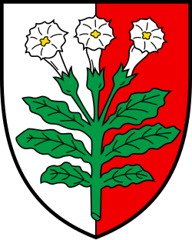
Per pale argent and gules, overall a tobacco stalk leaved and flowered proper. The shield is split vertically, white on the left and red on the right. A green tobacco stalk with leaves and flowers rises in the middle, over both colours. White and red are the colours of Payerne, on which the village long depended. The tobacco recalls the main crop of the place.[7][8]
Founding of Corcelles-près-Payerne
Who created the village is not known. The Roman road from Avenches to Payerne runs through the site, and remains of the aqueduct that supplied Aventicum from Lake Seedorf have been found there. In the Middle Ages Corcelles always formed part of the domain of Payerne.
History of Corcelles-près-Payerne
Roman period. The site is crossed by the Roman road Avenches-Payerne and by an aqueduct supplying Aventicum from Lake Seedorf.
11th century. Date of the 1'118 coins of the hoard discovered in 1955.
1148. Pope Eugene III reportedly confirms that the parish church belongs to the monastery of Payerne. Date uncertain.
1228. Mention of the parish.
1235. First mention in the form «Corsales».
1453. The village has 60 hearths (households).
1542. A great fire reportedly destroys a large part of the village. Date uncertain.
Ancien Régime. Corcelles is subject to the avoyer of Payerne and sends two councillors and three commune members to the town Council.
1719. Tobacco growing is reportedly introduced this year.
1744. Construction of the parsonage in the Neuchâtel style.
18th century. Horse breeding.
1801-1806. Procedure to separate from Payerne.
1817. Division of property completed; Corcelles receives among other things 4 hectares of vineyards at Savuit (municipality of Lutry).
1845-1863. Corcelles is attached to the parish of Payerne.
1906. The embankment of the Broye allows the plain to be farmed.
1955. Discovery of a rich hoard of 1'118 coins from the 11th century.
1 January 2008. The new districts come into force: the municipality moves from the district of Payerne to the Broye-Vully district.[3][4]
Population of Corcelles-près-Payerne
Sources and references: [5]
| 1453 | 60 hearths (households) |
| 1764 | 503 |
| 1850 | 880 |
| 1900 | 1'189 |
| 1950 | 1'259 |
| 2000 | 1'644 |
| 2025 | 3'129 |
Families of Corcelles-près-Payerne
Citizen families before 1800. Bossy, Buache, Cherbuin, Chuard, Coucet, Detrey, Doudin, Fivaz, Hermann, Jan, Jan du Chêne, Jaquemet, Jomini, Oulevey, Perrin, Pradervand, Rapin and Ruerat, without a precise date.[9]
In the 19th century. The Delacour family (from Missy VD) obtains citizenship in 1806.[9]
From 1901 to 1962. 23 registrations. Several families come from abroad: from Germany (Hey in 1934, Cossmann in 1946 and Moll in 1960) and from Italy (Facchinetti in 1953 and Gotti in 1953 and 1960). From Switzerland come the Aebi family from Seeberg BE, the Berger family from Spiez BE, the Bärtschi family from Eggiwil BE, the Fischer family from Triengen LU, the Junod family from Genève GE, the Mäder family from Agriswil FR, the Rüfenacht family from Vechigen BE, the Ryser family from Lützelflüh BE, the Schülé family from Fenin-Vilars-Saules NE and the Spätig family from Lüscherz BE (1956), the Gyger family from Gampelen BE (1957), the Flühmann family from Neuenegg BE, the Locher family from Hasle bei Burgdorf BE, the Ramseyer family from Signau BE and the Repetti family from Berzona TI (1958), the Anderfuhren family from Iseltwald BE (1959) and the Büschi family from Kriechenwil BE and the Lubini family from Rivera TI (1962). The last registrations date from 1962 (Büschi and Lubini).[9]
Notable people of Corcelles-près-Payerne
Ernest Chuard (1857-1942). Born in Corcelles-près-Payerne, this doctor of chemistry taught at the University of Lausanne and directed the wine research station. A Vaud State Councillor and then Federal Councillor (1919-1928), he was President of the Confederation in 1924 and promoted the tuberculosis law known as the Chuard law (1925).[10]
Louis Chuard (1827-1908). A farmer, he was syndic of Corcelles from 1858 to 1863 and a Radical member of the Vaud Grand Council. A State Councillor from 1873 to 1876, he then became prefect of the Payerne district (1877-1907). A founding member of the Vaud Agricultural Society, he was the father of Ernest Chuard.[11]
Paul Perrin (1886-1958). A railwayman born in Corcelles-près-Payerne, he was deputy general secretary of the Swiss Railway Workers' Federation from 1918 to 1952. A Socialist National Councillor from 1919 to 1953, he also sat on the committee of the Swiss Federation of Trade Unions and edited the paper Le Cheminot.[12]
Albert Savary (1871-1954). A ropemaker born in Corcelles-près-Payerne, he settled in Lausanne in 1900 and specialised in tarpaulins, tents and later demountable halls for exhibitions and festivals. His firm became Savary et Fils in 1928. A Radical, he sat on the Lausanne municipal council (1917-1933).[13]
Economy of Corcelles-près-Payerne, past and present
Tobacco and field crops. The soil suits tobacco, sugar beet, cereals and potatoes. About twenty small and medium-sized farms work this land.[8]
The Lavaux vineyards. The division of property with Payerne in 1817 had given the village 4 hectares of vines at Savuit. The municipality owns 4.3 hectares of vines in Lavaux, at Lutry and Savuit.[1][8]
Brickworks and workshops. In 2004 the HDS stressed the weight of industry, with the Morandi brickworks, engineering workshops and small and medium-sized firms. The village has two stations, on the Estavayer-Fribourg line and the Broye line. The municipality lists firms in terracotta, iron trading, construction, precision engineering and pyrotechnics.[1][8]
Historic sites in Corcelles-près-Payerne
Church of Saint-Nicolas. Romanesque church dedicated to Saint Nicholas, altered several times. Cultural property of regional importance (federal PBC inventory).[2]
Parsonage. Parsonage in the Neuchâtel style built in 1744.
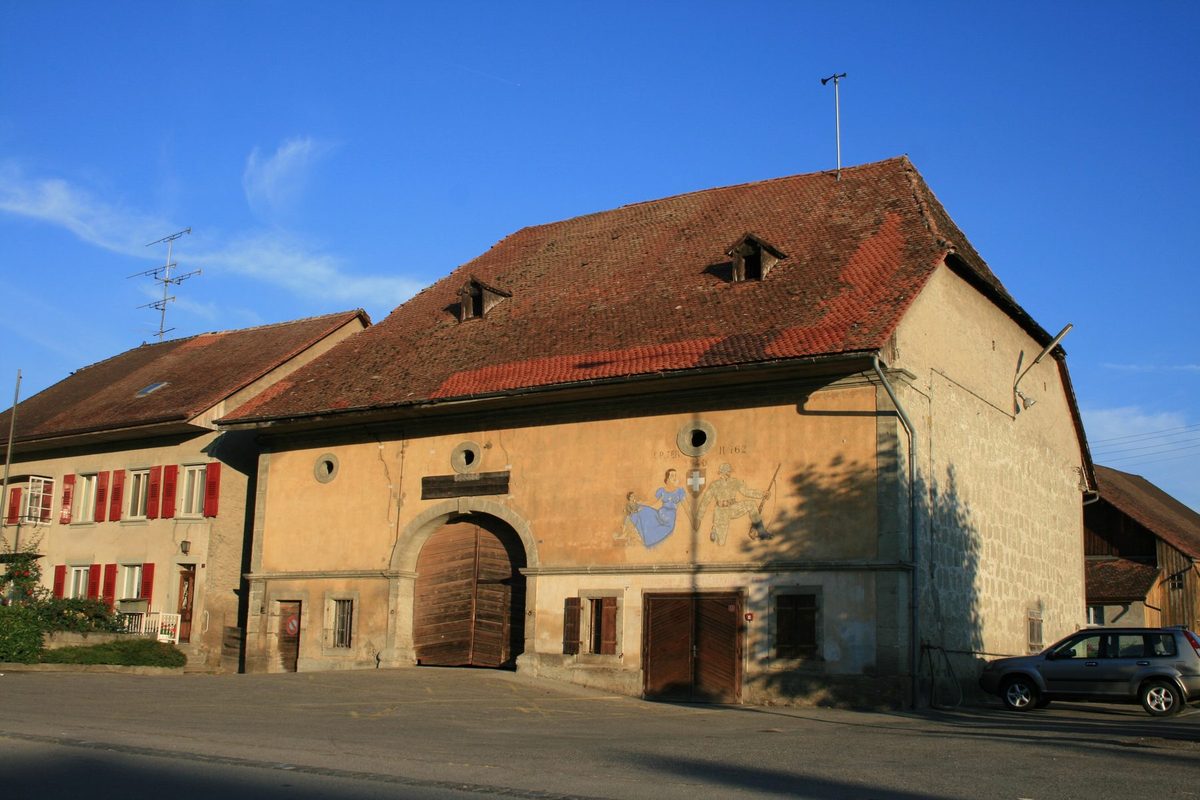
Granaries and oven. The stone granaries and the oven in the Rue des Péralles are listed as a cultural property of regional importance (federal PBC inventory).[2]
Broye plain. Plain made cultivable by the embankment of the Broye in 1906.
Remains in Corcelles-près-Payerne
Roman aqueduct. Remains of the aqueduct that supplied Aventicum (Avenches) with water from Lake Seedorf.
Corcelles-près-Payerne hoard. Rich hoard of 1'118 coins from the 11th century, discovered in 1955.
Protected heritage in Corcelles-près-Payerne
Cultural property of regional significance (B objects)[6]
- Eglise réformée Saint-Nicolas
- Greniers en pierre et four
Traditions and festivals in Corcelles-près-Payerne
The wine auction. The communal Chasselas is sold at public auction on the first Saturday of March. It is one of the last auctions of its kind.[8]
The May festival. In May the village festival combines the Abbaye shooting contest and the youth society's festival. In October the commune holds a brisolée (roast chestnut meal).[8]
The White Bears. The people of Corcelles are nicknamed the "Ours Blancs" (White Bears).[8]
Sources
- Dictionnaire historique de la Suisse, « Corcelles-près-Payerne »
- Office fédéral de la protection de la population, Inventaire suisse des biens culturels d'importance nationale et régionale, liste du canton de Vaud (état au 1.1.2026)
- État de Vaud, communiqué du 12.07.2007, « Organisation des préfectures et adaptation au nouveau découpage territorial »
- Canton de Vaud, Loi sur le découpage territorial (LDecTer, RSV 132.15) du 30 mai 2006
- Statistique Vaud, « Population résidante permanente au 31 décembre 2025 »
- Federal Office for Civil Protection (FOCP), Swiss Inventory of Cultural Property (PCP), list for the canton of Vaud (as of 1.1.2026)
- IPI, Swissreg, emblems database: coat of arms of Corcelles-près-Payerne (no. 102025)
- Official Gazette of the Canton of Vaud (FAO), "Alphabet des communes vaudoises: Corcelles-près-Payerne"
- Register of Swiss Surnames, 3rd edition (1989), search Commune "Corcelles-près-Payerne", Canton VD
- Dictionnaire historique de la Suisse, « Chuard, Ernest », version du 15.07.2005
- Dictionnaire historique de la Suisse, « Chuard, Louis », version du 22.12.2003
- Dictionnaire historique de la Suisse, « Perrin, Paul », version du 22.04.2009
- Dictionnaire historique de la Suisse, « Savary, Albert », version du 15.03.2010
Published by Sébastien Jörg ·
Other villages near Corcelles-près-Payerne
Missing information, or do you have a source? Suggest a correction or addition. Every submission is checked before it's published.
Suggest a change