Payerne
In the 12th century the monks forged a « testament of Queen Bertha » to make her the founder of Payerne, the town that grew up around their Romanesque abbey church.
Entry based on 20 sources · Our method · Reusable text (CC BY-SA)
Origin of the name Payerne
The place is mentioned in 961 in the phrase "ecclesie sancte Marie Paterniacensis", then in 1049 as "in loco Paterniaco". The name comes from a Gallo-Roman estate called "Paterniacum", after a Roman family or owner named Paternus, whose name appears on an inscription found on site. The old German name is "Peterlingen".[1]
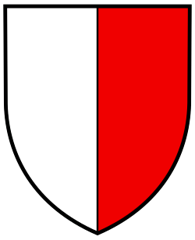
Coat of arms of Payerne
Per pale argent and gules. The shield is divided vertically, white on the left and red on the right. These are the arms of the town's monastery. The burghers' seal, known from impressions from 1343 onwards, shows a shield divided into two plain fields.[10][11]
Founding of Payerne
A Roman villa first stood on the site. Around 950-960 the Burgundian royal family founded a chapter of canons here, endowed by Queen Bertha. Her daughter Adelaide of Burgundy then had it attached to Cluny as a priory. Payerne grew out of this monastery. The monastery held lordship over the town, which developed around it and obtained liberties. A charter that Peter II of Savoy reportedly granted in 1240 is not confirmed.[1][2][3]
History of Payerne
Roman period. Roman settlement remains inside and outside the later town walls. An inscription bears the name Paternus.[1]
961. First mention, in the phrase "ecclesie sancte Marie Paterniacensis".[1]
around 950-965. A chapter of canons is founded by the Burgundian royal family (around 950-960) on the site of a Roman villa. Around 965, at the request of Adelaide, daughter of Queen Bertha, it becomes a Cluniac priory.[2][3]
1033. Emperor Conrad II is crowned King of Burgundy in the monastery church.[1]
mid-11th century. Construction of the second church, which forms the core of the present abbey church.[3][5]
1348. Liberties granted to Payerne create a Council of Twelve.[1]
1416. The town has 340 hearths (households).[1]
1444. The priory is raised to the rank of abbey.[2][3]
1536. Bernese conquest: the monastery is suppressed and Payerne becomes the seat of a Bernese bailiwick (1536-1798).[1][3]
1764. The town has 1'685 inhabitants.[1]
1876. Opening of the Fribourg-Yverdon railway line, followed in 1877 by the Palézieux-Lyss line.[1]
1900. The town has 5'224 inhabitants.[1]
1926. Restoration of the abbey church begins and its interior is cleared; it continues until 1971.[3]
1926. Creation of the military airfield.[1]
2000. The town has 7'294 inhabitants.[1]
2007. Architecture competition for the restoration of the abbey church and the redesign of the square.[5]
2020. In July the restored abbey church reopens to the public with a new visitor trail.[6]
Population of Payerne
Sources and references: [1][8]
| 1416 | 340 hearths (households) |
| 1764 | 1'685 |
| 1803 | 2'002 |
| 1850 | 3'078 |
| 1900 | 5'224 |
| 1950 | 5'649 |
| 2000 | 7'294 |
| 2025 | 10'972 |
Families of Payerne
Citizen families before 1800. The Register counts 41 citizen families from before 1800. Thirty-six are listed with no precise date, among them the Fivaz, the Jomini, the Rapin and the de Mestral Combremont. The Marcuard, from Grandcour VD, and the Pradervand, from Fribourg, are admitted in 1543, the Bel in 1590, the Groux in 1779 and the de Sybourg, from Villars-le-Grand VD, in 1785.[12]
In the 19th century. The Keller, from Orbe VD, in 1804, the Champion, from France, in 1810, the Ringwald, from Germany, in 1826, the Zbinden, from Guggisberg BE, in 1833, and the Walter, from Germany, in 1890.[12]
1901 to 1962. Sixty-seven registrations, thirty-six of them in 1956 alone. Twenty families come from the canton of Bern, nine from the canton of Fribourg, seven from France and five from Italy. There is also one family from Spain in 1953 and one from Great Britain in 1956. The Gagnaux, from La Vounaise FR, admitted in 1962, close the list.[12]
Notable people of Payerne
Marius. The bishop has the villa Paterniacum built in 587, together with a chapel dedicated to Mary, the future parish church of Payerne.[1][11]
Guillaume Farel. He preaches the Reformation in Payerne in 1532.[1]
Pierre Viret. He in turn preaches the Reformation in Payerne in 1532 and 1533. The town adopts the new faith before the Bernese conquest.[1]
Pierre Willomet. In 1738 he draws the «Plan topographique du territoire, seigneurie et gouvernance de Payerne».[1]
Antoine-Henri Jomini (Payerne 1779 - Passy 1869). Made a baron of the Empire in 1808, he becomes general-in-chief in the service of Nicholas I in 1826. In 1838 he publishes the Précis de l'art de la guerre. Payerne erects a statue to him in 1906.[13]
Aimée Rapin (1868-1956). An artist from Payerne born without arms, she paints still lifes, landscapes and portraits with her feet.[14][15]
Hélène Monastier (Payerne 1882 - 1976). Born in Payerne, she works from 1905 as an educator at the Maison du Peuple in Lausanne. A pacifist, she defends conscientious objectors during the First World War. She works with Pierre Cérésole on the creation of Service Civil International, which she chairs from 1940.[16]
Jacques Chessex (Payerne 1934 - Yverdon-les-Bains 2009). Born in Payerne on 1 March 1934, the writer spends his childhood there before growing up in Lausanne. He receives the Prix Goncourt in 1973.[17]
Economy of Payerne, past and present
Fields, tobacco and charcuterie. For centuries farming and crafts were the main activities in Payerne. The right of common grazing on other people's land was abolished in 1803. Tobacco growing, begun in 1719, flourished in the 19th century. It led to the opening of the Frossard (1868-1965) and Fivaz (1876-1965) factories. The town is still known for its charcuterie.[1]
Milk, tiles and fibre cement. Nestlé made condensed milk in Payerne from 1890 to 1933. Tiles were made here as early as the Middle Ages. Founded in 1898, a mechanised brickworks passed to the Morandi family in 1934 and ran until 1969-1970. Eternit settled here in 1955 to make fibre cement products. In 2005 the service sector provided 80% of jobs.[1]
The town's vineyards. Payerne owns about 13 hectares of vineyards, acquired in the 16th century. Its two estates in Lavaux, Château Tour Bertholod in Lutry and Château Montagny in Villette, have been vinified at Château Montagny since 2010, then bottled at the L'Abbatiale cellar in Payerne.[11]
Airfield and motorway. Created in 1926, the military airfield opened to civil aviation in the late 2000s. The Official Gazette of the Canton of Vaud also mentions the Swiss Aéropôle technology park, devoted to aeronautics. The A1 motorway has served the town since 2001.[1][11]
Historic sites in Payerne
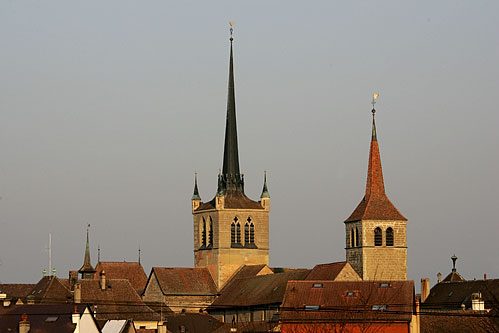
Payerne Abbey Church. Romanesque Cluniac church whose core dates from the mid-11th century, on the site of the priory founded in the 10th century. Emperor Conrad II was crowned King of Burgundy here in 1033. Restored from 1926 to 1971 and again from 2007, it reopened to the public in 2020. It is a cultural property of national importance.[1][3][4][5][6]
Church of Notre-Dame. Reformed church of Notre-Dame (parish church), also a cultural property of national importance.[4]
Brandons de Payerne. Carnival held every year, described as one of the oldest in Switzerland.[7]
Remains in Payerne
Roman villa beneath the abbey church. The monastery was built on the site of a Roman villa. Roman remains have been found inside and outside the town walls, including an inscription bearing the name Paternus.[1][3]
Protected heritage in Payerne
Cultural property of national significance (A objects in the PCP inventory)[9]
- Abbatiale et anciens bâtiments conventuels avec collège, château, salle capitulaire, tribunal, maison des régents, puits et fontaine
- Eglise réformée Notre-Dame (paroissiale)
- Fontaine du Banneret
- Payerne, bourg médiéval - Époque contemporaine
Cultural property of regional significance (B objects)[9]
- Archives communales
- Gare
- Halles de production, Eternit AG
- Musée de l'Abbatiale de Payerne
- Restes de l'enceinte avec tours Barraud, des Rammes, ronde et fausse tour
Legends of Payerne
Queen Bertha. Queen Bertha, mother of Adelaide of Burgundy, buried at Payerne before April 961, has remained in popular memory as a benevolent queen of the Pays de Vaud. This legend goes back to forged documents, the « testament of Queen Bertha », written by the monks in the first half of the 12th century to present her as the founder of Payerne. It became very popular when the canton was created. Tradition reportedly also links her to the saying « du temps que Berthe filait » (« in the days when Bertha spun »), which evokes a lost golden age.[2]
Traditions and festivals in Payerne
The Brandons. For several days, parades, floats, costumes and music fill the town. For the occasion, the hat-shaped beignets des Brandons fritters are made in the Payerne and Moudon areas.[18][19][11]
The Tirage. For four days the Tirage combines a traditional shooting competition with a funfair. Together with the Brandons and the Foire de la Saint-Martin, it is one of the typical Payerne festivals.[20][14][11]
The Foire de la Saint-Martin. Every year the Saint-Martin fair fills the streets of Payerne with stalls, local produce and entertainment.[18][14][11]
Sources
- Dictionnaire historique de la Suisse, Gilbert Marion, « Payerne (commune) », version du 04.01.2011
- Dictionnaire historique de la Suisse, Germain Hausmann, « Payerne (abbaye) », version du 28.05.2020
- Inventaire fédéral des biens culturels (PBC), fiche 6400 « Abbatiale et anciens bâtiments conventuels », texte de la Société d'histoire de l'art en Suisse
- Office fédéral de la protection de la population, géodonnées de l'Inventaire PBC (objets A), commune de Payerne
- Conseil d'État du canton de Vaud, exposé des motifs et projet de décret n° 112 (subvention pour la restauration de l'abbatiale de Payerne), novembre 2013
- Municipalité de Payerne, préavis n° 23/2021 « Abbatiale, candidature au patrimoine mondial de l'UNESCO », 6 octobre 2021
- Suisse Tourisme (MySwitzerland), « Brandons de Payerne »
- Statistique Vaud, « Population résidante permanente au 31 décembre 2025 »
- Federal Office for Civil Protection (FOCP), Swiss Inventory of Cultural Property (PCP), list for the canton of Vaud (as of 1.1.2026)
- IPI, Swissreg, emblems database: coat of arms of Payerne (no. 101886)
- Official Gazette of the Canton of Vaud (FAO), "Alphabet des communes vaudoises: Payerne"
- Register of Swiss Surnames, 3rd edition (1989), search Commune "Payerne", Canton VD
- Historical Dictionary of Switzerland (HDS), Jean-Jacques Eggler, "Jomini, Antoine Henri", version of 17.02.2009
- Commune of Payerne, knowledge test about Payerne (2018), with answers
- freizeit.ch, events listing, "Augenblick auf die Sammlungen: Aimée Rapins Blumensträusse" (Payerne Abbey Church)
- City of Lausanne, "Hélène Monastier"
- Swiss National Library, Swiss Literary Archives, inventory of the Jacques Chessex papers
- Fribourg Region (Fribourg Tourism), Estavayer-Payerne, "Traditions"
- Vaud Promotion (myvaud.ch), "Beignets des Brandons"
- Switzerland Tourism (MySwitzerland), "Tirage" (Payerne)
Published by Sébastien Jörg ·
Localities of the municipality with a page
Other villages near Payerne
Missing information, or do you have a source? Suggest a correction or addition. Every submission is checked before it's published.
Suggest a change